9.9 Compressor failures and their root causes
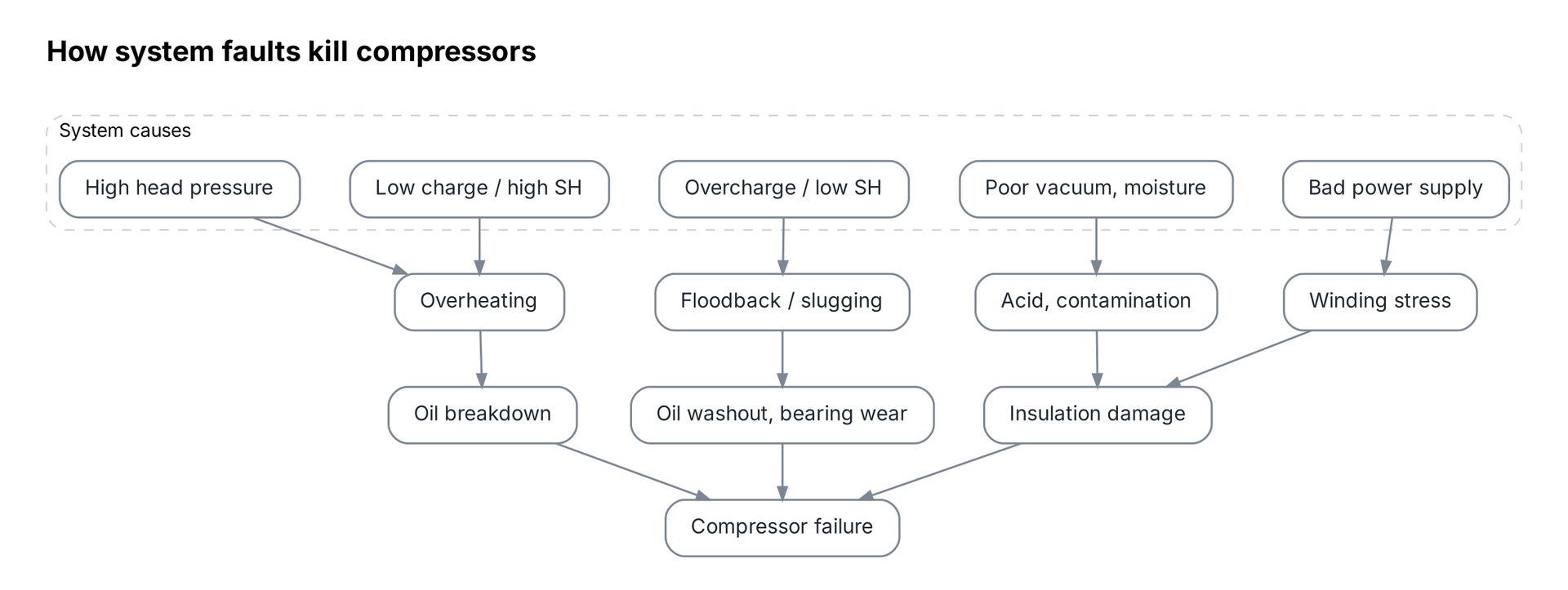
The compressor is the heart of the heat pump. When it fails, replacing it without finding the root cause often leads to a second failure within weeks. Always ask what made it fail.
Like a motorbike engine seized because the oil ran out, the engine is the victim, not the cause. The same is true for compressors.
Main failure types
| Failure | What happens | Common root causes |
|---|---|---|
| Liquid floodback | Liquid refrigerant enters the compressor and washes oil away | Low superheat, overcharge, faulty expansion valve, low evaporator air or water flow |
| Liquid slugging | A slug of liquid enters the compression chamber; mechanical damage | Refrigerant migration during off cycle, no crankcase heater, poor piping |
| Overheating | Motor and oil get too hot; oil breaks down | Low charge, high superheat, high discharge pressure, high compression ratio |
| Oil loss | Bearings run dry | Oil trapped in system, long pipes without oil return, leaks, floodback |
| Electrical burnout | Motor windings short to each other or to earth | Voltage imbalance, single phasing, overheating, moisture and acid in system |
| Contamination | Moisture, air or debris cause acid and wear | Poor evacuation, open system left too long, no drier, brazing without nitrogen |
Checks before condemning a compressor
| Check | How | Typical result for healthy compressor |
|---|---|---|
| Winding resistance (single-phase: C-S, C-R, S-R; three-phase: between each pair) | Multimeter, power isolated | Three-phase windings equal within a few percent; single-phase S-R = C-S + C-R |
| Insulation resistance to earth | Insulation tester at 500 V DC | Above 1 MΩ minimum at 500 V DC (healthy compressors usually read well above 2 MΩ; follow the manufacturer's manual) |
| Running current | Clamp meter on each phase | Within nameplate RLA, balanced |
| Compression | Pressure difference when running | Normal discharge-suction difference for conditions |
| Oil condition | Sample or acid test kit | Clear, no burnt smell, acid test negative |
After a burnout
- Recover refrigerant; do not vent.
- Test oil for acid.
- Replace compressor and filter-drier; fit a suction line filter-drier if acid is present.
- Pressure test with dry nitrogen; evacuate deeply (lesson 9.10).
- Weigh in correct charge.
- Check acid again after running; change drier again if needed.
Worked example — Voltage imbalance
Measured line voltages: 410 V, 400 V, 385 V.

Average = (410 + 400 + 385) ÷ 3 = 398.3 V Maximum deviation = 398.3 − 385 = 13.3 V Imbalance = 13.3 ÷ 398.3 × 100 = 3.3 %
Voltage imbalance above about 2 % is generally considered harmful to motors; the current imbalance it causes is several times larger. Get the supply checked before fitting a new compressor.
Remember
- The compressor is usually the victim, not the culprit.
- Floodback and overheating are the two biggest killers.
- Check windings, insulation, current and oil before condemning.
- After a burnout, clean the system or the new compressor will fail too.
Compressors rarely fail on their own; they are usually killed by something else in the system.
There are no comments for now.
to be the first to leave a comment.