9.5 Reading fault codes and controller logs
A controller is the electronic board that runs the heat pump. It reads sensors and switches, and stops the unit when a value goes out of range. It then shows a fault code (a short code on the display) and usually stores it in a log with date, time and readings.
Each manufacturer uses its own codes. Always look up codes in that unit's service manual. This lesson explains the general categories, which are similar across makes.
A fault code is like the warning light on a car dashboard. The oil light says oil pressure is low. It does not say whether the oil is leaking or the pump is worn. You still need to investigate.
Generic fault categories
| Category | What it means | Typical first checks |
|---|---|---|
| High-pressure protection | HP switch or sensor saw too high discharge pressure | Water/air flow at condenser, scale, overcharge, non-condensables (9.6) |
| Low-pressure protection | LP switch or sensor saw too low suction pressure | Evaporator air/water flow, ice, low charge, expansion valve (9.7) |
| High discharge temperature | Compressor outlet too hot | Low charge, high superheat, high compression ratio |
| Water flow fault | Flow switch open or flow too low | Pump, strainer, air lock, closed valve |
| Freeze protection | Water or refrigerant near 0 °C in evaporator | Low flow, low set point, low charge |
| Sensor fault | Sensor open or short circuit | Wiring, connector, sensor resistance vs table |
| Communication fault | Boards or display not talking | Cable, connector, earthing, interference |
| Compressor overcurrent / overload | Current too high or motor too hot | Voltage, phase loss, locked rotor, high pressure |
| Phase / voltage fault | Missing phase, wrong sequence, voltage out of range | Supply, phase sequence relay, cables |
| Inverter / drive fault | Drive detected internal or motor problem | Supply, heat sink, motor windings, drive cooling fan |
| Defrost fault | Defrost took too long or did not end | Defrost sensor, reversing valve, ice build-up |
How to use the log
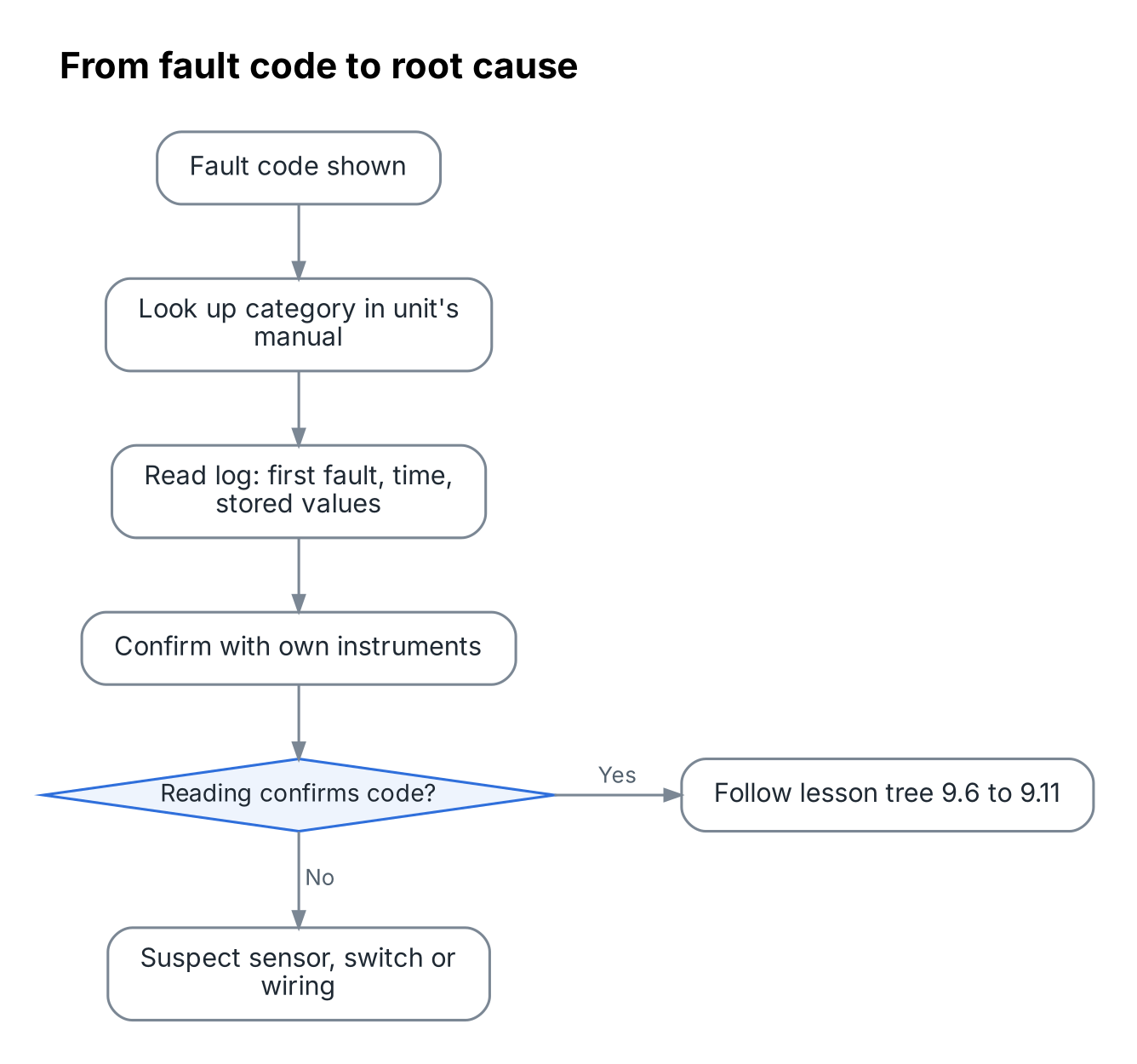
- Note the first fault in a sequence. Later faults are often knock-on effects.
- Note the time pattern: same time each day points to a load, a supply dip or a timer.
- Read stored values at trip time if available: pressures, temperatures, current.
- Check how often the fault repeats. Some controllers lock the unit after a set number of trips.
Remember
- Codes differ by make; always use the unit's own manual.
- A code names the protection, not the cause.
- The first fault in the log is usually the most useful.
- Confirm with your own gauges and meters.
A fault code tells you which protection acted, not why it acted.
There are no comments for now.
to be the first to leave a comment.