9.4 A systematic troubleshooting method
Troubleshooting is the process of finding the root cause of a fault. A root cause is the first thing that went wrong; a symptom is what you see. A tripped compressor is a symptom. A blocked strainer that starved the condenser of water may be the root cause.
A good doctor asks questions, takes temperature and pulse, then decides. A good technician does the same. Replacing parts until it works is expensive, and the real cause often returns.
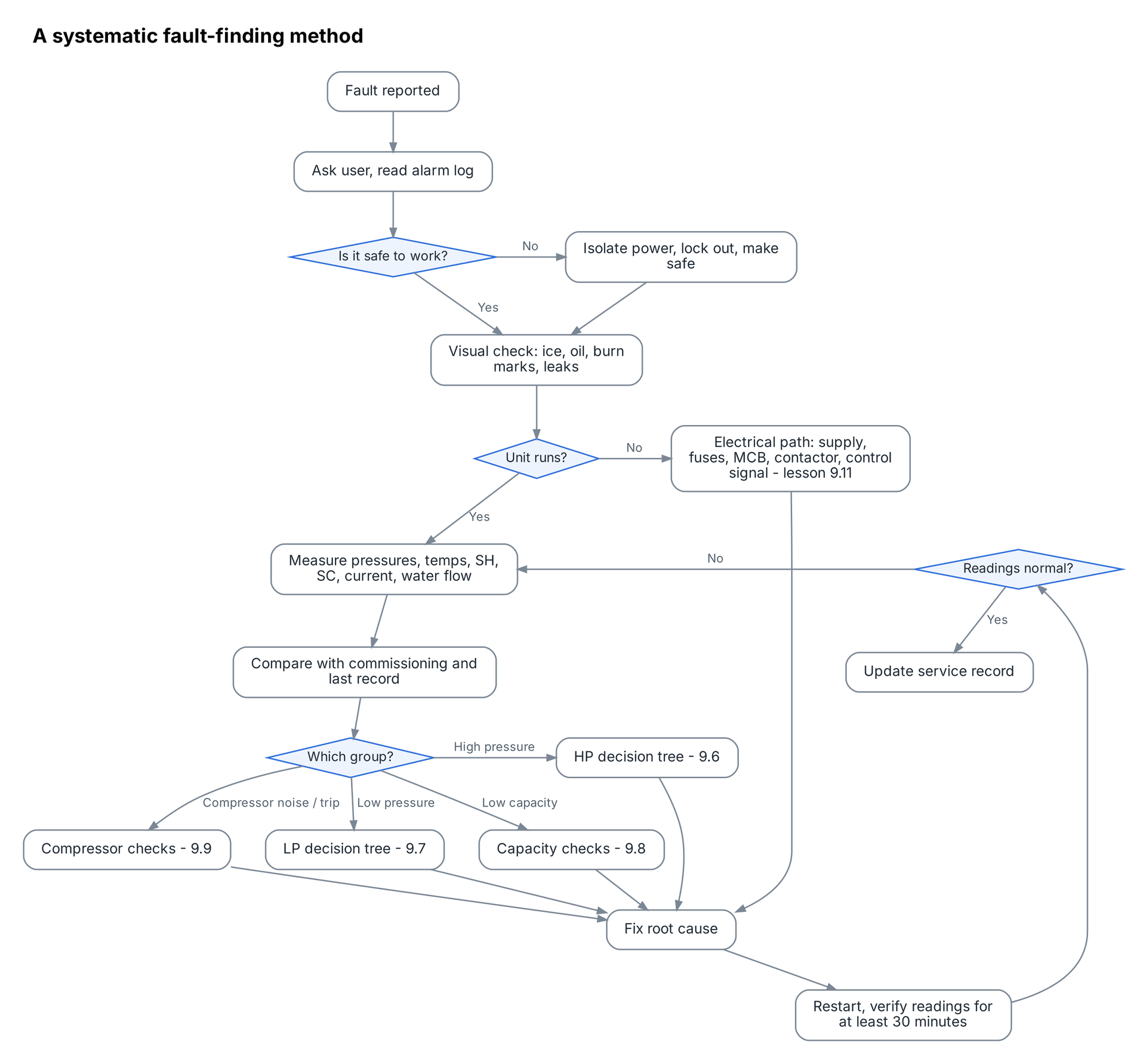
Six steps
- Listen and gather. Ask the user what happened, when, and what changed. Read the alarm log.
- Observe safely. Look, listen, smell. Check for ice, oil stains, burnt smells, water leaks.
- Measure. Pressures, temperatures, superheat, subcooling, currents, voltages, water flow.
- Compare. Against commissioning values, the manual, and the previous service record.
- Isolate the cause. Use the decision trees in lessons 9.6 and 9.7. Test one idea at a time.
- Fix, verify, record. Repair the root cause, run the unit, confirm readings, write it down.
Normal reading guide (typical, air-to-water heat pump with R32 or R410A)
| Reading | Typical normal range | Note |
|---|---|---|
| Superheat at compressor suction | 4–8 K | Depends on expansion valve setting |
| Subcooling at condenser outlet | 3–8 K | Depends on charge and design |
| Water ΔT across condenser | 3–7 K | Lower means high flow; higher means low flow |
| Discharge temperature | Typically below about 100–110 °C | Very high means overheating compressor |
| Phase current imbalance | Within about 2–3 % | Higher points to supply or motor problem |
Refrigerant pressures depend on the refrigerant and temperatures, so always convert pressure to saturation temperature with a P-T chart or gauge scale.
Worked example — Is this superheat normal?
Superheat is the suction line temperature minus the evaporating saturation temperature.

Suction pressure reads 7.5 bar(g). From the P-T chart for the refrigerant, saturation is 2 °C (example). Suction line temperature is 14 °C. SH = 14 − 2 = 12 K.
This is higher than the typical 4–8 K. The evaporator is starved: suspect low charge, a blocked filter-drier, or a faulty expansion valve.
Remember
- Symptom is not cause; keep asking "why".
- Measure before you touch anything.
- Change one thing at a time and re-measure.
- Always verify and record after the fix.
Find faults by measuring and comparing, not by guessing and replacing parts.
There are no comments for now.
to be the first to leave a comment.