9.6 High-pressure trips
The high-pressure (HP) switch is a safety switch on the discharge line. It opens when discharge pressure crosses a set limit and stops the compressor. Its job is to protect the compressor, pipes and people from over-pressure.
Think of a pressure cooker on a high flame with a blocked vent. Pressure keeps rising because heat goes in but cannot leave. In a heat pump the condenser is the vent. If it cannot reject heat, pressure rises.
In heating mode, the condenser is the water-side PHE. In cooling or defrost mode, the air coil acts as the condenser. So always ask which heat exchanger is the condenser at the moment of the trip.
Main causes
- Low water flow through the condenser (pump fault, blocked strainer, closed valve, air lock).
- Scale on the PHE water side.
- Water set point too high for the unit, or return water too hot.
- Overcharge of refrigerant.
- Non-condensable gases (air or nitrogen) in the circuit.
- Restriction after the condenser, which backs up liquid.
- In cooling/defrost: dirty air coil, failed fan, hot air recirculation.
- Faulty HP switch or pressure sensor.
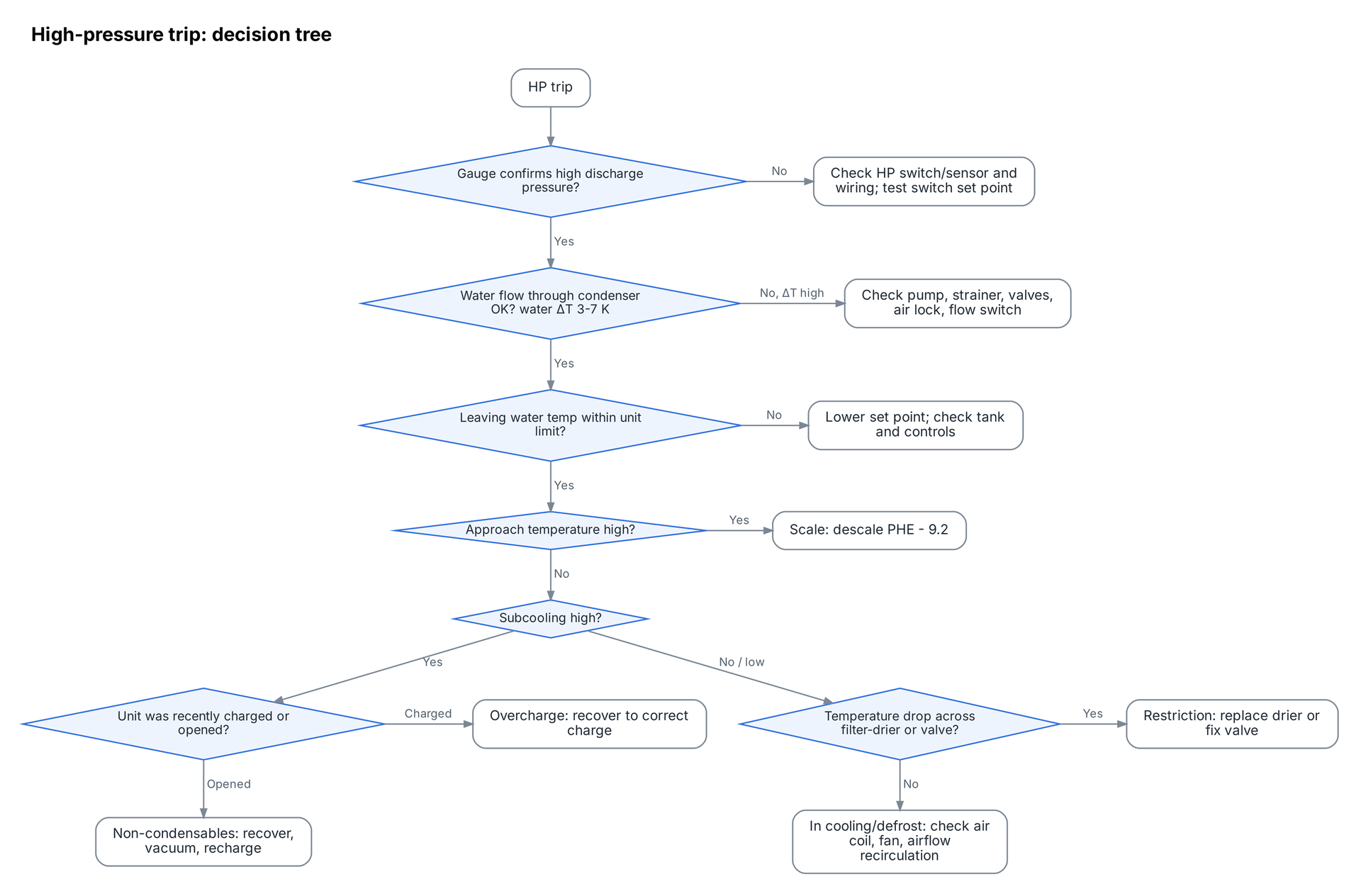
Symptom → cause → check → fix (high pressure)
| Symptom | Likely cause | Check | Fix |
|---|---|---|---|
| HP trip, water ΔT high (over about 8 K) | Low water flow | Strainer, pump, valves, air vents | Clean strainer, vent air, repair pump |
| HP trip after months of good running, ΔT normal | Scale on PHE | Approach temperature vs commissioning | Descale PHE |
| HP trip, high subcooling, after a recharge | Overcharge | Weigh charge vs nameplate | Recover excess |
| HP high, pressure does not match temperature when off | Non-condensables | Standing pressure vs ambient saturation | Recover, vacuum, weigh in fresh charge |
| HP trip in cooling, fan running slow or off | Fan motor or capacitor failure | Fan current, capacitor value | Replace capacitor or motor |
| Trip but gauge shows normal pressure | Faulty switch or sensor | Compare sensor with gauge | Replace switch or sensor |
Worked example — Is the water flow too low?
A 20 kW heat pump in Indore heats water. Supply 55 °C, return 45 °C. Find the actual flow.

Q = 20 kW, cp = 4.19 kJ/kg·K, ΔT = 55 − 45 = 10 K ṁ = 20 ÷ (4.19 × 10) = 0.477 kg/s 0.477 kg/s × 3,600 = 1,718 kg/h ≈ 1,720 LPH.
For a 5 K design ΔT the flow should be about 3,440 LPH. The flow is half of design. Clean the strainer and check the pump before blaming refrigerant.
Remember
- First ask: which coil is the condenser right now?
- Check water flow and ΔT before touching refrigerant.
- Rising approach temperature means scale.
- Overcharge and air in the system both raise subcooling and head pressure.
A high-pressure trip almost always means heat is not being removed from the condenser fast enough.
There are no comments for now.
to be the first to leave a comment.