9.3 Water treatment and scale prevention
Water quality is measured by a few simple numbers. Hardness is the amount of dissolved calcium and magnesium, given as mg/L (ppm) of CaCO₃. TDS (total dissolved solids) is all dissolved salts in mg/L. pH shows whether water is acidic (below 7) or alkaline (above 7).
Borewell water in many parts of India is hard. Hardness of several hundred mg/L is common in places like Rajasthan, Gujarat and parts of Bengaluru. A kettle used with such water gets a white crust; a heat pump gets the same crust inside its PHE, and fast, because the water is hot.
Scale forms faster at higher temperatures. That is why hot-water heat pumps above about 55 °C are most at risk. Open systems, where fresh make-up water is added all the time, bring in new hardness every day.
Typical water quality guide for heat pump circuits
| Parameter | Typical target (closed loop) | Why it matters |
|---|---|---|
| pH | 7.5–9.0 | Low pH corrodes copper; very high pH can attack aluminium and brazing |
| Total hardness | Below about 100–150 mg/L as CaCO₃ for hot water service (typical) | Scale on PHE |
| TDS | Below about 500 mg/L (typical) | Scale and corrosion |
| Chlorides | As low as practical; typically below about 200 mg/L for stainless steel at heat pump temperatures | Pitting of stainless plates |
| Suspended solids | Filtered by strainer, mesh typically 0.5–1 mm | Blocking of PHE channels |
These are typical values. Always use the limits in the unit's manual where available.
Ways to prevent scale
| Method | How it works | Good for | Limits |
|---|---|---|---|
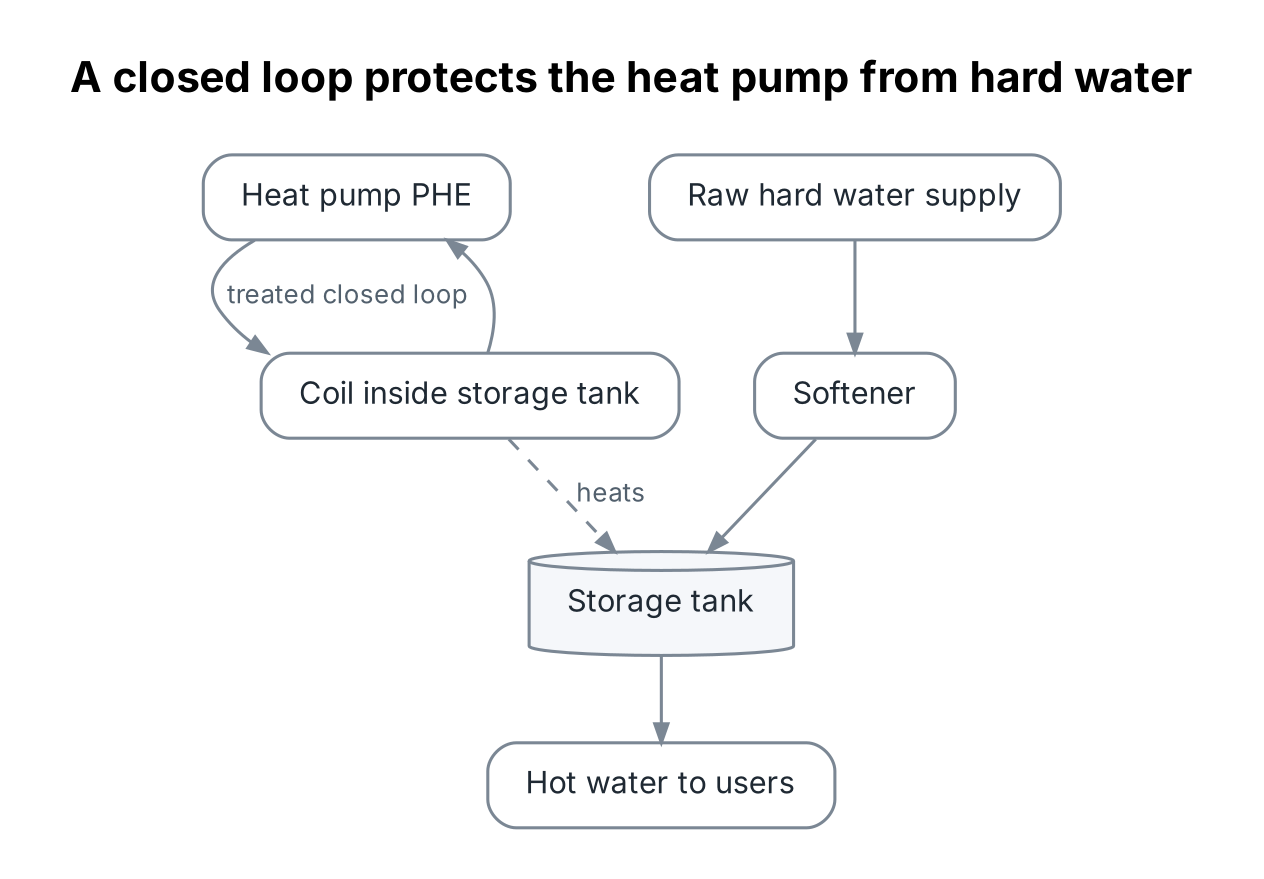
| Closed loop with indirect PHE | Hard water never touches the heat pump PHE | Most sites with hard water | Needs a second heat exchanger in the tank |
| Water softener (ion exchange) | Swaps calcium and magnesium for sodium | Domestic and hotel hot water | Needs regular salt and regeneration |
| Reverse osmosis (RO) | Removes most dissolved salts | Small flows, very bad water | Wastes water; RO water can be corrosive, so adjust pH |
| Polyphosphate dosing | Keeps hardness in suspension | Moderate hardness | Must be food-safe for drinking water |
| Lower hot water set point | Less scaling at lower temperature | Where use allows | Check hygiene needs (legionella) |
| Y-strainer and dirt separator | Catches sand and rust | All systems | Must be cleaned monthly |
Worked example — How much scale comes in?
A hotel in Jaipur uses 5,000 L of hot water a day. Hardness is 300 mg/L as CaCO₃. If even a tenth of this hardness drops out as scale:

V = 5,000 L, H = 300 mg/L, f = 0.1 m = 5,000 × 300 × 0.1 = 150,000 mg = 150 g per day.
Over a year: 150 g × 365 ≈ 55 kg of potential scale. Even if most leaves with the water, some will settle in the PHE. This is why open systems on hard water need a softener or an indirect loop.
Remember
- Test hardness, TDS and pH at commissioning and every quarter.
- Hot water above about 55 °C scales fastest.
- An indirect closed loop is the best protection on hard water.
- Clean strainers monthly.
Most water-side problems in Indian sites come from hard, dirty or corrosive water, and they are cheaper to prevent than to clean.
There are no comments for now.
to be the first to leave a comment.