9.1 Preventive maintenance schedule and service records
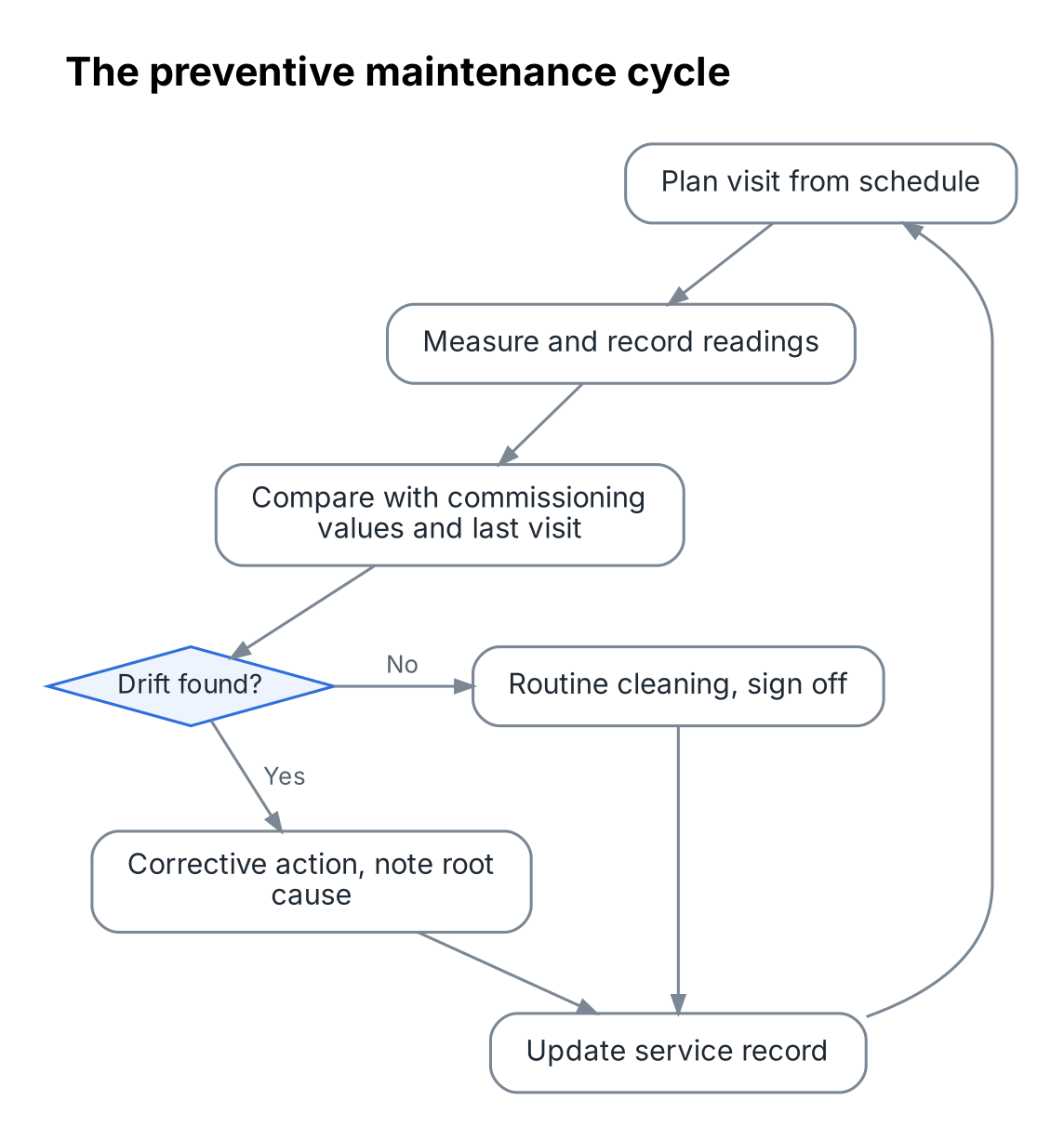
Preventive maintenance (PM) means planned checks done before something breaks. Breakdown maintenance means repairing after a failure. PM costs less because small problems such as a dirty filter are fixed before they trip the compressor.
Think of a pressure cooker. You check the gasket and the whistle before cooking, not after the lid blows. A heat pump works the same way. Most failures start as a slow drift in a pressure, temperature or current.
A service record is the written history of a unit. Each visit you note readings, work done and parts changed. Over months the record shows trends, like a slowly rising discharge temperature, that a single visit cannot.
PM schedule
| Frequency | Who | Check | What "good" looks like |
|---|---|---|---|
| Daily | Operator | Unit running, no alarms on controller | No active alarm; set point reached |
| Daily | Operator | Supply and return water temperature | Difference (ΔT) typically 3–7 °C |
| Daily | Operator | Unusual noise, vibration, water drips | None |
| Monthly | Technician | Clean Y-strainer on water inlet | Mesh clear; pressure drop back to normal |
| Monthly | Technician | Clean air-coil fins (light wash) | Fins clear of dust, leaves, lint |
| Monthly | Technician | Condensate drain and tray | Free-flowing, no algae |
| Monthly | Technician | Water system pressure and air vents | Pressure as commissioned; no trapped air |
| Quarterly | Technician | Suction and discharge pressures, superheat, subcooling | Within commissioning values |
| Quarterly | Technician | Compressor and fan current on each phase | Within nameplate; phases balanced within about 2–3 % |
| Quarterly | Technician | Tighten electrical terminals, inspect contactors | No burnt marks, no pitting |
| Quarterly | Technician | Leak check on brazed joints and flare nuts | No oil stains, detector silent |
| Quarterly | Technician | Water quality test (hardness, TDS, pH) | Within limits of lesson 9.3 |
| Yearly | Technician | Descale plate heat exchanger (more often in hard water) | Approach temperature back to commissioning value |
| Yearly | Technician | Deep coil clean with coil cleaner | Full air flow restored |
| Yearly | Technician | Insulation resistance test of compressor and fan motors | Above 1 MΩ minimum at 500 V DC (healthy compressors usually read well above 2 MΩ; follow the manufacturer's manual) |
| Yearly | Technician | Calibrate or verify sensors and safety switches | Readings match reference instrument; HP/LP switches trip at set point |
| Yearly | Technician | Expansion vessel pre-charge, safety valve, pump bearings | Pre-charge as designed; valve not passing |
What a service record must contain
| Field | Example |
|---|---|
| Date, site, unit serial | 12-03-2026, Hotel, Pune, serial XXXX |
| Ambient and water temperatures | Ambient 34 °C; water in 48 °C, out 54 °C |
| Suction and discharge pressure (R410A) | 15.0 bar(g) / 35.0 bar(g) |
| Superheat and subcooling | 6 K / 5 K |
| Compressor current (R/Y/B) | 18.2 / 18.4 / 18.1 A |
| Alarms in log since last visit | None |
| Work done, parts used | Strainer cleaned; coil washed |
| Next action | Descale PHE at next quarterly visit |
Remember
- PM is planned; breakdown repair is unplanned and costs more.
- Record readings every visit so you can see trends.
- Compare against commissioning values, not just "looks fine".
- Hard water and dusty sites need shorter intervals.
A heat pump that is checked on a fixed schedule and logged every time rarely fails without warning.
There are no comments for now.
to be the first to leave a comment.