9.8 Low capacity and falling COP
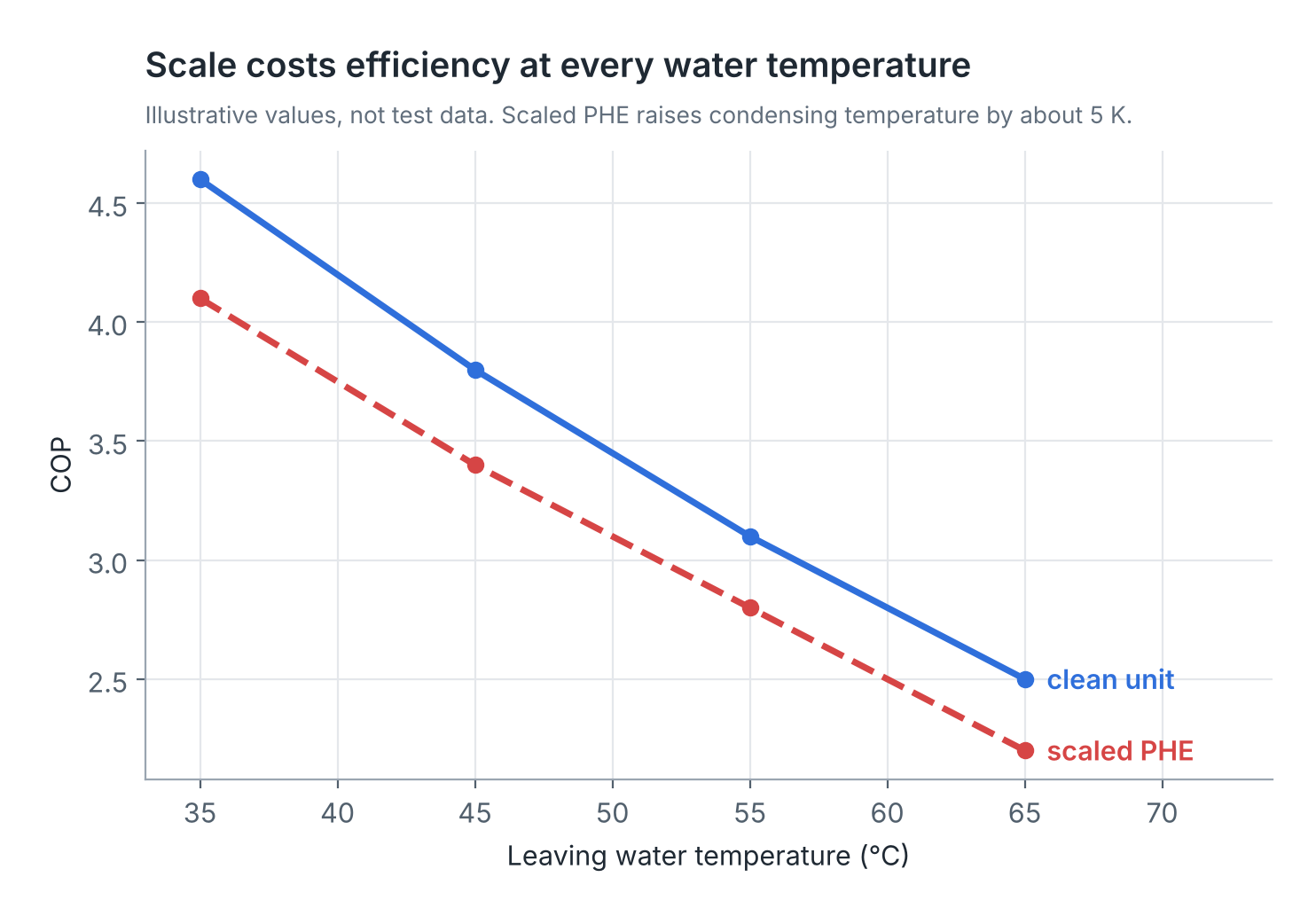
Capacity is the heat output in kW. COP (coefficient of performance) is heat output divided by electrical input. A unit with COP 4 gives 4 kWh of heat for 1 kWh of electricity.
Falling COP often shows up first in the electricity bill, not as a fault code. The unit keeps running but heats slower and costs more. Like a fridge with a dirty back grill, it still cools but runs much longer.
Main causes
- Dirty air coil or scaled PHE.
- Low or high refrigerant charge.
- Wrong water flow (too low or too high).
- Expansion valve badly set or faulty.
- Compressor wear: leaking valves or scroll tips cause low compression.
- Reversing valve leaking hot gas internally into suction.
- Wrong set point or poor controls (short cycling).
- Unit running outside its design conditions (very cold or very hot water).
Symptom → cause → check → fix (capacity and COP)
| Symptom | Likely cause | Check | Fix |
|---|---|---|---|
| Slow heat-up, high discharge pressure, rising approach | Scaled PHE | Approach temperature | Descale |
| Slow heat-up, low suction, high SH | Low charge | SH, SC, leak test | Fix leak, recharge by weight |
| Low current, small pressure difference, normal charge | Compressor wear / internal leak | Compression ratio, current vs data | Replace compressor (find root cause first) |
| Suction line warm in heating, both reversing valve outlets similar temperature | Reversing valve leaking | Temperatures at valve ports | Replace reversing valve |
| Frequent start-stop | Short cycling: small buffer, tight differential | Controller log of starts per hour | Adjust differential, add buffer volume |
| COP low only on very cold mornings | Normal effect of low ambient | Compare with manufacturer data | Expected; check defrost and backup |
Worked example — Measure field COP
A heat pump at a hostel in Bhopal. Water flow 2,000 LPH, in 45 °C, out 52 °C. Input power measured 4.2 kW.

ṁ = 2,000 ÷ 3,600 = 0.556 kg/s Q = 0.556 × 4.19 × (52 − 45) = 0.556 × 4.19 × 7 = 16.3 kW COP = 16.3 ÷ 4.2 = 3.9
If commissioning COP at the same conditions was 4.3, the drop is about 9 %. Daily cost impact for 10 hours at the example rate of ₹9/kWh: Input at COP 4.3 = 16.3 ÷ 4.3 = 3.79 kW; at COP 3.9 = 4.2 kW. Extra = 0.41 kW × 10 h × ₹9 = ₹37 per day, about ₹13,500 per year.
Remember
- COP = heat out ÷ power in; measure both.
- Compare at the same water and ambient conditions.
- Small COP losses add up to large yearly costs.
- Clean heat exchangers first; condemn the compressor last.
When capacity or COP falls, the cause is usually one of three: poor heat transfer, wrong charge, or a tired compressor.
There are no comments for now.
to be the first to leave a comment.