9.2 Cleaning coils and heat exchangers; descaling
An air coil (finned tube heat exchanger) picks up dust, cotton lint, leaves and oily kitchen fumes. A plate heat exchanger (PHE) is a stack of thin pressed plates; refrigerant flows on one side and water on the other. Scale is a hard layer of calcium and magnesium salts left by hard water when it is heated.
Look inside an old geyser in Delhi or Chennai and you will see white rock on the element. The same rock forms in the PHE water channels. Even a thin layer of scale cuts heat transfer noticeably, because scale conducts heat far worse than steel.
Cleaning the air coil
- Isolate power and lock out.
- Brush or vacuum loose dirt from the air-inlet side.
- Spray coil cleaner (non-acidic, safe for aluminium and copper) and wait for the time on the label.
- Rinse with low-pressure water from the air-outlet side towards the inlet (back-flush), so dirt goes out the way it came in.
- Straighten bent fins with a fin comb.
Never use a high-pressure jet close to the fins. It flattens them and blocks air flow.
Descaling a plate heat exchanger
Descaling means circulating a mild acid solution through the water side to dissolve scale. Use a descaling solution suited to stainless steel plates and copper brazing; follow the chemical supplier's strength and time. Typical practice is a weak acid such as citric acid or a proprietary inhibited descaler.
Steps:
- Switch off the heat pump and the system pump. Isolate power.
- Close isolation valves V1 and V2 on the main water lines.
- Connect hoses from the descaling pump to service valves V3 (inlet) and V4 (outlet) on the PHE.
- Fill the tank with descaling solution. Circulate against the normal flow direction (back-flush) for better scale removal.
- Watch for foaming. Foaming means the acid is still reacting with scale. When foaming stops and pH stays steady, scale is dissolved.
- Drain the solution into a container for neutralisation. Never drain acid into a garden or open drain.
- Flush with clean water until the outlet pH is neutral (about 7).
- Neutralise if the chemical supplier says so, flush again, reconnect, vent air and restart.
- Record the approach temperature before and after.
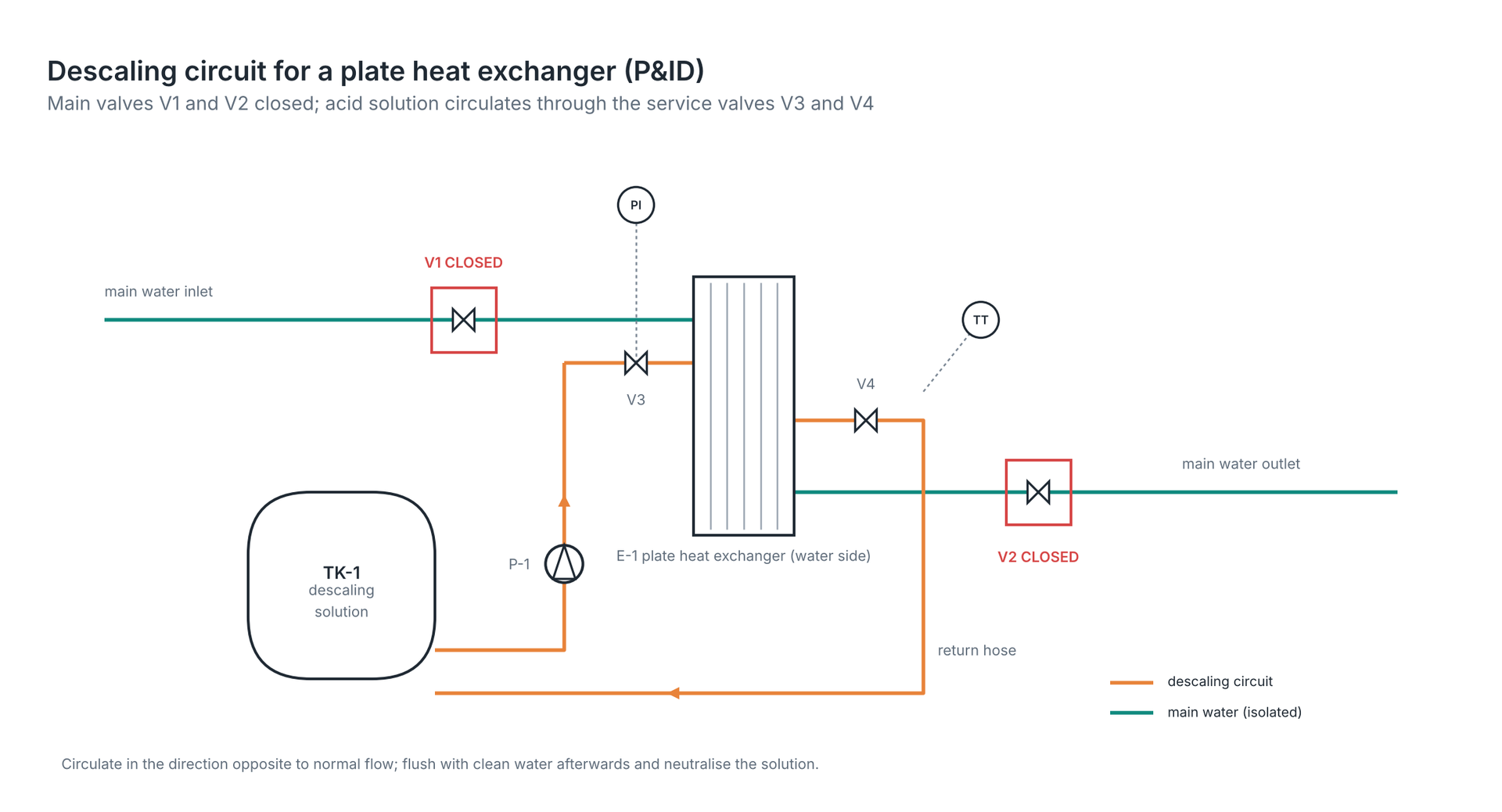
Legend: TK tank; P pump; V1/V2 isolation ball valves (closed during descaling); V3/V4 service (flushing) valves; E-1 plate heat exchanger; PI pressure indicator; TT temperature transmitter; arrows show back-flush direction (opposite to normal flow).
| Item | Symptom of fouling | Clean when |
|---|---|---|
| Air coil (heating mode) | Low suction pressure, more frequent defrost | Visibly dirty, or suction falls versus record |
| Air coil (cooling / heat rejection) | High discharge pressure | Discharge pressure rises versus record |
| Water-side PHE (condenser) | High discharge pressure, approach temperature rising | Approach rises by about 2–3 K over commissioning (typical) |
| Water-side PHE (evaporator) | Low suction, freeze-protection alarms | Approach rises over commissioning |
| Y-strainer | Low flow, flow switch trips | Pressure drop across it rises |
Worked example — Is the condenser PHE scaled?
Approach temperature is the difference between the refrigerant condensing temperature and the leaving water temperature.

At commissioning in Ahmedabad: condensing temperature 58 °C, water out 55 °C. Approach = 58 − 55 = 3 K.
One year later, same load: condensing temperature 63 °C, water out 55 °C. Approach = 63 − 55 = 8 K.
The approach has grown by 5 K. Higher condensing temperature means higher compressor work. Descale the PHE.
Remember
- Back-flush coils from outlet side to inlet side, at low pressure.
- Descale against normal flow direction, then flush to neutral pH.
- Use chemicals compatible with stainless steel, copper and brazing.
- Track approach temperature to know when to descale.
Dirt on the air side and scale on the water side both act like a blanket, so the heat pump must work harder to move the same heat.
There are no comments for now.
to be the first to leave a comment.