5.9 Multiple units: cascading and redundancy
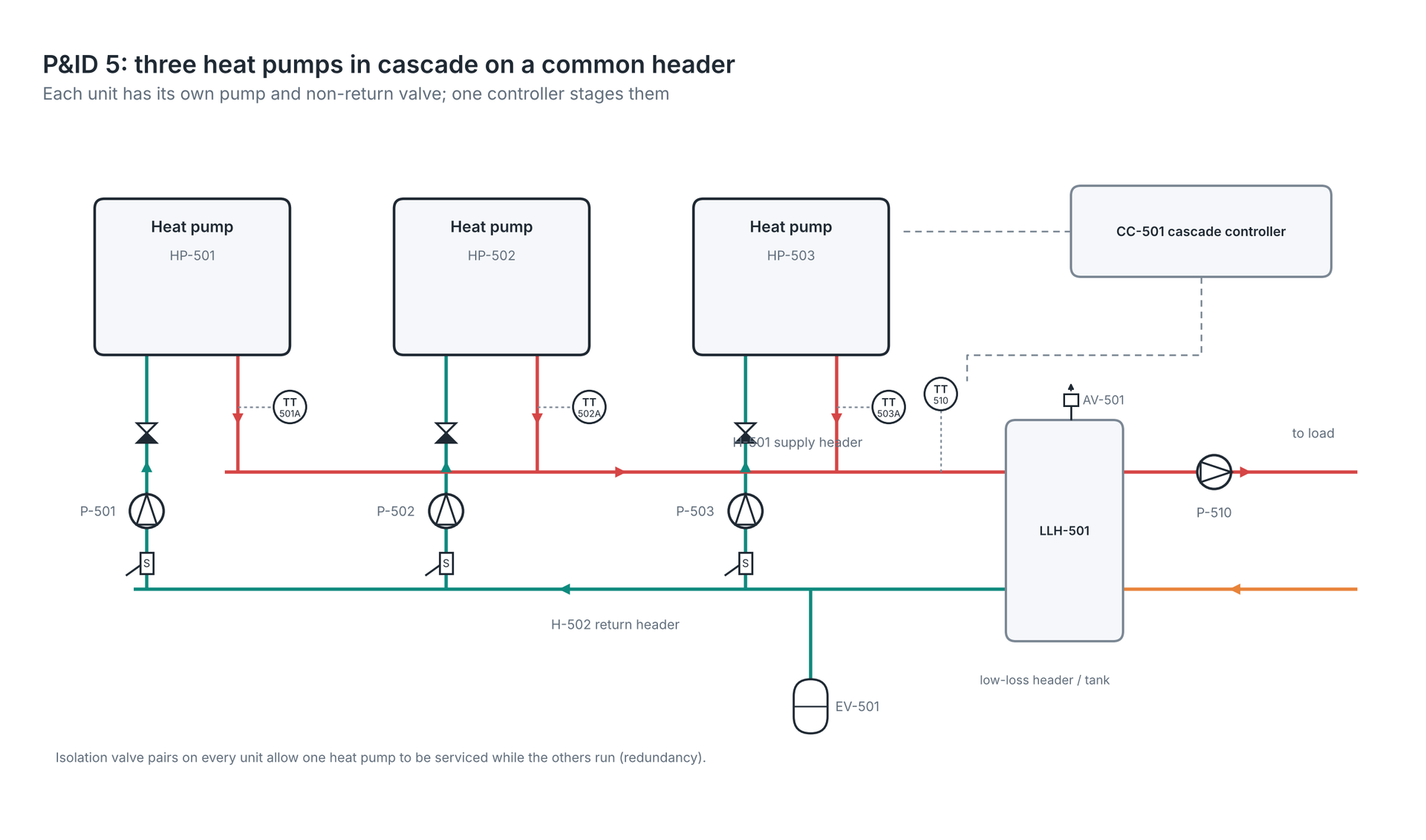
Cascading means connecting several heat pumps to one header and switching them on in stages as demand rises. A master controller rotates the lead unit to share running hours equally.
Redundancy is the spare capacity you keep for failure. N+1 means one more unit than needed. For a hospital or hotel, losing hot water is not acceptable, so N+1 is common.
Header design:
- Use a common supply and return header with reverse-return piping, or a low-loss header, so each unit gets equal flow.
- Each unit has its own pump (or motorised valve), NRV, isolation valves, strainer and flow switch.
- Size header velocity low (typical ≤ 0.6 m/s) so it acts as a hydraulic separator.
| Arrangement | Pros | Cons |
|---|---|---|
| One large unit | Low capital, simple | No backup, poor part-load |
| 2 × 50 % | Some backup (50 %) | Half output on failure |
| 3 × 50 % (N+1) | Full output with one down | Higher capital |
| 4 × 33 % (N+1) | Fine staging, full backup | More pipework, controls |
Worked example — redundancy choice for a 120 kW hospital load
Design load 120 kW at design ambient. Option 1: 3 × 40 kW (N). One failure → 80 kW = 67 % output. Option 2: 4 × 40 kW (N+1). One failure → 120 kW = 100 %. Extra capital is one unit; for a hospital, choose N+1.
Remember
- Cascade for part-load efficiency and resilience.
- Equal flow to each unit: reverse return or individual pumps with balancing.
- NRV on every unit to stop back-flow through idle units.
- Rotate lead unit to equalise hours.
Several smaller heat pumps in cascade give better part-load efficiency and keep hot water flowing if one unit fails.
There are no comments for now.
to be the first to leave a comment.