5.1 Reading a datasheet: rating conditions and what they hide
A datasheet is like a car's mileage figure. It is measured under fixed, gentle conditions, and real roads give less. A heat pump's heating capacity (kW of heat delivered) and COP (coefficient of performance: heat out divided by electricity in) change with outdoor air temperature and the water temperature you ask for.
Every rating should state its rating condition: the ambient dry-bulb (DB) temperature, the wet-bulb (WB) temperature (which tells humidity), and the water inlet and outlet temperatures. If a sheet gives a capacity without these, you cannot compare it with anything.
Common rating points used by manufacturers (typical, they vary by standard and product type):
| Rating style | Ambient DB / WB | Water | Typical use |
|---|---|---|---|
| Mild "domestic hot water" point | 20 °C / 15 °C | 15 °C in → 55 °C | Hot water heat pumps |
| Space-heating low temperature | 7 °C / 6 °C | 30 °C in → 35 °C out | Underfloor heating |
| Space-heating medium temperature | 7 °C / 6 °C | 40 °C in → 45 °C out | Radiators, fan coils |
| Cold climate check | −7 °C / −8 °C | 30 → 35 °C | Winter capacity |
What datasheets often hide:
- Defrost losses. Ratings at 20 °C have no frost. Below about 7 °C with high humidity, the evaporator frosts and defrost cycles cut average output (typical 5–15 %).
- Heat-up vs. steady state. A "15 → 55 °C" rating is an average over a heat-up. Reheating a tank already at 45 °C gives a lower COP.
- Pump and fan power. Check whether COP includes the water pump power. Some sheets exclude it.
- Maximum vs. nominal. Inverter units list a nominal and a maximum capacity. Size on the capacity at your condition, not the maximum.
- Sound level. Sound pressure (dB(A) at a distance) and sound power are different numbers. Sound power is always the larger.
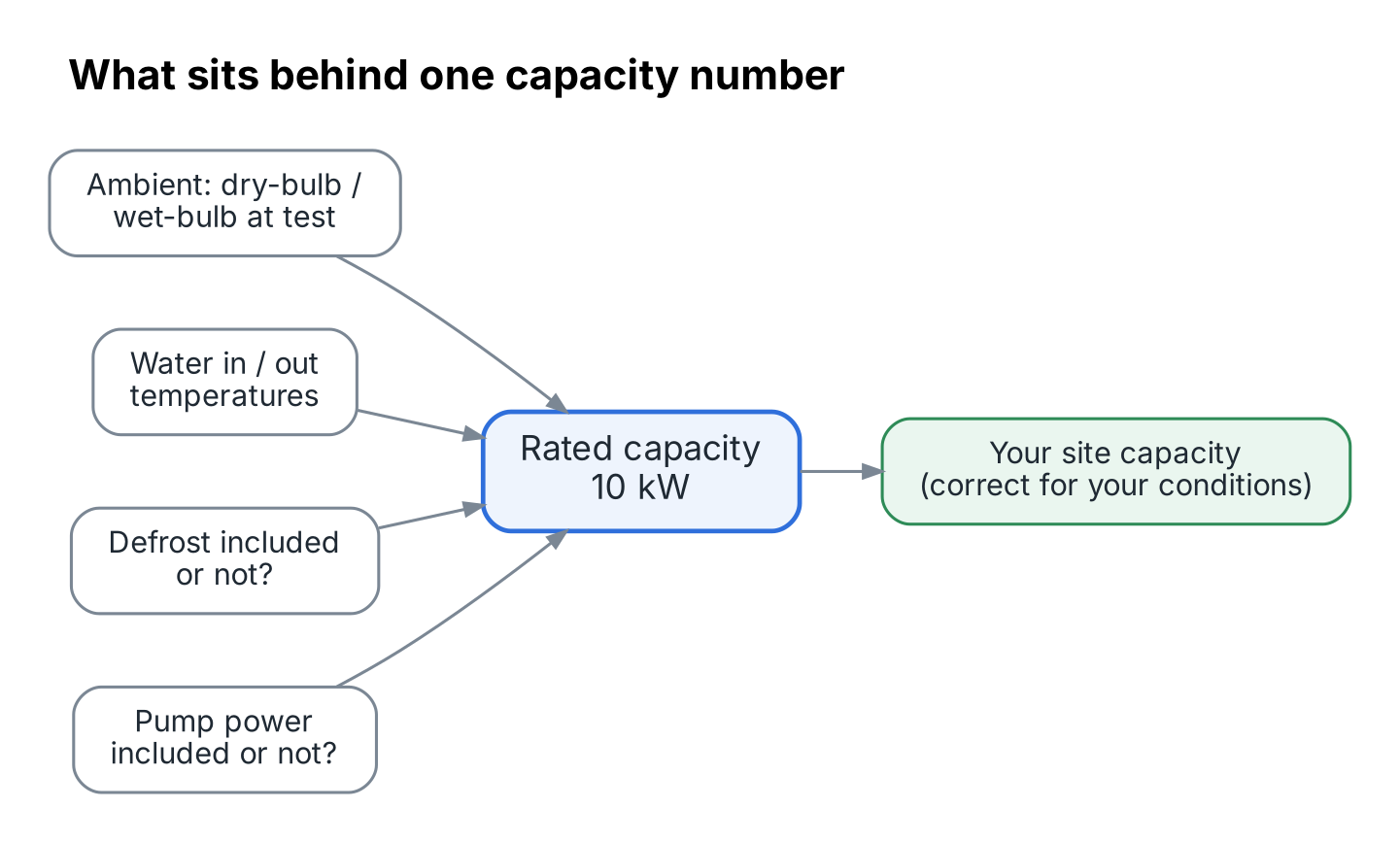
Worked example — correcting a datasheet COP for site water temperature
A unit is rated 10 kW, COP 4.2 at 20 °C ambient, water 15 → 55 °C. Your site in Shimla needs 60 °C water at 5 °C ambient. Use the manufacturer's correction table. If none exists, a Carnot-ratio estimate gives a rough direction.

Rated: Thot ≈ 55 °C average-to-final. Use average water 35 °C = 308 K; Tcold = 293 K → Carnot = 308/15 = 20.5. Site: average water 37.5 °C = 310.5 K; Tcold = 278 K → Carnot = 310.5/32.5 = 9.6. COPsite ≈ 4.2 × 9.6/20.5 ≈ 2.0. This is a rough, conservative estimate. Always prefer the manufacturer's own performance table.
Remember
- No rating condition, no comparison.
- Capacity and COP fall when ambient falls or water temperature rises.
- Ask whether defrost and pump power are included.
- Size on capacity at the design condition, not the maximum.
A datasheet capacity is true only at the exact air and water temperatures it was tested at.
There are no comments for now.
to be the first to leave a comment.