5.10 Water quality and material selection
Indian water ranges from soft rainwater to borewell water with TDS above 1,500 mg/L. Hardness (calcium and magnesium) forms scale on hot surfaces. Scale is a thermal blanket: a 1 mm layer can cut heat transfer noticeably and raise condensing pressure.
Key terms:
- TDS (total dissolved solids): all dissolved salts, mg/L (ppm).
- Hardness: calcium + magnesium, expressed as mg/L CaCO₃.
- Chlorides: attack stainless steel (pitting), especially when hot.
- pH: acidity; below about 6.5 corrodes copper, above about 9 encourages scale.
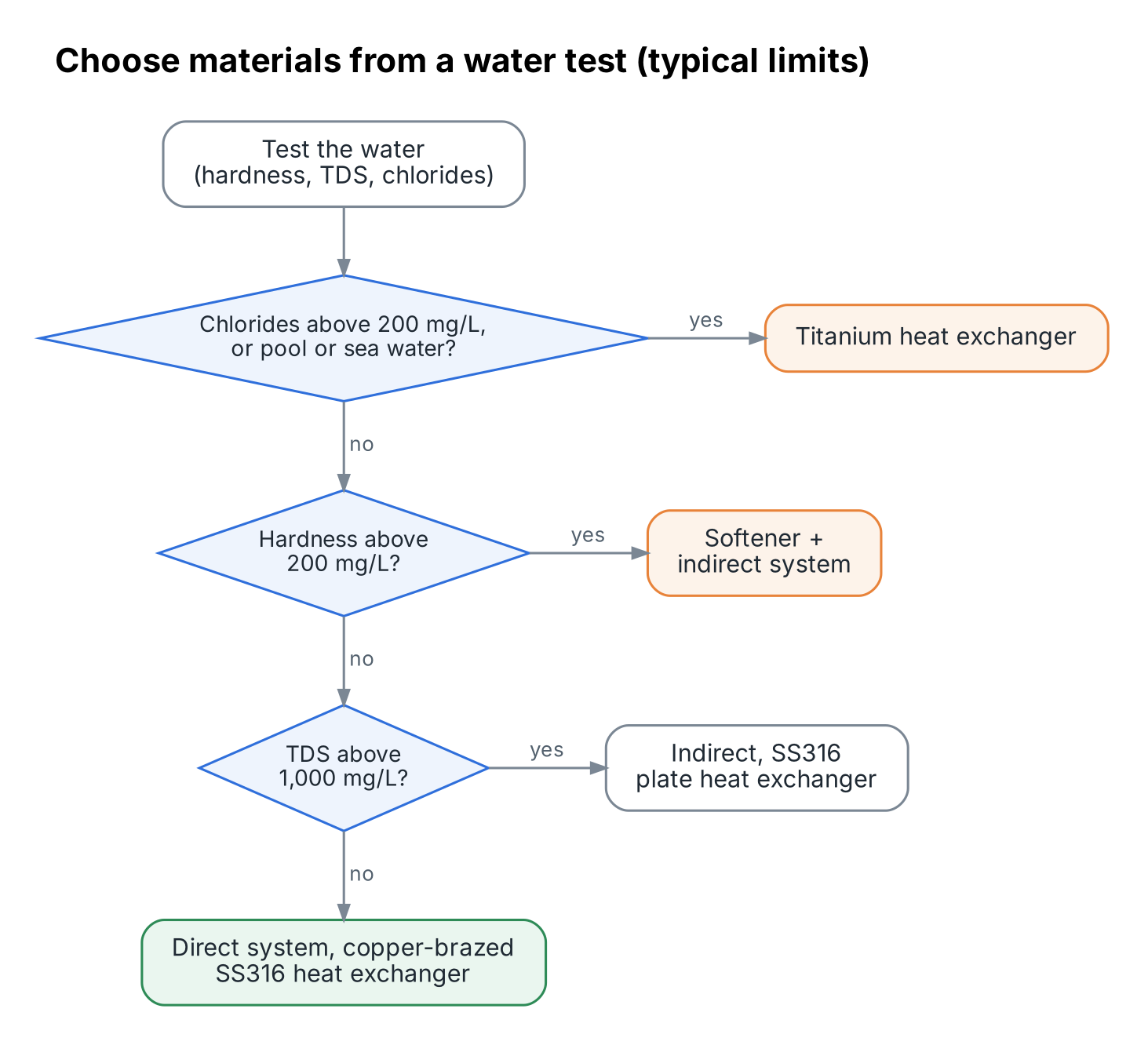
Typical guide values for water passing through a brazed plate or coaxial condenser (check manufacturer):
| Parameter | Typical acceptable | Comment |
|---|---|---|
| pH | 7.0–9.0 | |
| Total hardness | < 150–200 mg/L as CaCO₃ | Soften above this |
| TDS | < 500 mg/L (preferred), up to ~1,000 with care | |
| Chlorides | < 100–200 mg/L for SS304 | SS316 or titanium above |
| Free chlorine | < 0.5–1 mg/L | Pools need care |
| Iron | < 0.2 mg/L | Fouling |
Material selection:
| Water type | Condenser material |
|---|---|
| Soft / RO municipal | Copper-brazed SS316 plate or copper coaxial |
| Hard borewell | Indirect loop + softener; SS316 PHE on user side |
| Swimming pool (chlorinated) | Titanium coil |
| Sea / brackish water | Titanium |
| Process with ammonia contact | Nickel-brazed or fully welded SS (no copper) |
Worked example — scale penalty
A unit in Jaipur on borewell water (hardness 450 mg/L) builds scale. Condensing temperature rises 4 K. Rule of thumb: COP falls roughly 2–3 % per K of extra lift (typical). COP drops from 3.5 to about 3.5 × (1 − 0.025 × 4) = 3.15. On 200 kWh heat/day: electricity rises from 57.1 to 63.5 kWh/day = 6.4 kWh × ₹9 = ₹58/day ≈ ₹21,000/year, before the cost of a failed condenser.
Remember
- Test the water before selecting: pH, hardness, TDS, chlorides, iron.
- Pools and sea water need titanium.
- High hardness → softener and/or indirect loop.
- Plan CIP (clean-in-place) connections on PHEs.
Bad water kills heat exchangers faster than anything else, so match materials and treatment to the site water.
There are no comments for now.
to be the first to leave a comment.