5.7 Hydraulics: piping, pumps, buffer tanks, flow rates
Flow rate links capacity and temperature rise:

Most heat pumps want a ΔT of about 5 K across the condenser (typical 3–7 K). Too low a flow raises condensing temperature and trips on HP. Too high a flow wastes pump power and erodes pipes.
Pipe velocity guide (typical): 0.6–1.2 m/s for small pipes, up to 1.5–2.0 m/s for larger mains. Keep below about 2.5 m/s to limit noise and erosion.
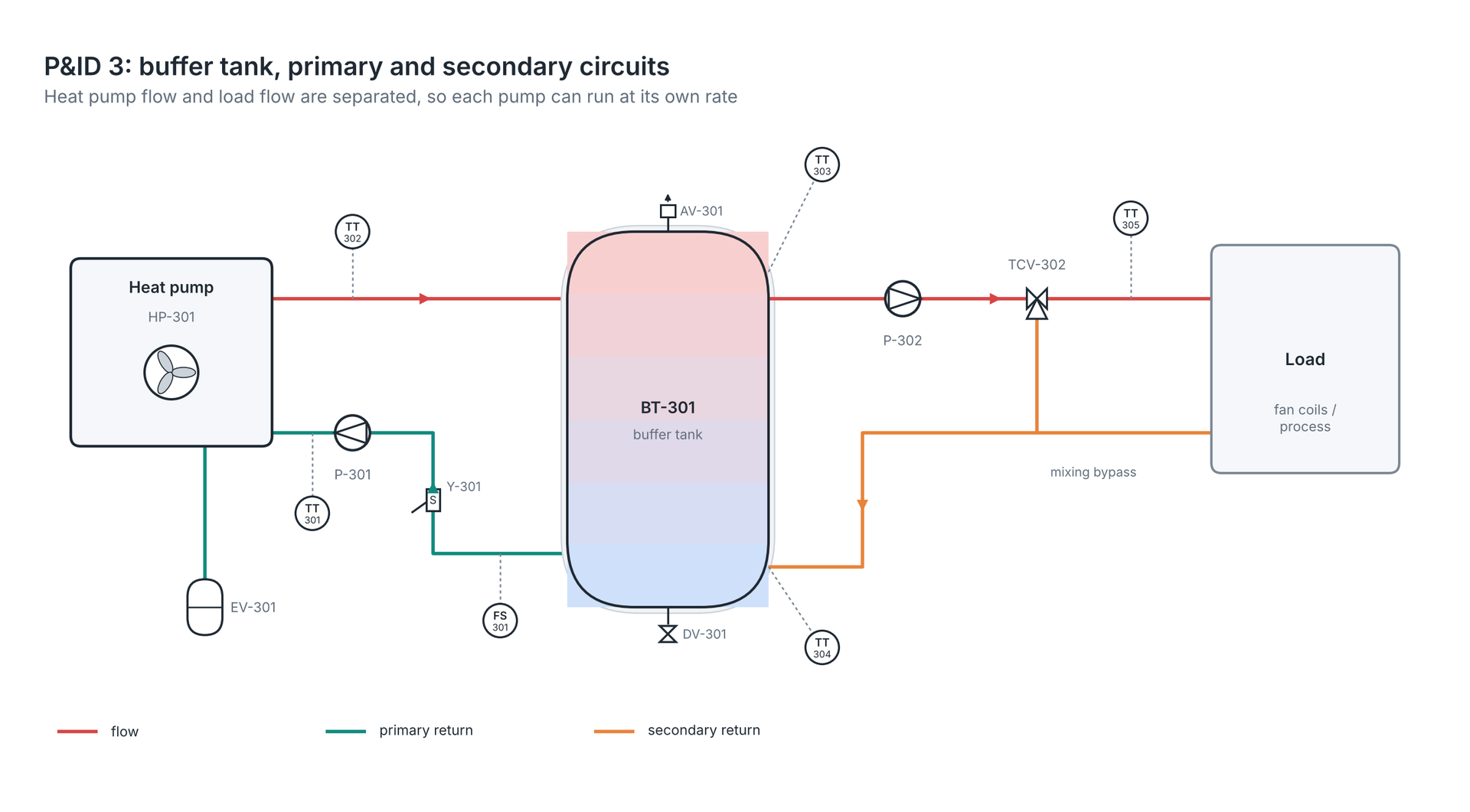
A buffer tank adds water volume. It is used when (a) the system water volume is too small, causing short cycling (frequent stop-starts), (b) defrost needs heat stored, or (c) primary and secondary flows differ. The buffer then acts as a hydraulic separator: primary pump (HP side) and secondary pump (load side) work independently.
Minimum water volume rule of thumb: typical 5–10 L per kW for inverter units, 10–20 L per kW for on/off units. Check the manufacturer's figure.
| Capacity | Flow at ΔT 5 K | Typical pipe (copper/PPR/steel) |
|---|---|---|
| 5 kW | 0.86 m³/h (860 LPH) | 22 mm Cu / 25 mm PPR / DN20 |
| 10 kW | 1.72 m³/h | 28 mm Cu / 32 mm PPR / DN25 |
| 20 kW | 3.44 m³/h | 35 mm Cu / 40 mm PPR / DN32 |
| 40 kW | 6.9 m³/h | 50 mm PPR / DN40 |
| 80 kW | 13.8 m³/h | DN50–DN65 |
Worked example — pump for a 30 kW unit
Flow = 0.86 × 30 / 5 = 5.16 m³/h. Pipe DN40 (ID ≈ 41 mm): area = 0.00132 m²; velocity = 5.16/3600/0.00132 = 1.09 m/s — fine. Head: condenser 3.5 m (from datasheet), pipe 30 m equivalent × 0.03 m/m = 0.9 m, strainer + valves 1.5 m → 5.9 m; add 15 % margin → about 6.8 m. Select a pump for 5.2 m³/h at about 7 m head: shaft power ≈ 212 W (hydraulic power ≈ 96 W) at 45 % pump efficiency.

Remember
- Set flow for ΔT ≈ 5 K across the heat pump.
- Fit a strainer before the heat pump and a flow switch at its inlet.
- Use a buffer when water volume is small or flows differ.
- Air vents at high points, drains at low points.
- Where load-side demand swings widely (hotel recirculation, fan-coil loops), fit the secondary pump with a variable frequency drive (VFD): pump power falls roughly with the cube of speed, so running at part load saves far more energy than throttling a valve.
The heat pump needs a steady, correct water flow — get the flow wrong and nothing else matters.
There are no comments for now.
to be the first to leave a comment.