5.6 Direct vs indirect heating
In a direct system, the potable (drinking-quality) or process water flows straight through the heat pump's condenser. It is simple and has no exchanger losses. But hard or dirty water scales the condenser.
In an indirect system, the heat pump heats a closed loop of clean, treated water. A plate heat exchanger (PHE) or tank coil transfers heat to the user water. This protects the heat pump, at the cost of a 3–5 K approach (temperature lost across the exchanger) and an extra pump.
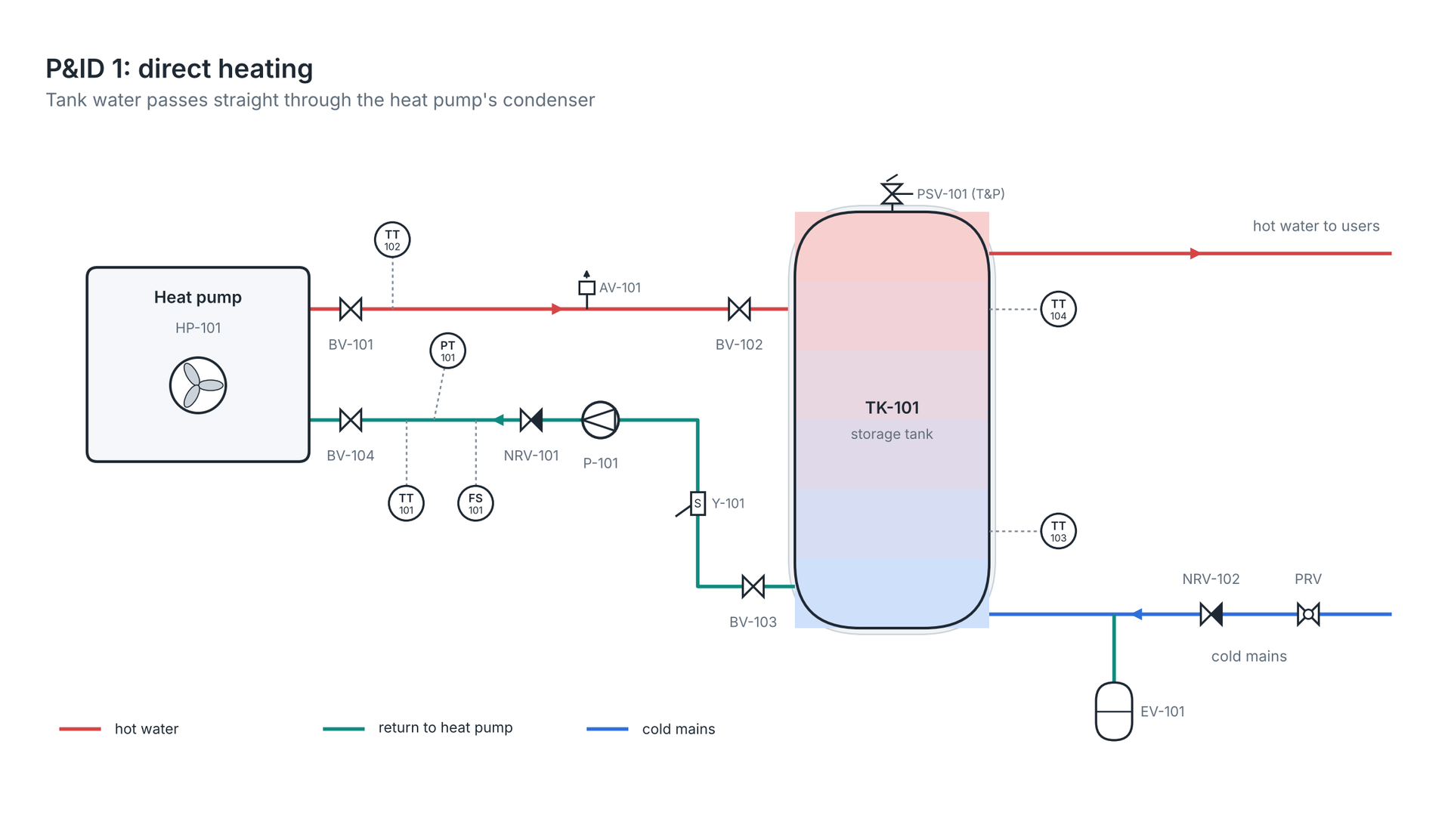
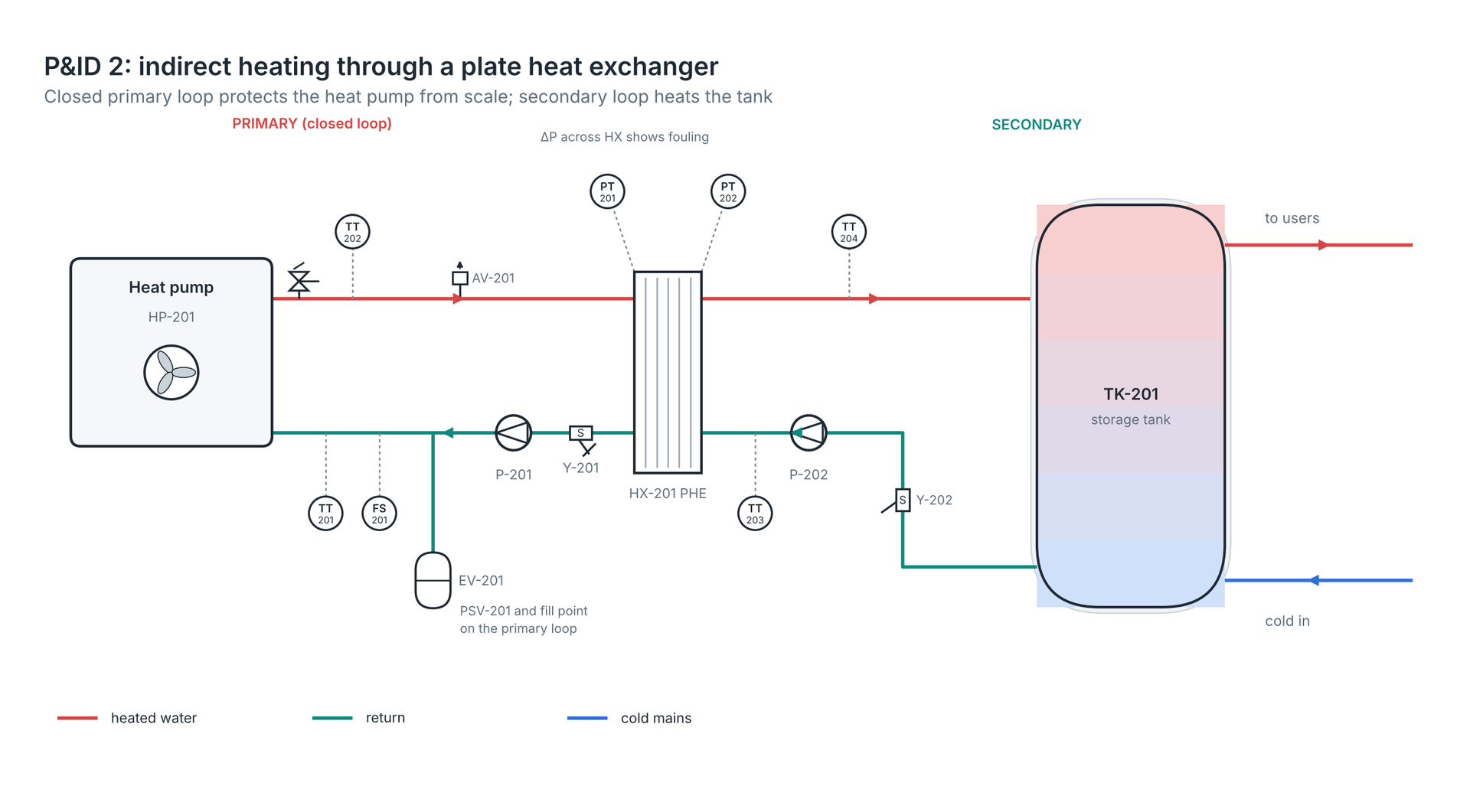
| Factor | Direct | Indirect (PHE) |
|---|---|---|
| Efficiency | Best — no approach loss | COP lower by typical 5–10 % |
| Cost | Lower | Extra PHE, pump, controls |
| Scaling risk to HP | High with hard water | Low — closed treated loop |
| Maintenance | Descale HP condenser | Descale PHE (easy to open/CIP) |
| Best for | Soft water, RO water, small domestic | Hard water, process fluids, pools, hygiene |
Worked example — approach penalty
Need 58 °C user water. PHE approach 4 K → primary must make 62 °C. If the envelope limit is 60 °C at design ambient, indirect fails while direct (58 °C) works. Either pick a higher-temperature unit or a closer-approach PHE (2 K, more plates).
Remember
- Direct is simpler and more efficient; indirect protects the machine.
- Use indirect when TDS/hardness is high or the fluid is not clean water.
- Add the PHE approach to the HP leaving water temperature.
- Fit isolation valves on both PHE sides for cleaning.
Direct heating passes the user's water through the heat pump condenser; indirect heating keeps it in a separate loop through a heat exchanger.
There are no comments for now.
to be the first to leave a comment.