5.4 Sizing: capacity, running hours and storage trade-off
Hot water demand is peaky. A hotel uses most of its water 6–9 am and 7–10 pm. A geyser meets a peak with high power. A heat pump meets it with stored hot water, filled slowly over many hours. The tank is a battery of heat.
Three steps:
- Find daily hot water energy.
- Choose running hours (typically 8–16 h per day for hot water; more hours means a smaller unit).
- Size storage to cover the peak that the heat pump cannot meet in real time.


Worked example — 40-room hotel in Pune
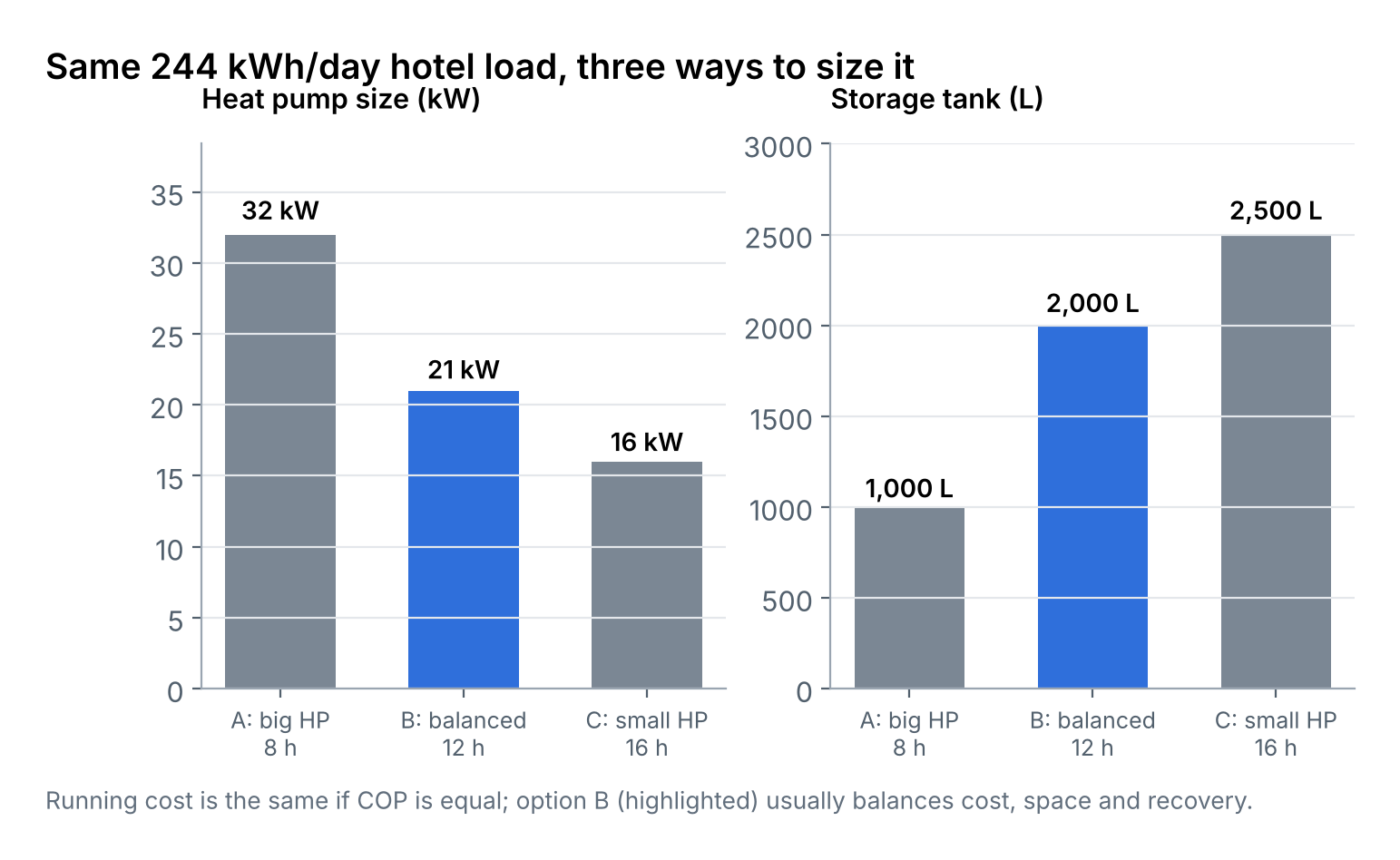
Load: 40 rooms × 2 guests × 60 L at 60 °C = 4,800 L/day plus kitchen 1,200 L = 6,000 L/day. Cold water 25 °C (typical Pune winter). ΔT = 35 K. Eday = 6,000 × 4.186 × 35 / 3600 = 244 kWh/day. Morning peak: 50 % of daily use in 3 hours = 122 kWh. Usable fraction of tank (stratification and mixing) η = 0.8 (typical 0.75–0.9).
| Option | Running hours | HP size | HP output in 3 h peak | Energy tank must hold | Tank volume |
|---|---|---|---|---|---|
| A — big HP | 8 h | 244/8 = 30.5 kW → 32 kW | 96 kWh | 122 − 96 = 26 kWh | 26×3600/(4.186×35×0.8) ≈ 800 L → 1,000 L |
| B — balanced | 12 h | 244/12 = 20.3 kW → 21 kW | 63 kWh | 59 kWh | ≈ 1,800 L → 2,000 L |
| C — small HP | 16 h | 244/16 = 15.3 kW → 16 kW | 48 kWh | 74 kWh | ≈ 2,260 L → 2,500 L |
Running cost is the same for all three if COP is equal: 244 kWh ÷ COP 3.8 = 64 kWh electricity/day × ₹9 = ₹578/day (example rate). Option B is usually best: moderate tank, room to recover if a second peak comes early, and some spare hours for derating. Check: the evening peak must be recovered in the hours between peaks. Option C needs 74 kWh ÷ 16 kW ≈ 4.6 h refill time — fine if peaks are 10 h apart.
Remember
- Energy per day sets total work; running hours set machine size.
- Storage covers what the machine cannot deliver during the peak.
- Leave 20–30 % spare hours for derating and defrost.
- Check recovery time between peaks.
Hot water sizing is a trade-off — a bigger tank lets a smaller heat pump run longer hours.
There are no comments for now.
to be the first to leave a comment.