5.3 The operating envelope
Every compressor has limits. If the water is too hot or the air too cold, the discharge temperature and pressure climb too high. The unit then trips on high pressure (HP) or high discharge temperature. The envelope shows the allowed area.
Read it like a road map. X-axis is ambient air temperature. Y-axis is leaving water temperature (LWT), the hot water temperature leaving the heat pump. Inside the shaded area the unit runs. Outside it, it stops or limits itself.
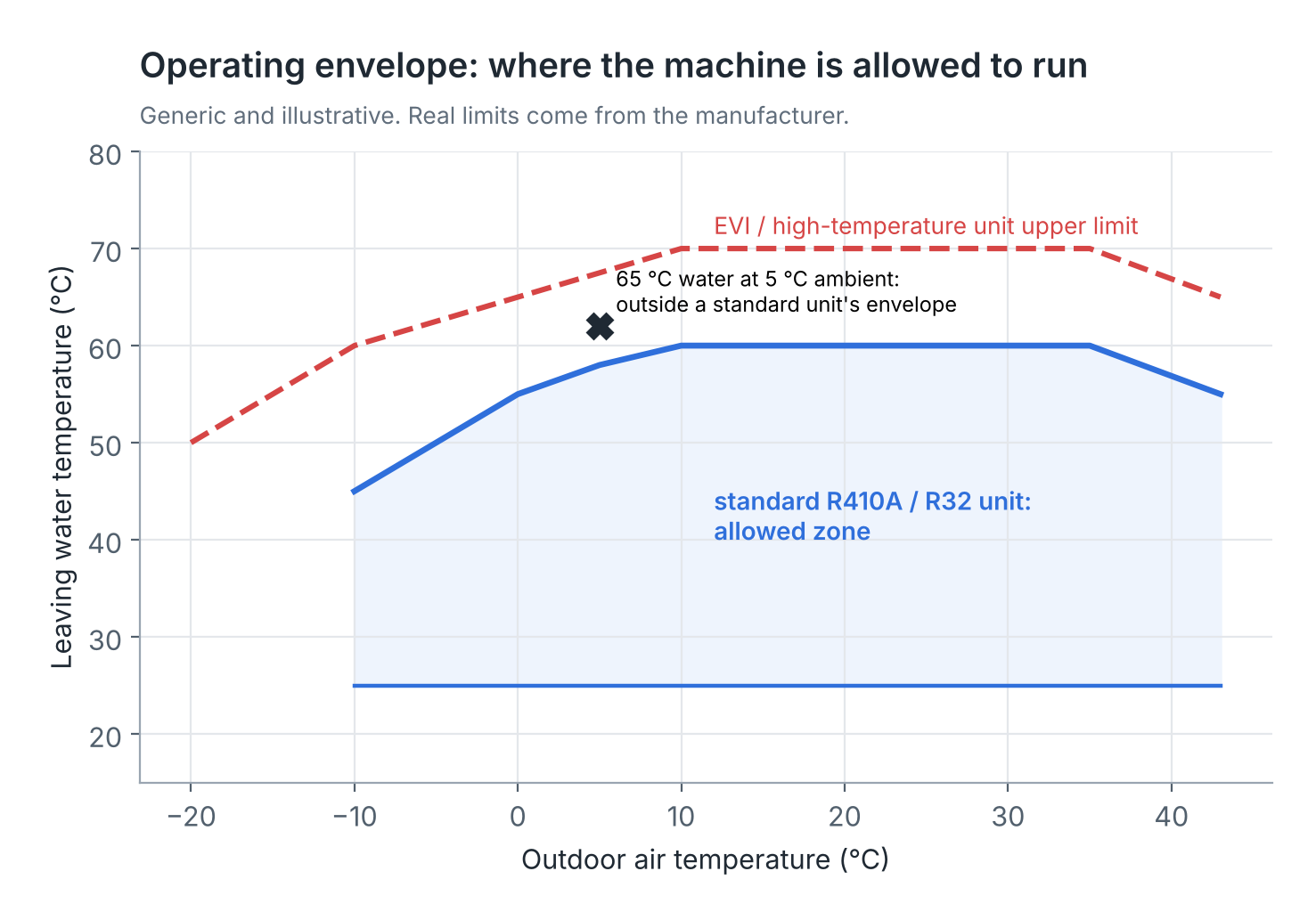
| Envelope edge | What happens if you cross it |
|---|---|
| Top (water too hot) | High-pressure trip, high discharge temperature |
| Left (air too cold) | Low suction pressure, low-pressure trip, poor oil return |
| Right (air too hot) | High condensing pressure; unit may limit capacity |
| Bottom (water too cold at start) | Low head pressure; some units need a minimum water temperature |
Worked example — will it run?
Project in Shimla: design ambient −2 °C, required 60 °C water. On the generic envelope, the upper boundary at −2 °C is about 53 °C. 60 °C > 53 °C, so the standard unit is outside the envelope. Options: choose an EVI (enhanced vapour injection) or high-temperature unit, or heat to 50 °C and top up with an electric or boiler stage.
Remember
- Plot your design point (ambient, LWT) on the envelope before selecting.
- Check both winter and summer corners.
- The envelope tightens at low ambient.
- EVI and CO₂ machines widen the envelope.
The operating envelope is the map of ambient and water temperatures in which the compressor can run safely.
There are no comments for now.
to be the first to leave a comment.