5.5 Storage tank sizing and stratification
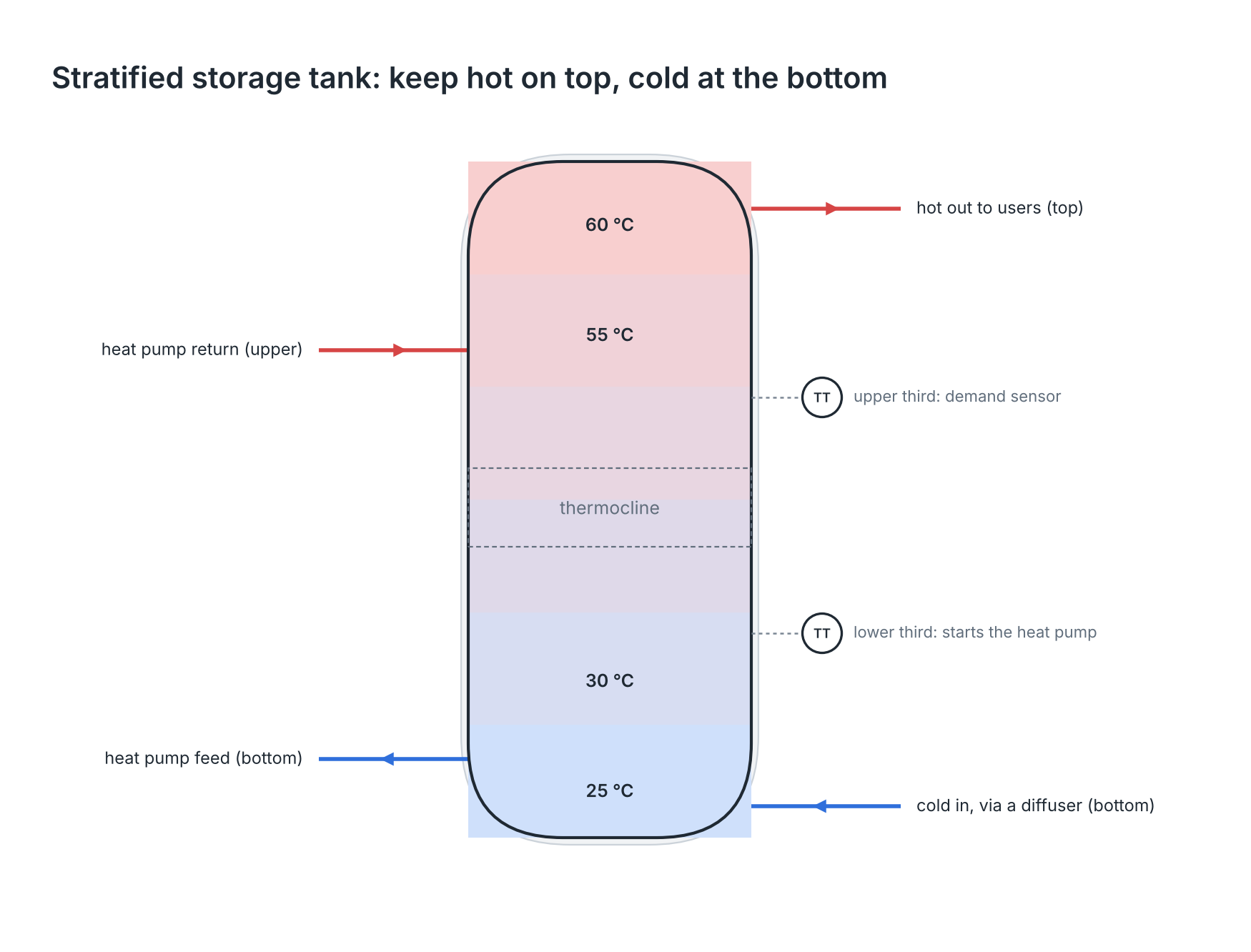
Hot water is lighter than cold. Left still, it forms layers: hot at the top, cold at the bottom, with a thin mixing zone between called the thermocline. This is stratification. Stir the tank and the layers mix, and the effect is lost.
Good stratification means the heat pump gets cold water from the bottom, which raises its COP. The user gets hot water from the top at full temperature until the tank is almost empty.
How to keep stratification:
- Bring cold make-up in at the bottom through a diffuser, at low velocity (typical under 0.3 m/s at inlet).
- Take hot draw-off from the top.
- Return heat pump hot water to the top; take heat pump feed from the bottom.
- Prefer tall vertical tanks (height:diameter around 2:1 to 3:1).
- Avoid recirculation return lines dumping into the middle at high flow.
| Item | Typical value |
|---|---|
| Usable fraction, well stratified | 0.8–0.9 |
| Usable fraction, mixed tank | 0.6–0.7 |
| Storage temperature | 55–60 °C |
| Legionella control | Store ≥ 60 °C, periodic pasteurisation cycle above 60 °C |
| Tank insulation | 50–100 mm PUF, typical loss target < 1 °C per 12 h |
Worked example — standing loss check
A 2,000 L tank at 60 °C in a 20 °C plant room loses heat at 2.0 W/K (UA, typical for well-insulated tank).

Qloss = 2.0 × (60 − 20) = 80 W = 1.92 kWh/day. Cost = 1.92 ÷ COP 3.8 × ₹9 ≈ ₹4.5/day. Good insulation makes standing losses minor.
Remember
- Hot in at top, cold in at bottom, slowly.
- Tall tanks stratify better.
- Place the HP start sensor in the lower third.
- Store at 60 °C or run pasteurisation for Legionella safety.
A stratified tank keeps hot water on top and cold at the bottom, so you can draw more usable hot water from the same volume.
There are no comments for now.
to be the first to leave a comment.