4.9 Cold climates and high altitude
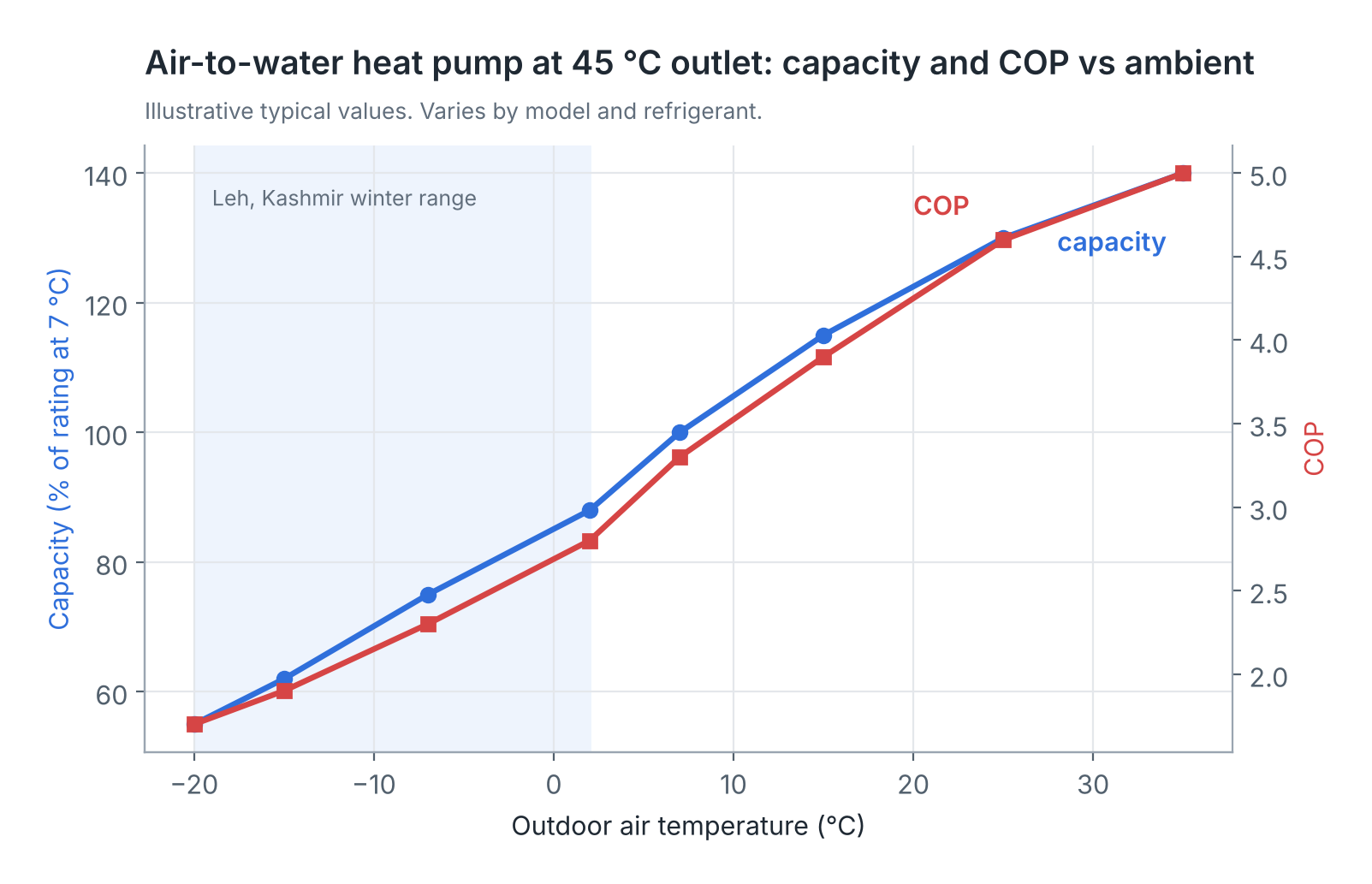
As outdoor air gets colder, the evaporator has less heat to pick up. Capacity falls and COP falls. Below about 5 °C with humid air, ice forms on the coil. The unit must defrost, usually by briefly reversing the cycle.
| Place (typical) | Altitude | Typical winter low | Notes |
|---|---|---|---|
| Delhi | ~220 m | 3–7 °C | Light frost risk, fog |
| Shimla | ~2,200 m | −2 to 2 °C | Defrost frequent |
| Srinagar | ~1,600 m | −5 to −2 °C | Glycol advisable |
| Leh | ~3,500 m | −15 to −25 °C | Low-ambient design, glycol, back-up |
Design rules for cold sites:
- Size at the local design low, not at the rated 7 °C point.
- Choose units built for low ambient (for example, vapour injection or CO₂ cycles).
- Protect water circuits with glycol (antifreeze) or drain-down. About 30% ethylene glycol protects to roughly −15 °C; about 40% to roughly −24 °C (typical).
- Glycol lowers heat transfer and raises pumping power; allow 5–10% derating (typical).
- Keep snow and ice away from the coil and condensate drains.
At altitude the air is thinner. At about 3,500 m air density is roughly 70% of sea level. A fan moves the same volume but less mass, so coil capacity falls. Water boils at about 88–89 °C at that height, so keep vent and relief settings in mind.
Worked example — derating at Leh
A heat pump gives 20 kW at 7 °C ambient at sea level. At Leh, design ambient is −15 °C. Use capacity factor 0.62 (from the chart), altitude factor 0.90 and glycol factor 0.95 (typical assumptions; check maker data).

- P = 20 × 0.62 × 0.90 × 0.95 = 10.6 kW
- A 20 kW-rated unit gives only about 10.6 kW at Leh. Size accordingly.
Remember
- Capacity and COP both fall as ambient falls.
- Defrost cycles take a share of every cold hour.
- Altitude reduces air mass flow and boiling point.
- Always protect water circuits from freezing.
In cold air, an air-source heat pump loses capacity and COP and must defrost; at altitude, thinner air reduces airflow mass and boils water at lower temperatures.
There are no comments for now.
to be the first to leave a comment.