4.3 Daily load profiles and peak demand
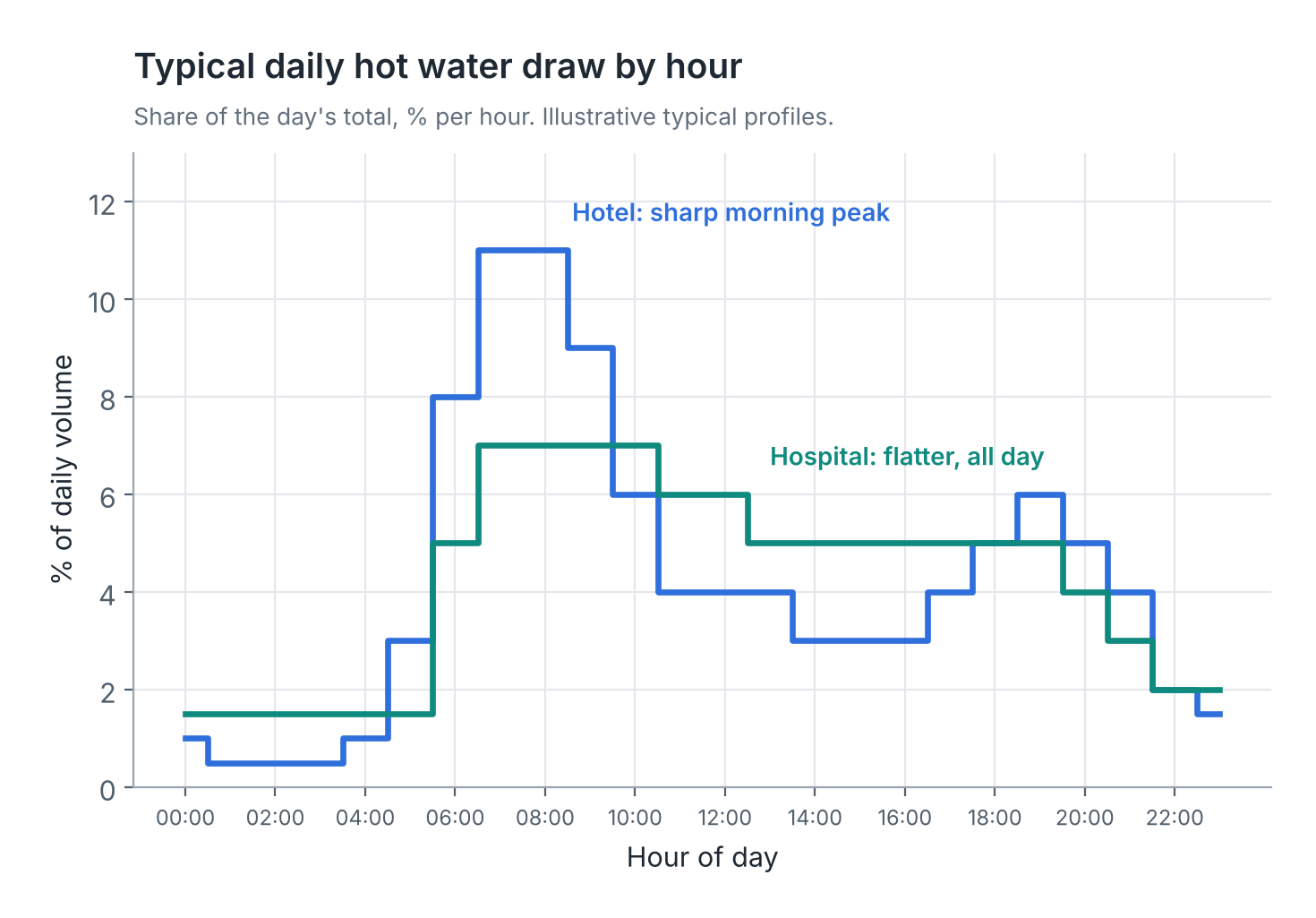
A load profile shows how much hot water is drawn in each hour of the day. Hotels and hostels have sharp morning peaks. Hospitals draw more evenly through the day.
A heat pump heats slowly but steadily. A storage tank is like an overhead water tank: it fills slowly and can be emptied quickly. The tank covers the peak while the heat pump catches up.
There is a trade-off. A bigger tank lets you use a smaller heat pump that runs longer. A smaller tank needs a bigger heat pump that can follow the peak.
| Design choice | Heat pump | Storage | Suits |
|---|---|---|---|
| Large storage | Smaller, runs 16–20 h | 30–50% of daily volume | Hotels, hostels with sharp peaks |
| Medium storage | Medium, runs 12–16 h | 20–30% of daily volume | Most commercial jobs |
| Small storage | Large, follows load | 10–15% of daily volume | Hospitals, process with even draw |
Worked example — storage for a peak period
A hostel uses 6,000 L/day at 60 °C. Cold water is 25 °C. The morning peak (6–9 am) takes 35% of the day. The heat pump delivers 20 kW. Usable storage fraction is 0.75 (the bottom of the tank mixes with incoming cold water).

- Peak draw = 0.35 × 6,000 = 2,100 L
- Recovery in 3 h = 20 × 3 ÷ (35 × 0.001163) = 60 ÷ 0.0407 = 1,474 L
- Net from tank = 2,100 − 1,474 = 626 L
- Storage = 626 ÷ 0.75 = 835 L → select 1,000 L
Remember
- Daily kWh ÷ running hours = heat pump capacity.
- Peak period draw minus recovery = storage need.
- Only about 70–80% of a tank is usable hot water.
- Hostels have the sharpest peaks; hospitals the flattest.
The daily total sets the heat pump size; the peak hours set the storage size.
There are no comments for now.
to be the first to leave a comment.