4.10 Worked examples, start to finish
Case A — 60-room mid-range hotel in Pune
Step 1. Demand. Design at 100% occupancy (typical 2 guests per room). Storage at 60 °C.
| Load | Basis (typical) | L/day at 60 °C |
|---|---|---|
| Guest rooms | 60 rooms × 140 L | 8,400 |
| Restaurant | 150 meals × 6 L | 900 |
| Staff | 20 × 10 L | 200 |
| Total | 9,500 |
Laundry is assumed outsourced. Add it if done in-house.
Step 2. Daily energy. Pune winter cold water is about 20 °C, so ΔT = 40 K.

- Q = 9,500 × 40 × 0.001163 = 442 kWh/day
- Add 15% for tank and recirculation losses: 442 × 1.15 = 508 kWh → use 510 kWh/day
Step 3. Heat pump capacity. Allow 16 running hours a day. This leaves margin for peaks and service.

- P = 510 ÷ 16 = 31.9 kW → select about 32 kW at the winter design ambient (about 10–12 °C early morning in Pune)
Step 4. Storage. From the profile in 4.3, 6–9 am takes 30% of the day.
- Peak draw = 0.30 × 9,500 = 2,850 L
- Recovery in 3 h = 32 × 3 ÷ (40 × 0.001163) = 96 ÷ 0.0465 = 2,064 L
- Net from tank = 2,850 − 2,064 = 786 L → ÷ 0.75 usable = 1,048 L
- Check against the rule of 20–30% of daily volume (1,900–2,850 L). Select 2,000 L to cover group check-outs and full-house days.
Step 5. Running cost (example rates). COP at 60 °C outlet, typical 3.0. LPG net calorific value about 12.8 kWh/kg, boiler efficiency 85%.
- Heat pump: 510 ÷ 3.0 = 170 kWh × ₹9 = ₹1,530/day
- LPG: 510 ÷ (12.8 × 0.85) = 46.9 kg × ₹100 = ₹4,690/day
Result: about 32 kW heat pump capacity at design ambient, 2,000 L storage at 60 °C, with recirculation loop and electric back-up.
Case B — 25 m × 12 m outdoor pool in Delhi, January
Step 1. Data.
- Area A = 300 m²; average depth 1.5 m; volume 450 m³
- Water 28 °C; daily mean air 14 °C; RH 70%; wind at surface 0.5 m/s (walled)
- Ground about 18 °C; shell area = 300 + 2 × (25 + 12) × 1.5 = 411 m²
- Pool used 12 h uncovered; covered 12 h at night
- Solar gain ignored for design (Delhi winter fog days)
Step 2. Evaporation (uncovered).
- pw at 28 °C = 3.78 kPa; pa = 0.70 × 1.60 = 1.12 kPa; Δp = 2.66 kPa
- Qevap = 300 × 2.66 × (0.089 + 0.0782 × 0.5) = 300 × 2.66 × 0.128 = 102.1 kW
Step 3. Convection. h = 6 W/m²K (typical, light wind).
- Qconv = 6 × 300 × (28 − 14) = 25,200 W = 25.2 kW
Step 4. Radiation. Tw = 301 K; Tsky ≈ 14 − 12 = 2 °C = 275 K.
- Qrad = 0.95 × 5.67 × 10⁻⁸ × 300 × (301⁴ − 275⁴)
- = 0.95 × 5.67 × 10⁻⁸ × 300 × (8.209 − 5.719) × 10⁹ = 40.2 kW
Step 5. Conduction. U ≈ 0.5 W/m²K to ground (typical, uninsulated).
- Qcond = 0.5 × 411 × (28 − 18) = 2,055 W = 2.1 kW
Step 6. Totals.
| Loss | Uncovered (kW) | Covered (kW, typical cover effect) |
|---|---|---|
| Evaporation | 102.1 | 10.2 (−90%) |
| Convection | 25.2 | 12.6 (−50%) |
| Radiation | 40.2 | 20.1 (−50%) |
| Conduction | 2.1 | 2.1 |
| Total | 169.6 | 45.0 |
- Daily loss = 12 × 169.6 + 12 × 45.0 = 2,035 + 540 = 2,575 kWh
- Make-up water: about 2 m³/day evaporated, heated from 15 °C: 2,000 × 13 × 0.001163 = 30 kWh
- Add 5% for pipe and filter losses: (2,575 + 30) × 1.05 = 2,735 kWh/day
Step 7. Capacity. Allow 20 running hours (defrost and filtration margin).
- P = 2,735 ÷ 20 = 137 kW at design ambient (night lows 6–8 °C)
- Pool heat pumps are often rated at higher ambient. The nameplate at that rating will be larger; check output at 7–10 °C air.
- Without a cover: 24 × 169.6 × 1.05 ≈ 4,270 kWh/day → about 215 kW. The cover saves over a third of the plant.
Step 8. Initial heat-up.
- Q = 450,000 L × (28 − 15) × 0.001163 = 6,804 kWh
- With the cover on 24 h, about 90 kW is spare after losses → about 75 h, or 3–4 days.
Step 9. Running cost (example). Typical pool COP 4.0 at these conditions.
- 2,735 ÷ 4.0 = 684 kWh × ₹9 = ₹6,156/day
Result: about 137 kW heat pump capacity at Delhi January design conditions, with a mandatory night cover.
Remember
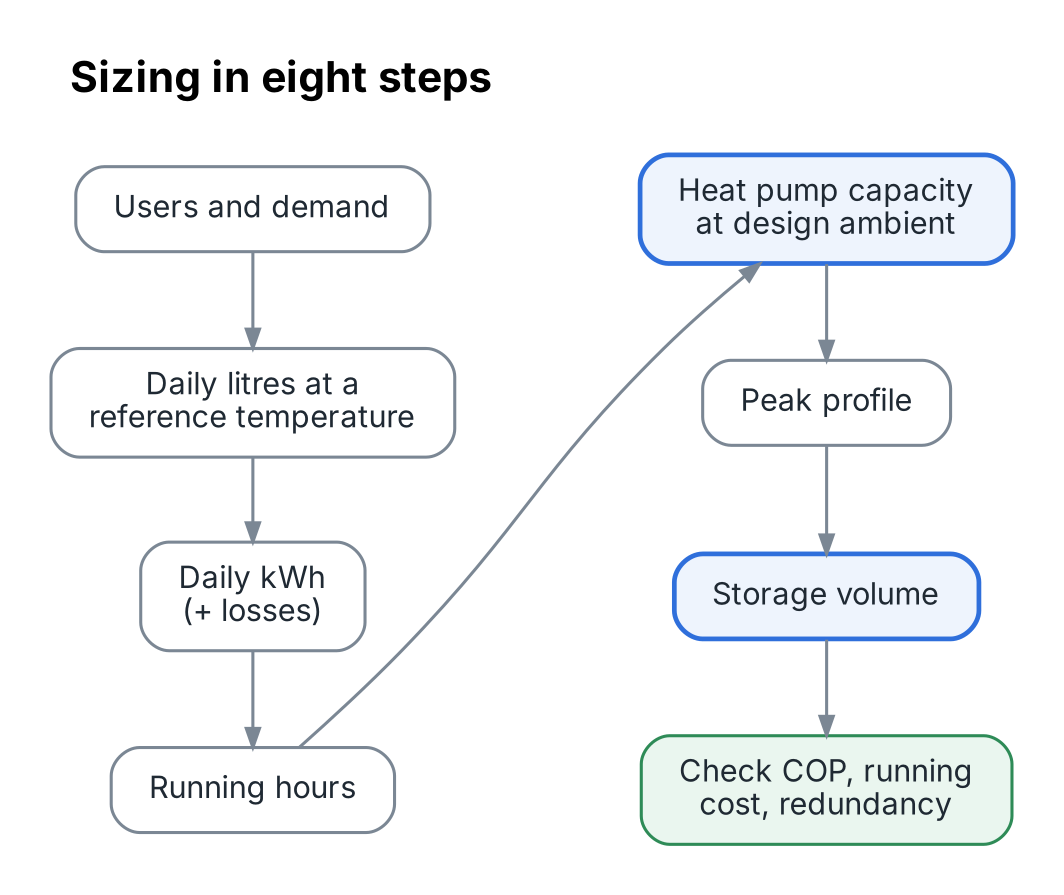
- Follow the same path every time: demand → kWh → hours → kW → storage.
- State every assumption (occupancy, temperatures, wind, cover).
- Check capacity at the design ambient, not the catalogue rating.
- Covers and insulation cut plant size more cheaply than bigger machines.
Every sizing job follows the same path — demand, energy, losses, running hours, capacity, storage — and checks the result against design conditions.
There are no comments for now.
to be the first to leave a comment.