4.4 Hotels, hostels and hospitals
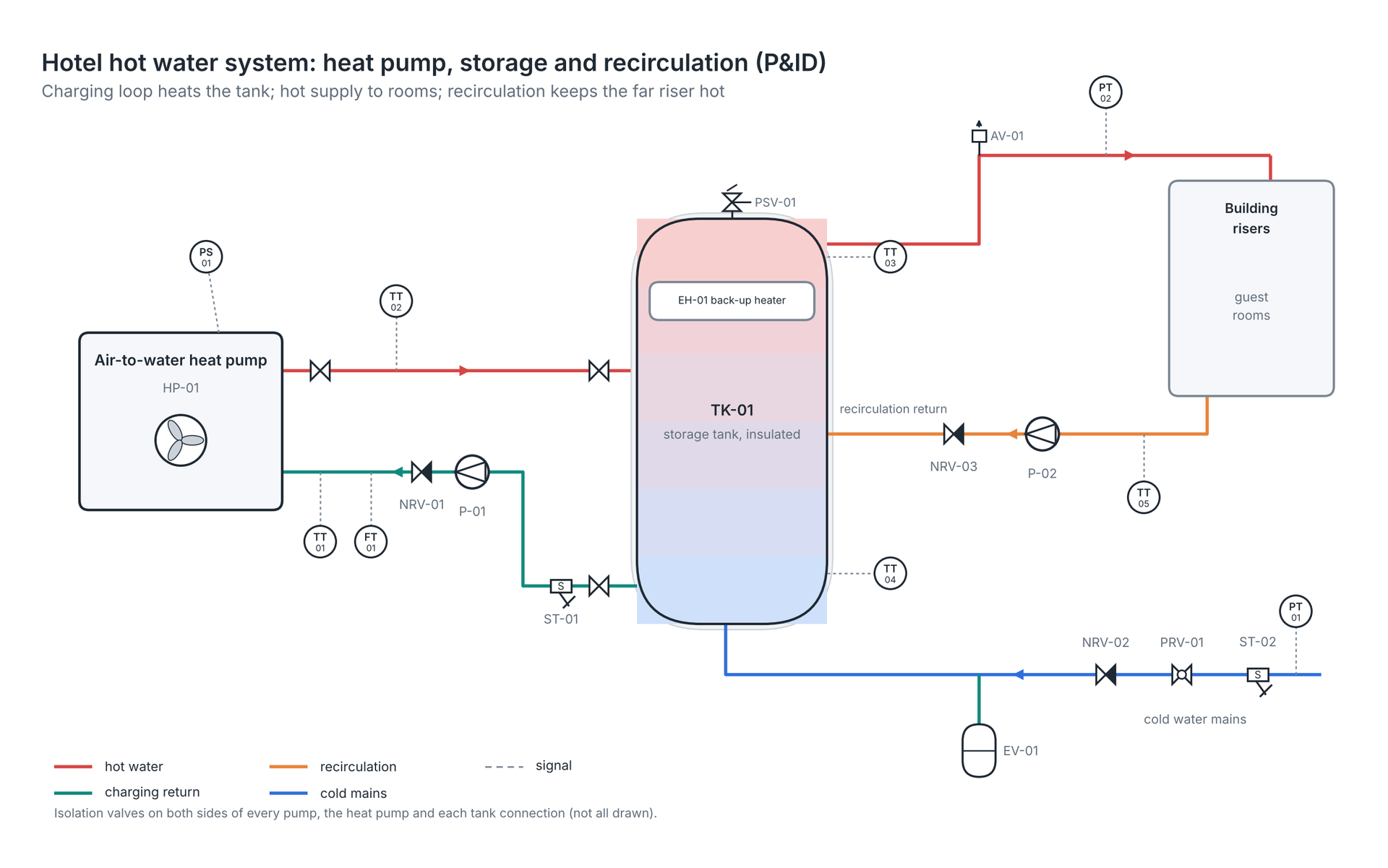
Hotels have morning and evening peaks. Their kitchens and laundries add large daytime loads. Guests expect hot water in seconds, so a recirculation loop is needed.
Hostels have short, very sharp peaks. Two hundred students may shower in 90 minutes. Storage must be generous.
Hospitals need water hot enough to control Legionella. Legionella is a bacterium that grows in warm stagnant water between about 25 °C and 45 °C. Common practice is to store at 60 °C or above and keep the return loop at 50 °C or above. Follow your local code and the hospital's infection-control team.
| Item | Hotel | Hostel | Hospital |
|---|---|---|---|
| Peak shape | Morning + evening | Very sharp morning | Spread over the day |
| Storage temperature | 55–60 °C | 55–60 °C | 60 °C or more |
| Recirculation loop | Yes | Usually | Yes, mandatory in practice |
| Special loads | Kitchen, laundry, spa | Mess kitchen | Laundry, CSSD, kitchen |
| Back-up heating | Electric or existing boiler | Electric | Always provide redundancy |
High-temperature points need boosters. A dishwasher final rinse needs about 82 °C. Do not raise the whole system to that temperature. Use a local booster heater instead.
Remember
- Hotels: two peaks plus kitchen and laundry.
- Hostels: one very sharp peak, so big storage.
- Hospitals: hygiene first — 60 °C storage, 50 °C or more on return, redundancy.
- Use local boosters for 80 °C+ points, not the whole system.
These three building types differ mainly in their peak pattern, their required temperatures and their hygiene rules.
There are no comments for now.
to be the first to leave a comment.