4.5 Swimming pools: heat-loss calculation
Key idea: A pool loses heat mainly by evaporation, so a cover saves more energy than any other measure.
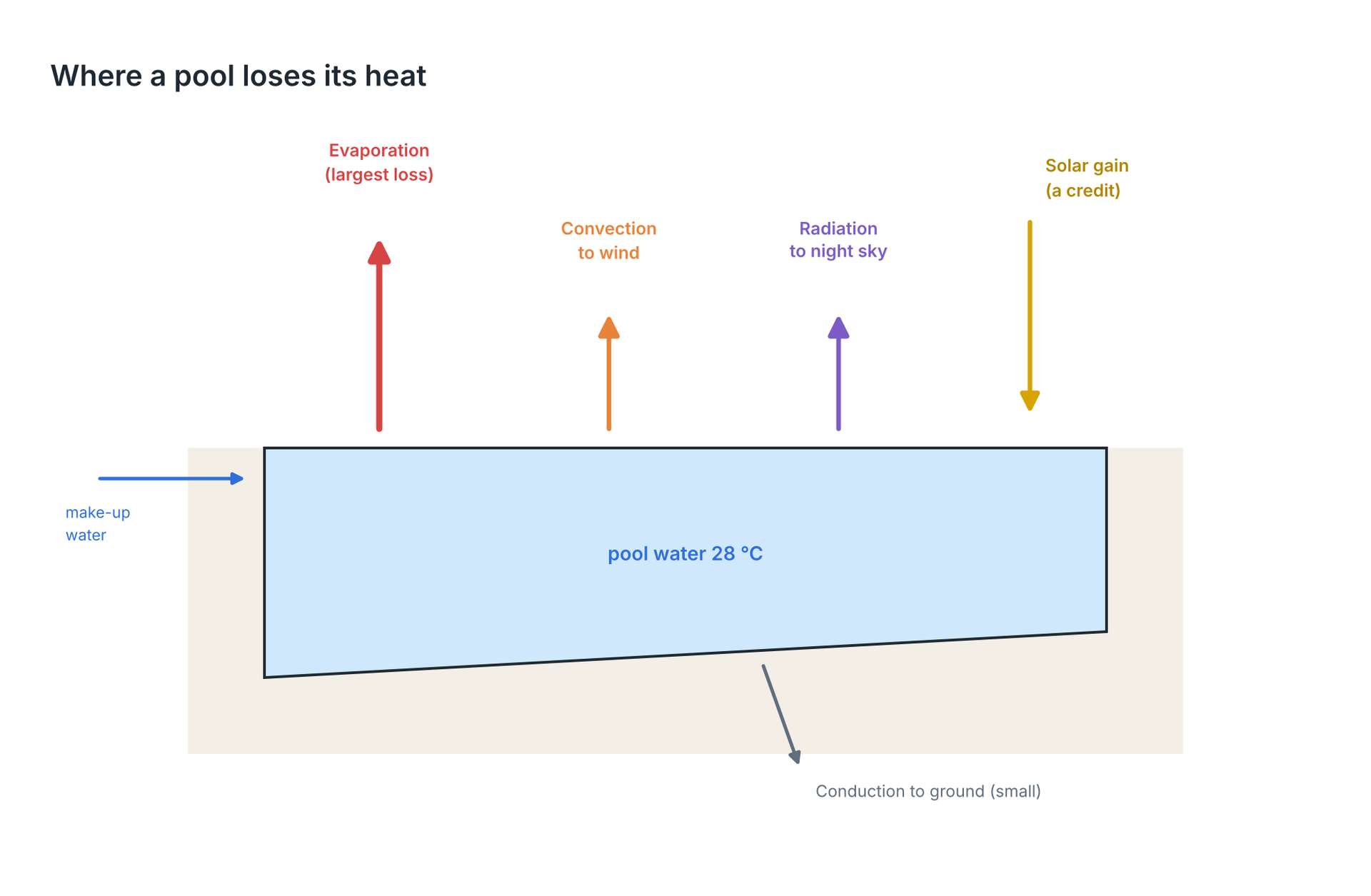
A pool loses heat four ways. Evaporation is water turning to vapour at the surface. Convection is warm water heating the air that blows across it. Radiation is heat lost to the cold sky. Conduction is heat lost through walls and floor to the ground.
Evaporation is usually half or more of the total. It depends on the vapour-pressure difference between water and air, and on wind speed. A matka cools water the same way, by evaporation.
Widely used empirical formulas:


- pw = saturation vapour pressure at water temperature; pa = actual vapour pressure of air.
- h = surface heat transfer coefficient, typical 5–10 W/m²K in light wind.
- ε = emissivity of water, about 0.95; σ = 5.67 × 10⁻⁸ W/m²K⁴.
- Tsky is often 10–15 K below air temperature on clear nights (typical).
| Saturation vapour pressure | kPa |
|---|---|
| 10 °C | 1.23 |
| 14 °C | 1.60 |
| 20 °C | 2.34 |
| 26 °C | 3.36 |
| 28 °C | 3.78 |
| 30 °C | 4.25 |
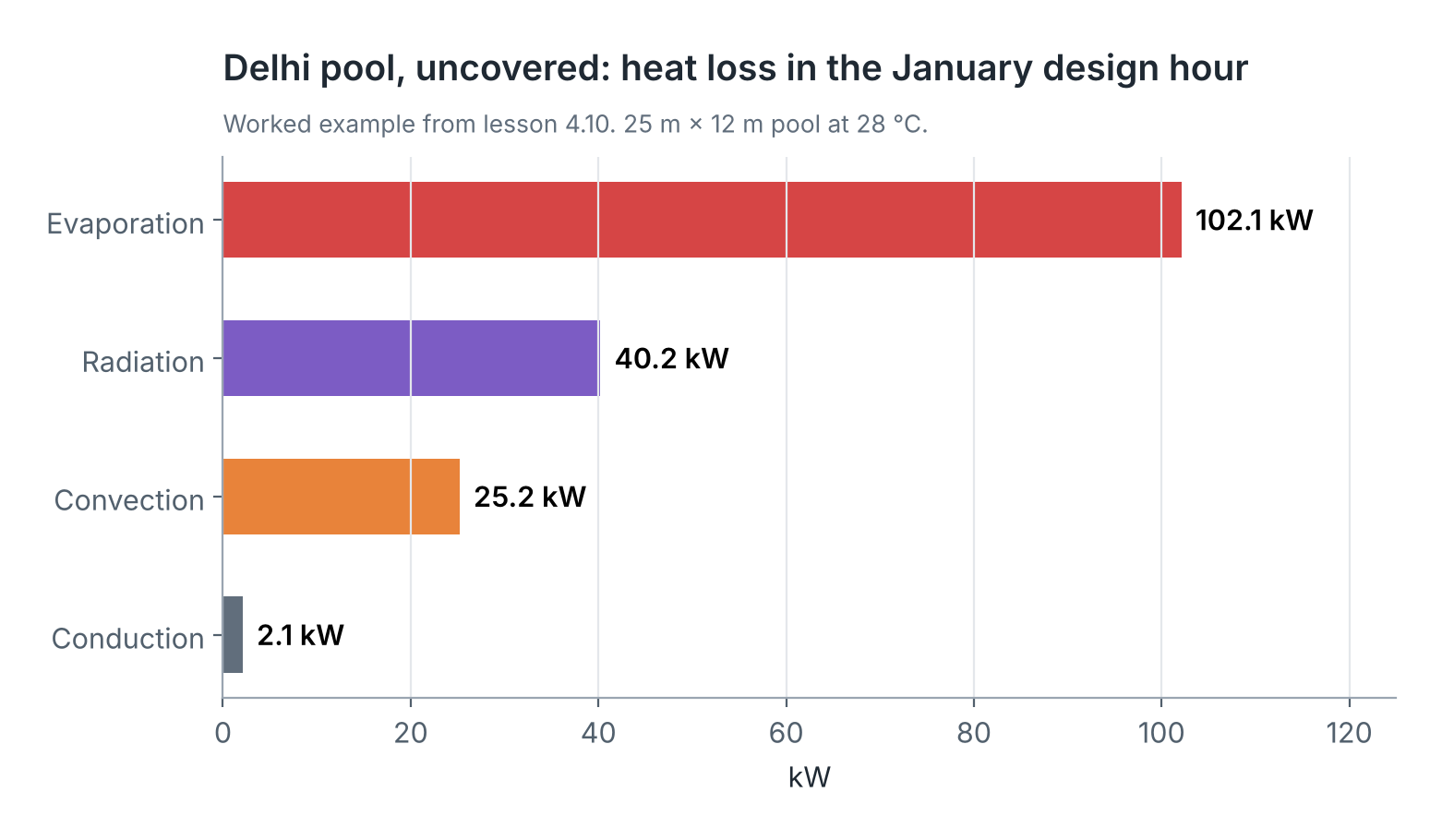
The full worked example is in Lesson 4.10.
Remember
- Evaporation is usually the biggest loss.
- A night cover typically cuts evaporation by 80–90%.
- Wind shelter (walls, hedges) reduces evaporation and convection.
- Indoor pools lose far less heat but need dehumidification.
Field tip: Measure wind at the water surface, not on the roof. Boundary walls often cut it to under 1 m/s.
A pool loses heat mainly by evaporation, so a cover saves more energy than any other measure.
Rating
There are no comments for now.
to be the first to leave a comment.