4.2 Estimating hot water demand: per person, per room, per bed
Demand figures mean nothing without a temperature. "50 litres per person" at 60 °C is about 88 litres at 45 °C (cold water 25 °C), because hot water gets mixed with cold at the tap. Always write the temperature next to the litres.
Use the figures below as starting points. Measure actual use on existing sites whenever you can. Water meters on the hot line are cheap and settle arguments.
Typical daily hot water demand (stored at 60 °C, cold water at about 25 °C). These are typical values, not standards.
| Building / user | Unit | Typical L/day at 60 °C |
|---|---|---|
| Home, economy | per person | 30–40 |
| Home, comfortable | per person | 40–60 |
| Hostel / dormitory | per bed | 30–50 |
| Hotel, budget | per room | 70–100 |
| Hotel, mid-range | per room | 100–150 |
| Hotel, luxury / resort | per room | 150–250 |
| Hospital, wards only | per bed | 70–100 |
| Hospital, incl. kitchen and laundry | per bed | 100–160 |
| Restaurant / canteen | per meal | 4–8 |
| Gym / sports shower | per shower | 15–25 |
| Staff (offices, factories) | per person | 5–10 |
Convert between temperatures with an energy balance. Hot water at temperature T₁ mixed with cold water gives the same energy as a larger volume at a lower temperature.
Worked example — convert demand to another temperature
A spec asks for 80 L per person at 45 °C. Cold water is 25 °C. What is the volume at 60 °C?
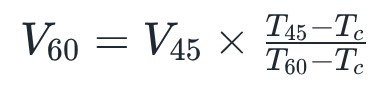
- V₆₀ = 80 × (45 − 25) ÷ (60 − 25)
- V₆₀ = 80 × 20 ÷ 35 = 45.7 L per person at 60 °C
Worked example — daily energy for an apartment block
A block has 40 flats with 4 people each. Use 45 L/person/day at 60 °C. Winter cold water in Bengaluru is about 20 °C.

- Volume = 40 × 4 × 45 = 7,200 L/day
- ΔT = 60 − 20 = 40 K
- Q = 7,200 × 40 × 0.001163 = 335 kWh/day
Remember
- Always state litres together with a temperature.
- 1 litre heated by 1 K needs 0.001163 kWh.
- Use typical tables only as a first estimate; meter real use where possible.
- Design for the coldest inlet water, usually the winter month.
Daily hot water demand equals the number of users multiplied by a typical litres-per-user figure, always stated at a reference temperature.
There are no comments for now.
to be the first to leave a comment.