4.7 Industrial process heat: dairy, food, pharma, textiles
Most factories run boilers at steam pressure for jobs that need only hot water. Each conversion from steam to hot water wastes energy. A heat pump can supply that hot water directly.
The best sites need heating and cooling together. A dairy chills milk to about 4 °C and also washes equipment at 70–80 °C. One heat pump can do both: the cold side chills, the hot side heats.
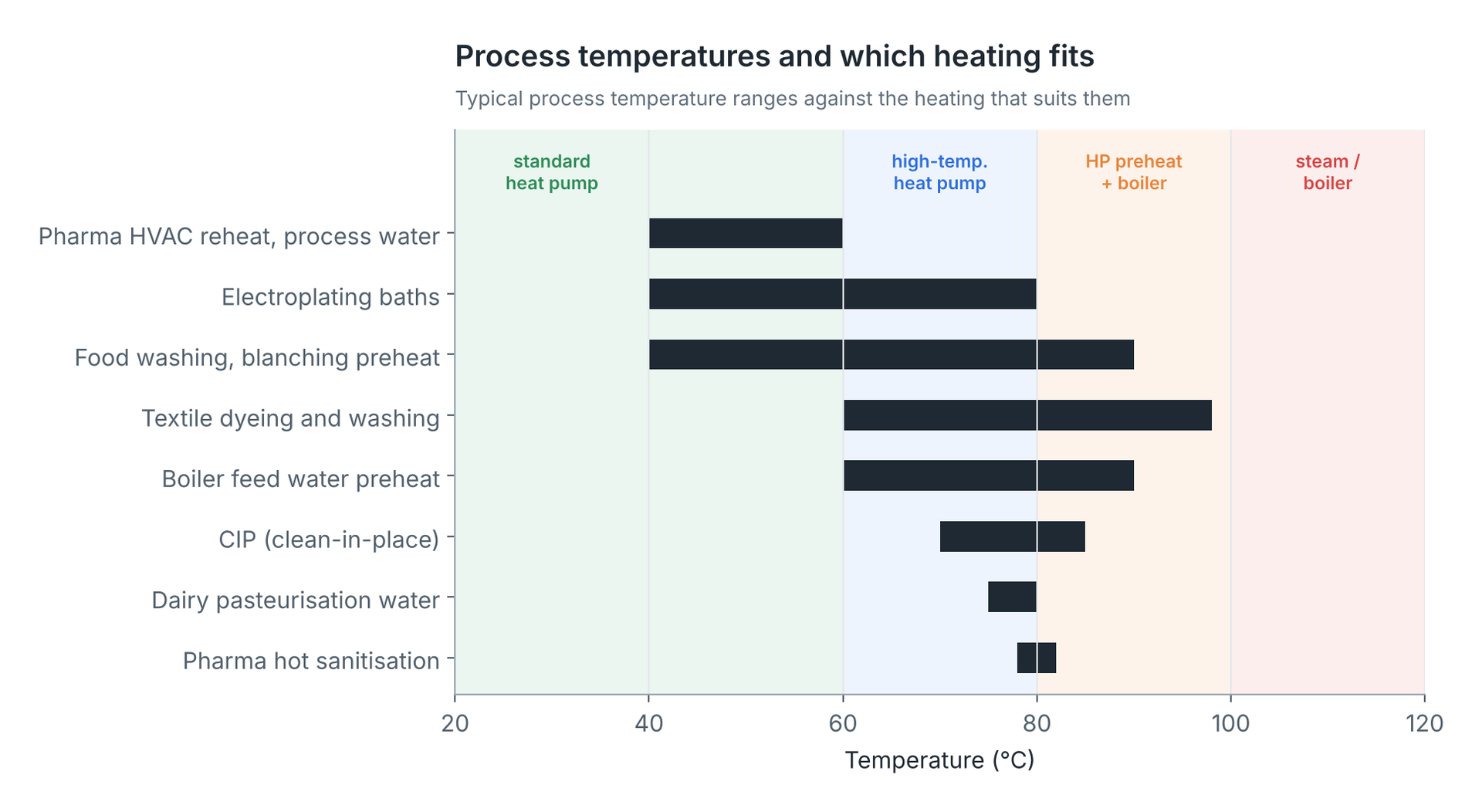
| Industry | Process | Typical temperature |
|---|---|---|
| Dairy | Pasteurisation (HTST) | 72 °C hold, water at 75–80 °C |
| Dairy / food | CIP (clean-in-place) | 70–85 °C |
| Food | Washing, blanching preheat | 40–90 °C |
| Pharma | Purified water hot sanitisation | About 80 °C |
| Pharma | HVAC reheat, process water | 40–60 °C |
| Textiles | Dyeing, washing | 60–98 °C |
| All | Boiler feed water preheat | 60–90 °C |
| Electroplating | Bath heating | 40–80 °C |
Worked example — dairy CIP hot water
A dairy uses 10,000 L/day of CIP water at 75 °C, heated from 30 °C. Today a diesel boiler (80% efficient) does this. Use example rates: diesel ₹100/L at about 10 kWh/L; electricity ₹9/kWh. Heat pump COP at 75 °C outlet, typical 2.8.

- Q = 10,000 × 45 × 0.001163 = 523 kWh/day
- Diesel = 523 ÷ (10 × 0.80) = 65.4 L → ₹6,540/day
- Heat pump electricity = 523 ÷ 2.8 = 187 kWh → ₹1,683/day
- Saving ≈ ₹4,857/day, before any value from cooling
Remember
- Hot water up to 80 °C is heat pump territory.
- Combined heating and cooling gives the highest overall value.
- Use the heat pump as a preheater for steam boilers above 80 °C.
- Waste heat (chiller condensers, compressor cooling) is an ideal source.
Many factory processes need hot water at 50–80 °C, which a heat pump can supply far more cheaply than a boiler.
There are no comments for now.
to be the first to leave a comment.