4.8 Drying and dehumidification
Drying needs two things: heat to evaporate water, and a way to remove the vapour. A conventional dryer heats air, passes it over the product and vents it outside. The heat leaves with the air.
A heat pump dryer runs in a closed loop. Moist air passes over the cold evaporator. Its moisture condenses and drains away. The same air is reheated on the condenser and sent back over the product. The dew point is the temperature at which air becomes saturated and water starts to condense.
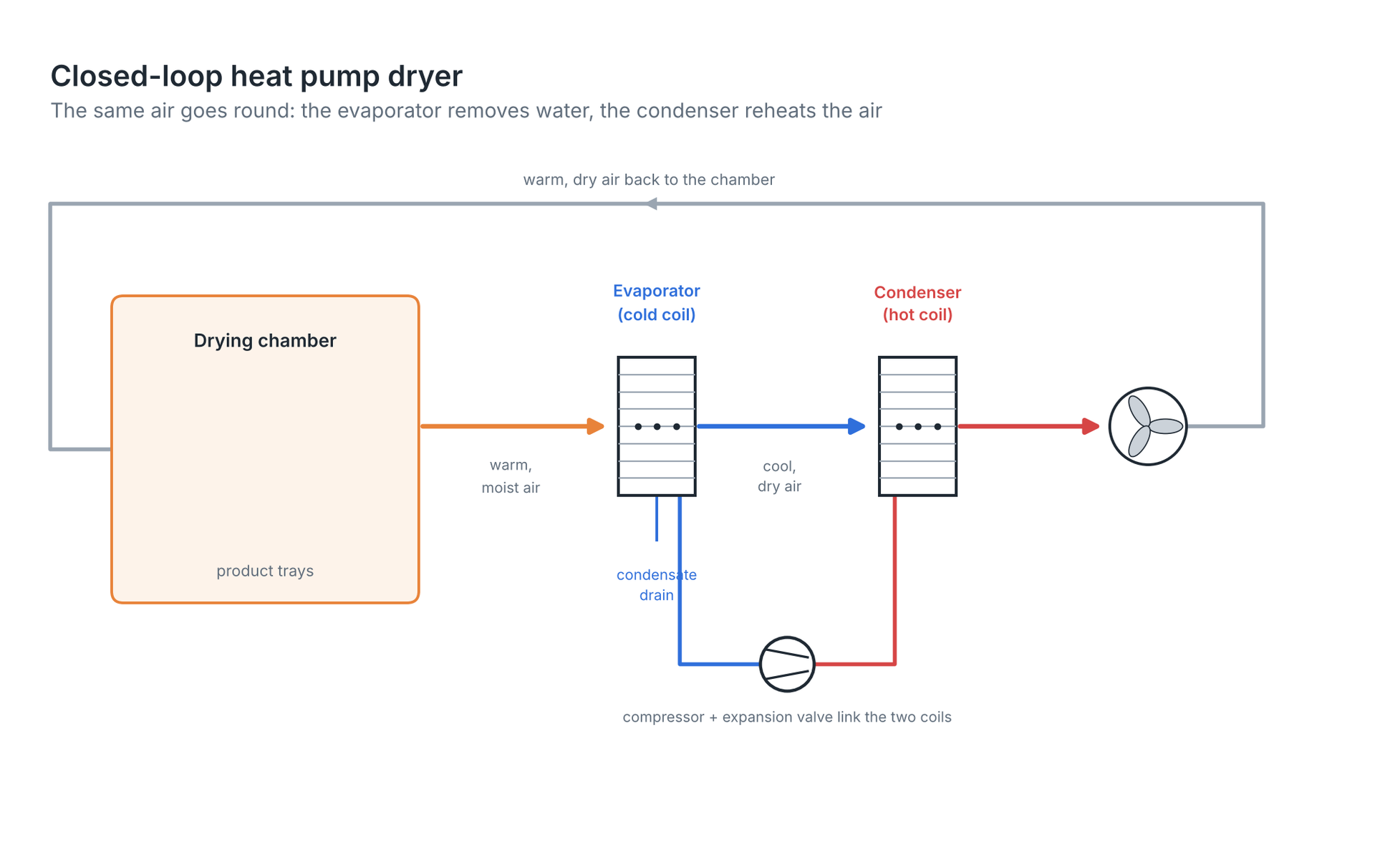
The key performance figure is SMER (specific moisture extraction rate). It is kilograms of water removed per kWh of electricity.
| Dryer type | Typical SMER (kg/kWh) | Typical air temperature |
|---|---|---|
| Electric heater, open vent | 0.3–0.9 | 50–80 °C |
| Heat pump, closed loop | 1.0–4.0 | 35–65 °C |
Low drying temperatures protect colour, aroma and nutrients. This suits spices, fruits, herbs, fish and some pharma products.
Worked example — fruit slices
A batch of 500 kg fresh fruit slices at 80% moisture (wet basis) is dried to 10%. Latent heat of water is about 0.68 kWh/kg. Heat pump SMER is 2.5 kg/kWh; a heater dryer is 0.6 kg/kWh.

- Dry solids = 500 × 0.20 = 100 kg
- Final mass = 100 ÷ 0.90 = 111.1 kg
- Water removed = 500 − 111.1 = 388.9 kg
- Heat pump: 388.9 ÷ 2.5 = 156 kWh → ₹1,404
- Heater dryer: 388.9 ÷ 0.6 = 648 kWh → ₹5,832
- Over a 20 h batch, the dryer must remove 19.4 kg/h on average.
Remember
- Size a dryer by water removed per hour, not by product weight.
- SMER compares dryers fairly.
- Closed-loop heat pump dryers work at gentle temperatures.
- Moisture removal is fastest at the start of a batch.
A heat pump dryer removes water by cooling air below its dew point and reuses the heat, so it uses far less energy than a heater-and-vent dryer.
There are no comments for now.
to be the first to leave a comment.