7.8 Evacuation and charging
Key idea: Pull a deep, steady vacuum to remove air and moisture, then charge the exact refrigerant weight the system needs.
Evacuation means removing air and water vapour from the refrigerant circuit with a vacuum pump. Water boils at very low pressure, so a deep vacuum makes moisture boil off and get pumped away. A micron gauge measures vacuum in microns of mercury (1 micron ≈ 0.133 Pa). The manifold's compound gauge is not accurate enough for this.
Evacuation steps
- Remove Schrader cores with a core tool and use short, large-bore hoses for speed.
- Connect the micron gauge as far from the pump as possible, ideally at the system.
- Run a two-stage vacuum pump with fresh oil.
- Pull down to the target. A common field target is 500 microns or lower (typical; follow the manual).
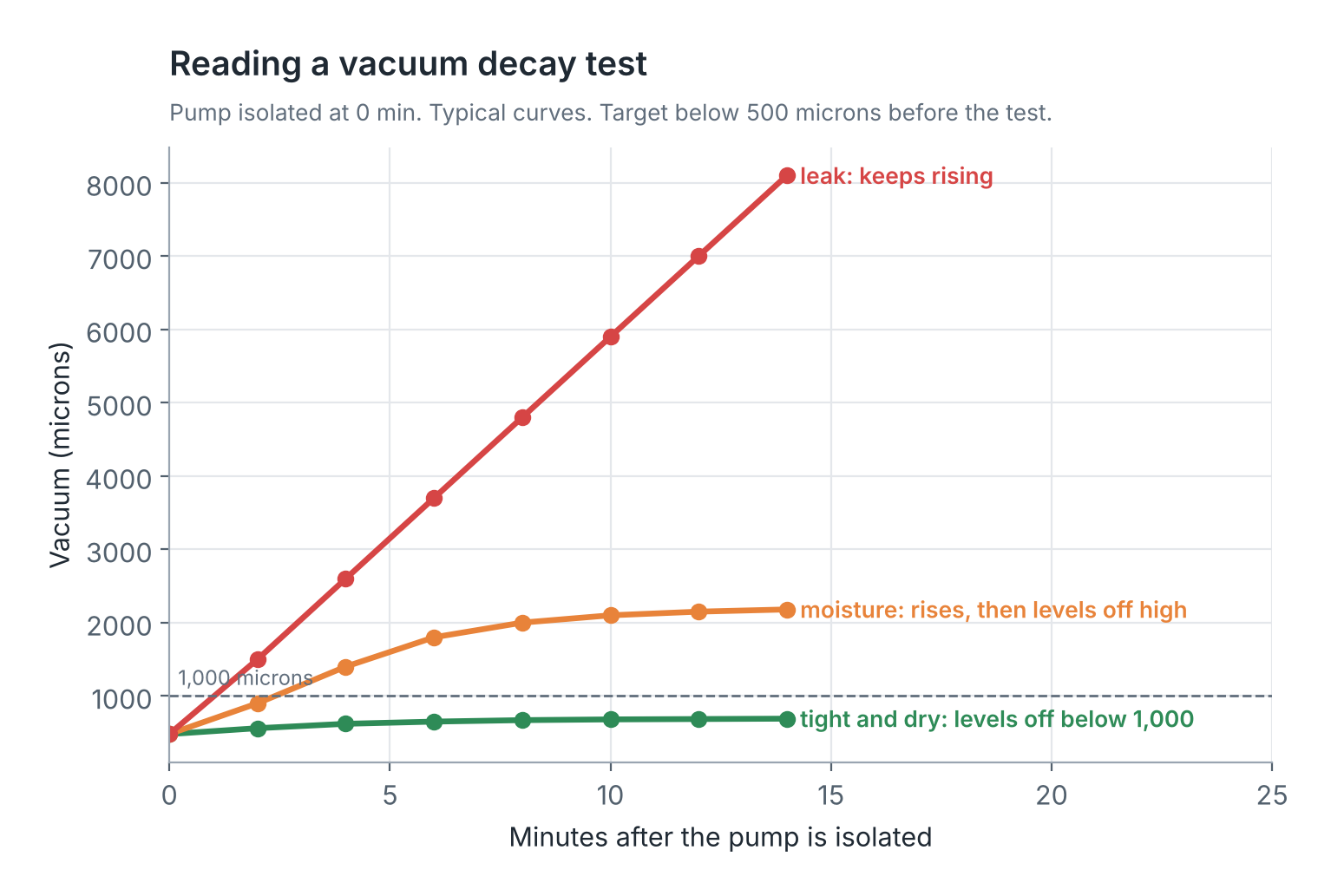
- Isolate the pump and do a decay test, typically 10–15 minutes.
- If the gauge rises and levels off below about 1,000 microns, the system is dry and tight. If it keeps rising steadily, there is a leak. If it rises and stops high, moisture remains: evacuate further.
Charging
- Charge by weight on a digital scale. Do not charge "by pressure" or "by feel of the suction line".
- Many split units are pre-charged for a set pipe length. Add extra charge per metre beyond it, as the manual states.
- Blends such as R410A and R407C must be charged as liquid. R32 is a single refrigerant, but liquid charging is still the normal practice.
- R32 and R290 are flammable (A2L and A3 safety classes). Use tools rated for them, remove ignition sources, and ventilate. R290 needs specific training.
- Record the charge on the unit label and in the commissioning sheet.
| Refrigerant | Safety class | Charge as | Notes |
|---|---|---|---|
| R410A | A1 (non-flammable) | Liquid | High pressure blend |
| R32 | A2L (mildly flammable) | Liquid (normal practice) | Single component |
| R407C | A1 | Liquid | Large glide blend |
| R134a | A1 | Liquid or vapour | Lower pressure |
| R290 (propane) | A3 (highly flammable) | Per manual only | Special training and tools |
Worked example — additional charge
A split unit in Kolkata is pre-charged for 7.5 m of pipe. The actual pipe run is 15 m. The manual says add 20 g per metre (example value) for the liquid line size used.

- Extra length: 15 − 7.5 = 7.5 m.
- Extra charge: 7.5 × 20 = 150 g.
- Weigh in 150 g as liquid, slowly, through the suction service port with the unit running (or as the manual says).
Remember
- Use a micron gauge; pressure test first, then vacuum.
- Target and decay test tell you dry, wet or leaking.
- Charge by weight; blends as liquid.
- Treat R32 and R290 as flammable: right tools, no sparks.
Field tip: Change vacuum pump oil after every wet system. Milky oil cannot pull a deep vacuum.
Pull a deep, steady vacuum to remove air and moisture, then charge the exact refrigerant weight the system needs.
Rating
There are no comments for now.
to be the first to leave a comment.