7.6 Insulation of pipes and tanks
Insulation slows heat flow through pipe and tank walls. The common material is closed-cell elastomeric foam (nitrile rubber tube). Closed cells resist water uptake, which matters in Indian monsoons. Glass wool and PUF (polyurethane foam) are used on tanks.
It works like the wall of a vacuum flask: it keeps hot water hot by slowing the heat leaving it.
| Pipe service | Typical insulation thickness | Notes |
|---|---|---|
| Hot water / heating, indoor | 13–19 mm | Thicker for larger pipes |
| Hot water / heating, outdoor | 19–25 mm | UV protection essential |
| Chilled water / cooling | 19–32 mm | Must be vapour-sealed to stop sweating |
| Refrigerant lines (split units) | 9–19 mm on both lines | Separate tubes for each line |
| Storage tanks | 50–100 mm PUF or equivalent | Cover top and nozzles too |
Outdoor protection
Sunlight breaks down most foam in one or two summers. Outdoors, cover it with aluminium cladding, UV-resistant paint or tape. Seal all joints with the maker's adhesive, not just plastic tape.
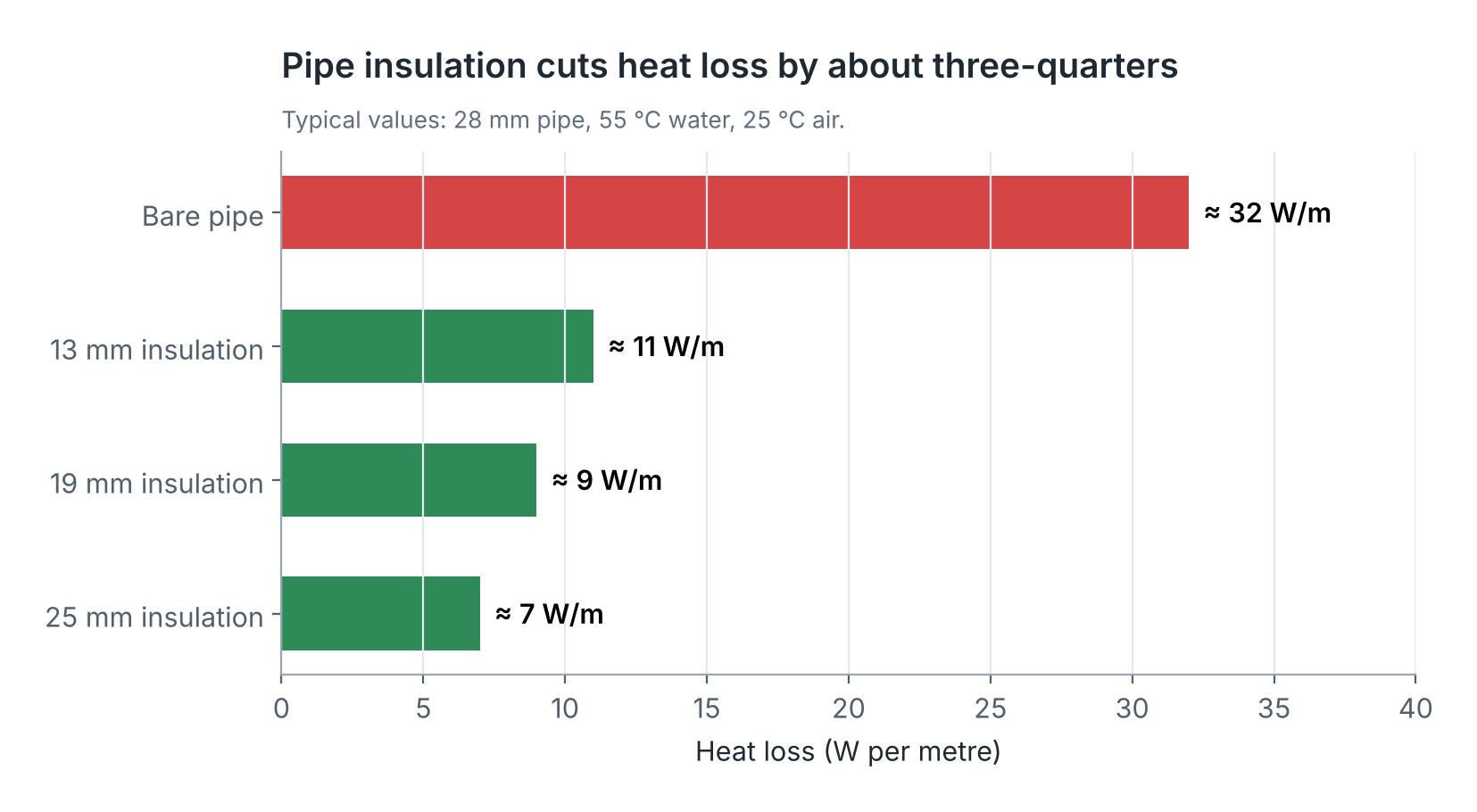
Worked example — what does bare pipe cost?
A Jaipur hostel has 20 m of 28 mm hot water pipe on the terrace at 55 °C, with air at 25 °C. Typical losses are about 32 W/m bare and 9 W/m with 19 mm insulation. Circulation runs 12 h a day. Heat pump COP 3.5. Electricity ₹9/kWh (example rate).

- Bare loss: 32 × 20 × 12 = 7,680 Wh = 7.7 kWh/day of heat.
- Insulated loss: 9 × 20 × 12 = 2,160 Wh = 2.2 kWh/day.
- Heat saved: 7.7 − 2.2 = 5.5 kWh/day.
- Electricity saved: 5.5 ÷ 3.5 = 1.57 kWh/day.
- Money saved: 1.57 × 9 = ₹14/day, about ₹5,100 a year, from roughly 20 m of insulation.
Remember
- Insulate every hot pipe, valve body and tank nozzle.
- Outdoors, foam must have UV protection.
- Chilled pipes need a continuous vapour seal or they drip.
- Keep insulation dry; wet insulation works poorly.
Heat you pay to make should reach the tap, not warm the terrace.
There are no comments for now.
to be the first to leave a comment.