7.10 Condensate drainage
Key idea: An air-source heat pump makes a lot of water from humid air and defrost, and it must drain away freely.
When outdoor air passes over the cold coil, its moisture condenses, just as a cold bottle from the fridge "sweats" on a humid day. In defrost, the ice on the coil melts and drains too. In coastal humid cities like Mumbai, Chennai and Kochi, the volume is large.
Good practice
- Drain from the unit base pan with the fitting supplied. Do not block base holes.
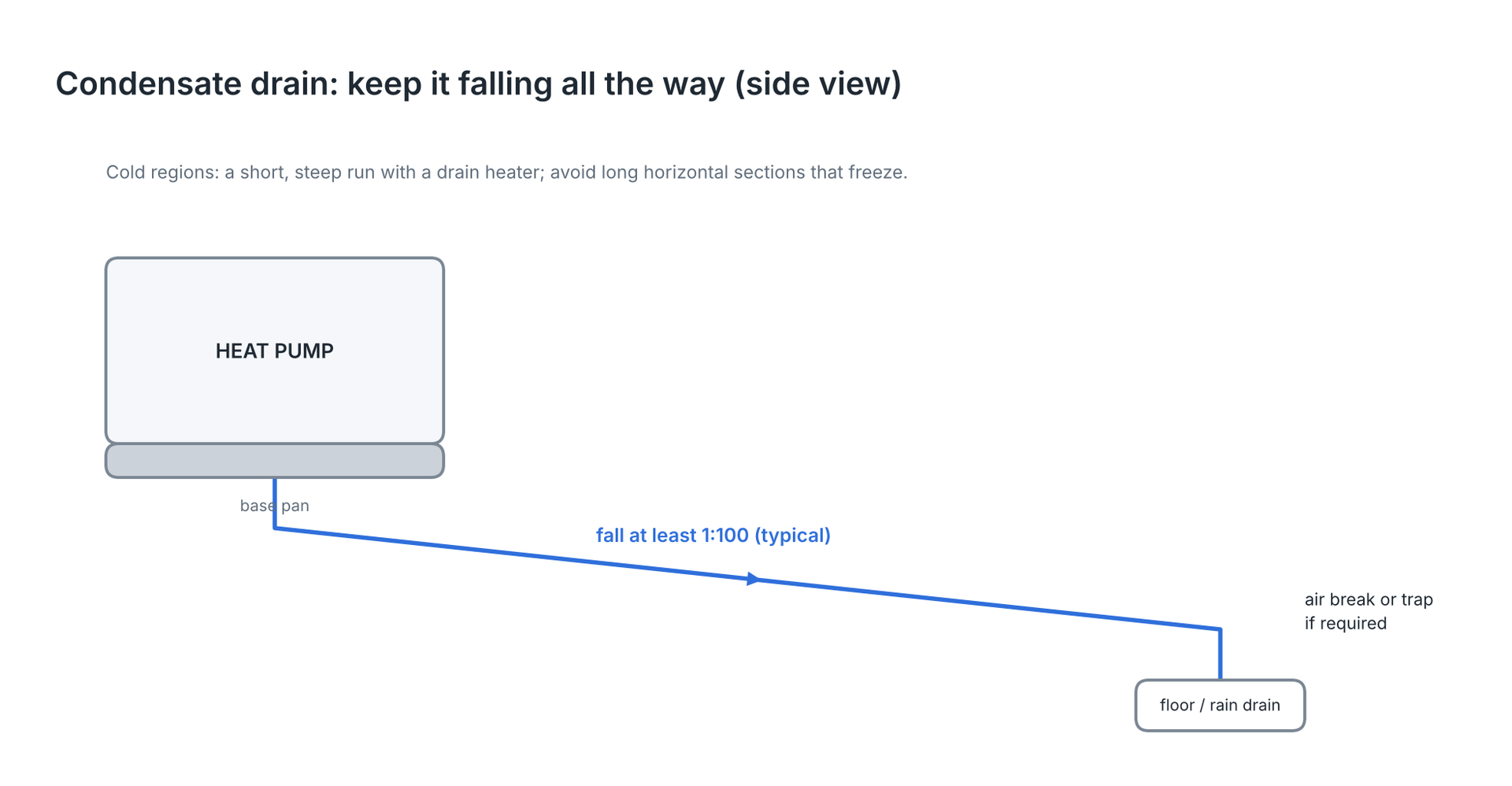
- Lay the drain pipe with a fall of at least 1:100 (1 cm per metre, typical) to a drain point, never to a walkway.
- Use a trap or air break where the manual requires it, and where draining into a sewer to stop smells.
- On roofs, route to the rainwater outlet. Water on the slab causes dampness and moss.
- In cold regions (Leh, Spiti, Kashmir, upper Himachal) drains can freeze. Keep them short and steep, and use a drain heater where the manual requires it. Ice blocking the base pan can damage the coil.
- Condensate is close to distilled water. It is soft but may carry dust and metals, so it is not drinking water. It can be reused for gardening.
Worked example — how much water?
A large air-source unit in Chennai moves 10,000 m³/h of air. Air enters at a humidity ratio of 20 g/kg (moisture per kg of dry air) and leaves at 18.5 g/kg. Air density is about 1.15 kg/m³.

- Air mass: 10,000 × 1.15 = 11,500 kg/h.
- Moisture removed: 11,500 × (0.020 − 0.0185) = 17 kg/h.
- About 17 litres per hour, roughly 400 litres in a 24-hour day. This needs a proper drain, not a bucket.
Remember
- Plan the drain at survey time; it can be many litres per hour.
- Keep a steady fall to an approved drain; never onto walkways.
- In cold regions protect the drain from freezing.
- Keep base pan holes clear of debris and leaves.
Field tip: Pour a bucket of water into the base pan at commissioning and watch where it goes.
An air-source heat pump makes a lot of water from humid air and defrost, and it must drain away freely.
Rating
There are no comments for now.
to be the first to leave a comment.