7.5 Valves, strainers, expansion vessels and air vents
| Component | Protects against | Where it goes | Typical spec |
|---|---|---|---|
| Ball valve (isolation) | Draining the whole system for service | Both sides of unit, pump, strainer | Full-bore, same size as pipe |
| Y-strainer | Dirt, scale, welding slag | Return, before pump and heat pump | Mesh typically 0.5–1 mm (follow manual) |
| Non-return valve (NRV) | Reverse flow, thermosiphon | After pump | Low-pressure-drop type |
| Expansion vessel | Pressure rise as water heats | Return side, near pump suction | Sized to system volume; pre-charged |
| Safety valve | Over-pressure | On the closed circuit, no valve between it and the heat source | Set below the weakest component's rating |
| Auto air vent | Air locks, noise, poor flow | Every high point | With isolating valve for replacement |
| Drain valve | Cannot empty or flush | Every low point | Hose-union type |
| Flexible connector | Vibration and pipe stress | At unit inlet and outlet | Rated for temperature and pressure |
A Y-strainer is a Y-shaped fitting with a mesh basket that catches dirt. In Indian borewell and tanker water, scale and sand are common. A blocked strainer is the top cause of low-flow trips.
An expansion vessel is a steel tank with a rubber diaphragm. One side has air at a set pre-charge pressure; the other side takes system water. It works like a pressure cooker's weight in reverse: it gives the water room to grow instead of venting it.
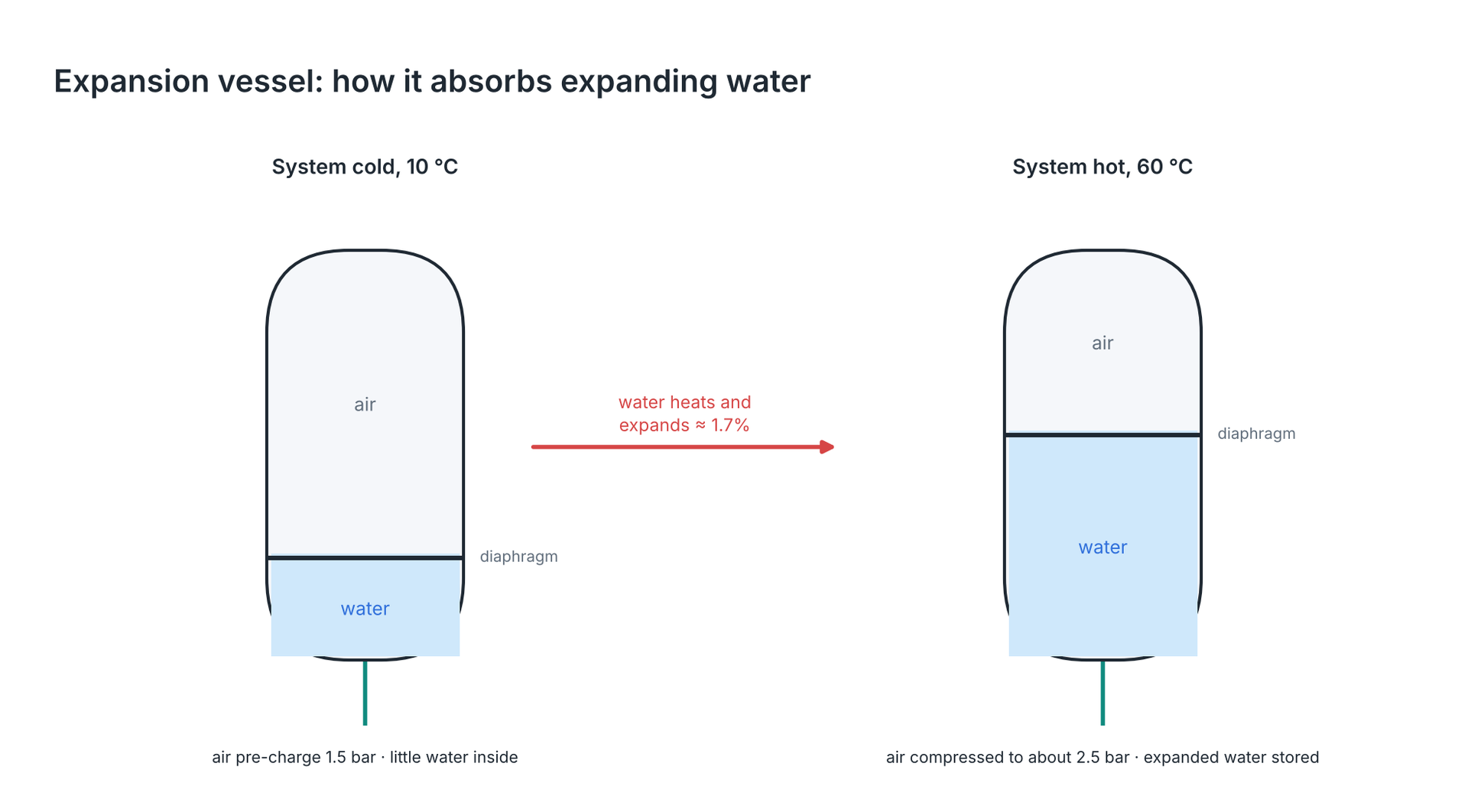
Worked example — size an expansion vessel
Closed heating loop in a Delhi school: system water 500 L, fill at 10 °C, maximum 60 °C. Pre-charge 1.5 bar(g). Safety valve 3 bar(g), so final working pressure is kept at 2.5 bar(g). Water expands about 1.7% from 10 to 60 °C (from density 999.7 to 983.2 kg/m³).
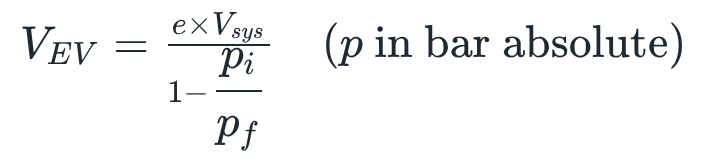
- Expansion volume: 0.0168 × 500 = 8.4 L.
- Absolute pressures: pᵢ = 1.5 + 1 = 2.5 bar(a); pf = 2.5 + 1 = 3.5 bar(a).
- Acceptance factor: 1 − 2.5 ÷ 3.5 = 0.286.
- Vessel: 8.4 ÷ 0.286 = 29.4 L.
- Choose the next size up: 35 L.
Check pre-charge with a tyre gauge before filling. Set it to about the static fill pressure at the vessel.
Remember
- Strainer before the pump and heat pump; clean it after the first week.
- Never put an isolation valve between the heat source and its safety valve.
- Size the expansion vessel from system volume; check pre-charge before filling.
- Air vents at every high point; bleed again after first run.
Each small fitting protects the heat pump from a specific enemy: dirt, air, pressure or backflow.
There are no comments for now.
to be the first to leave a comment.