7.3 Foundations, anti-vibration mounts and service access
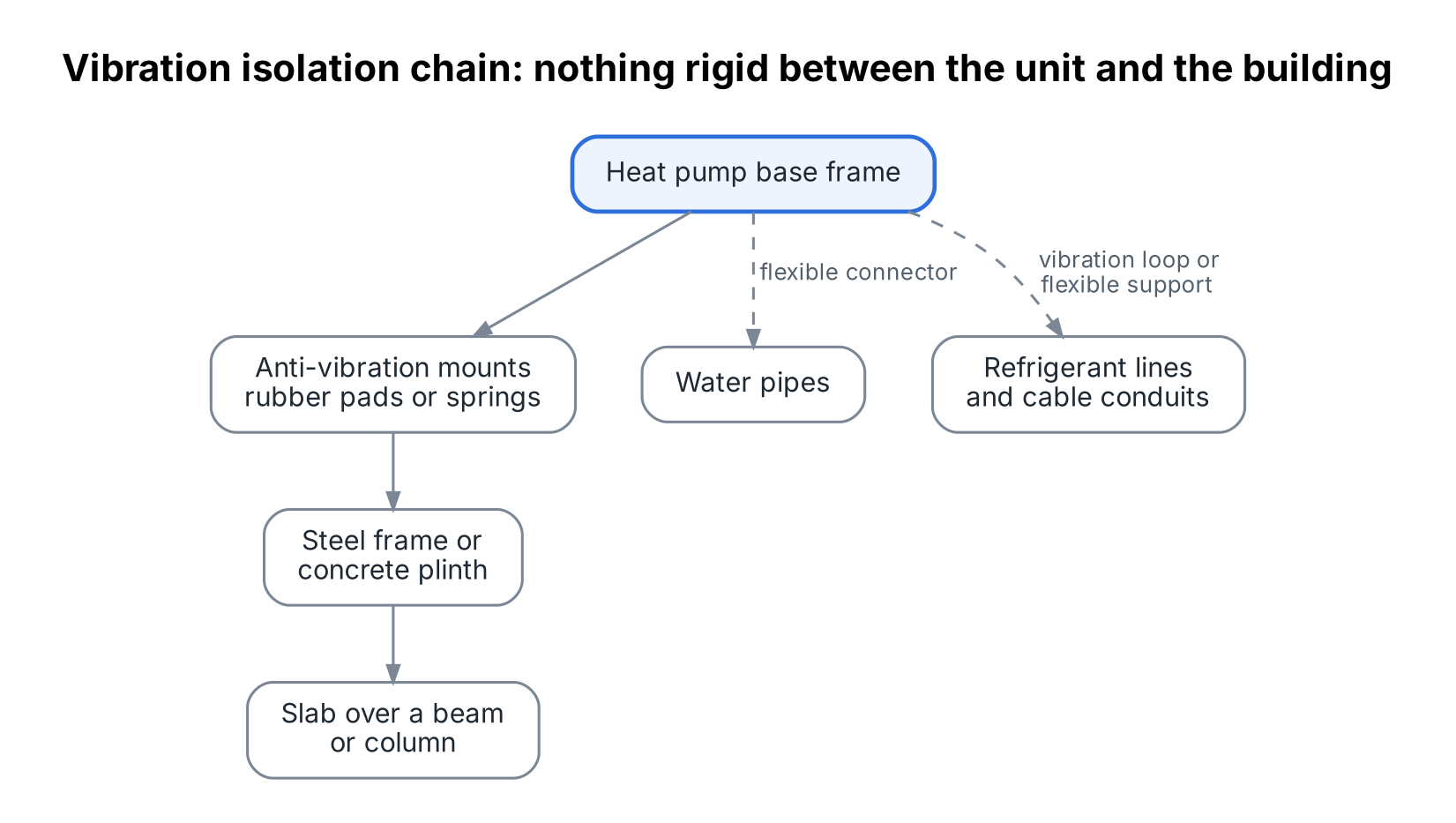
The heat pump has a compressor and fans that vibrate. A rigid bolt to a thin slab turns the whole roof into a loudspeaker. Anti-vibration (AV) mounts are rubber pads or springs that stop vibration passing into the structure.
Foundations
- Ground mounting: a concrete plinth 100–150 mm above finished ground (typical). It keeps the unit above splash water and flooding.
- Roof mounting: place the unit on a steel frame or plinth that sits over beams or columns, not mid-span on a thin slab. Ask a structural engineer for heavy units.
- Level within the manual's tolerance (often a few mm per metre). An unlevel unit can hold water in its drain pan and strain pipe joints.
- In high-wind or cyclone areas (Odisha, coastal Andhra, Gujarat coast) bolt the unit or frame down.
- In snow areas (Leh, Kashmir, upper Himachal) raise the unit above expected snow depth so the coil and drain stay clear.
Anti-vibration mounts
| Mount type | Typical static deflection | Use |
|---|---|---|
| Ribbed rubber / neoprene pad | 2–5 mm | Small and medium units on ground or strong slab |
| Rubber-in-shear mount | 5–10 mm | Medium units on roofs |
| Spring mount (with restraint) | 15–25 mm | Large units on light structures, near bedrooms |
Static deflection (δ) is how far the mount squashes under the unit's weight. More deflection means a lower natural frequency and better isolation.
Worked example — will a rubber pad isolate the compressor?
A unit sits on rubber pads that deflect 3 mm. The compressor runs at 2,900 rpm (48 Hz).

- Natural frequency: 15.8 ÷ √3 = 15.8 ÷ 1.73 = 9.1 Hz.
- Frequency ratio: r = 48 ÷ 9.1 = 5.3.
- Transmissibility: T = 1 ÷ (5.3² − 1) = 1 ÷ 27.1 = 0.037, so about 4% passes through.
- Isolation ≈ 96%. Good.
- Now an inverter compressor slowing to 20 Hz: r = 20 ÷ 9.1 = 2.2; T = 1 ÷ (4.84 − 1) = 0.26. Only 74% isolation. On a light roof near bedrooms, softer (spring) mounts help.
Isolation only works when r is above about 1.4 (√2). Near r = 1 the mount makes vibration worse (resonance).
Service access
Leave room to open every panel, remove the compressor and pull the fan. Keep isolation valves, strainers and the electrical isolator reachable without a ladder where possible. On roofs, provide a safe walkway and a fixed anchor for a harness.
Remember
- Plinth or frame on beams, not on a thin mid-span slab.
- Mounts must deflect enough; check isolation at low inverter speed too.
- Bolt down in windy areas; raise above snow in cold regions.
- Flexible connectors on all pipes leaving the unit.
A solid, level base plus correct anti-vibration mounts stops noise, cracked pipes and early compressor failure.
There are no comments for now.
to be the first to leave a comment.