7.7 Refrigerant piping for split units: brazing, nitrogen purge, pressure test
A split heat pump has the compressor or the water heat exchanger in separate units joined by refrigerant pipes. Those pipes must stay clean and dry inside. Moisture and oxide scale cause acid, blocked expansion valves and burnt compressors.
Brazing is joining copper at high temperature (above 450 °C) using a filler rod. Copper-to-copper joints commonly use copper-phosphorus rods; copper-to-brass or steel needs a silver rod with flux. Hot copper reacts with air and forms black oxide flakes inside the pipe. Flowing nitrogen through the pipe while brazing pushes the air out and stops this.
Safety first
- Use only oxygen-free dry nitrogen (OFN). Never use oxygen or compressed air: oxygen with oil can explode.
- Always use a nitrogen regulator. A full cylinder can be above 150 bar.
- Keep a fire extinguisher and a wet cloth or heat shield at the joint. Protect valves and sensors from heat.
- Work in ventilated space. Nitrogen displaces oxygen in closed rooms.
- Recover any refrigerant first; never braze a pipe that holds refrigerant.
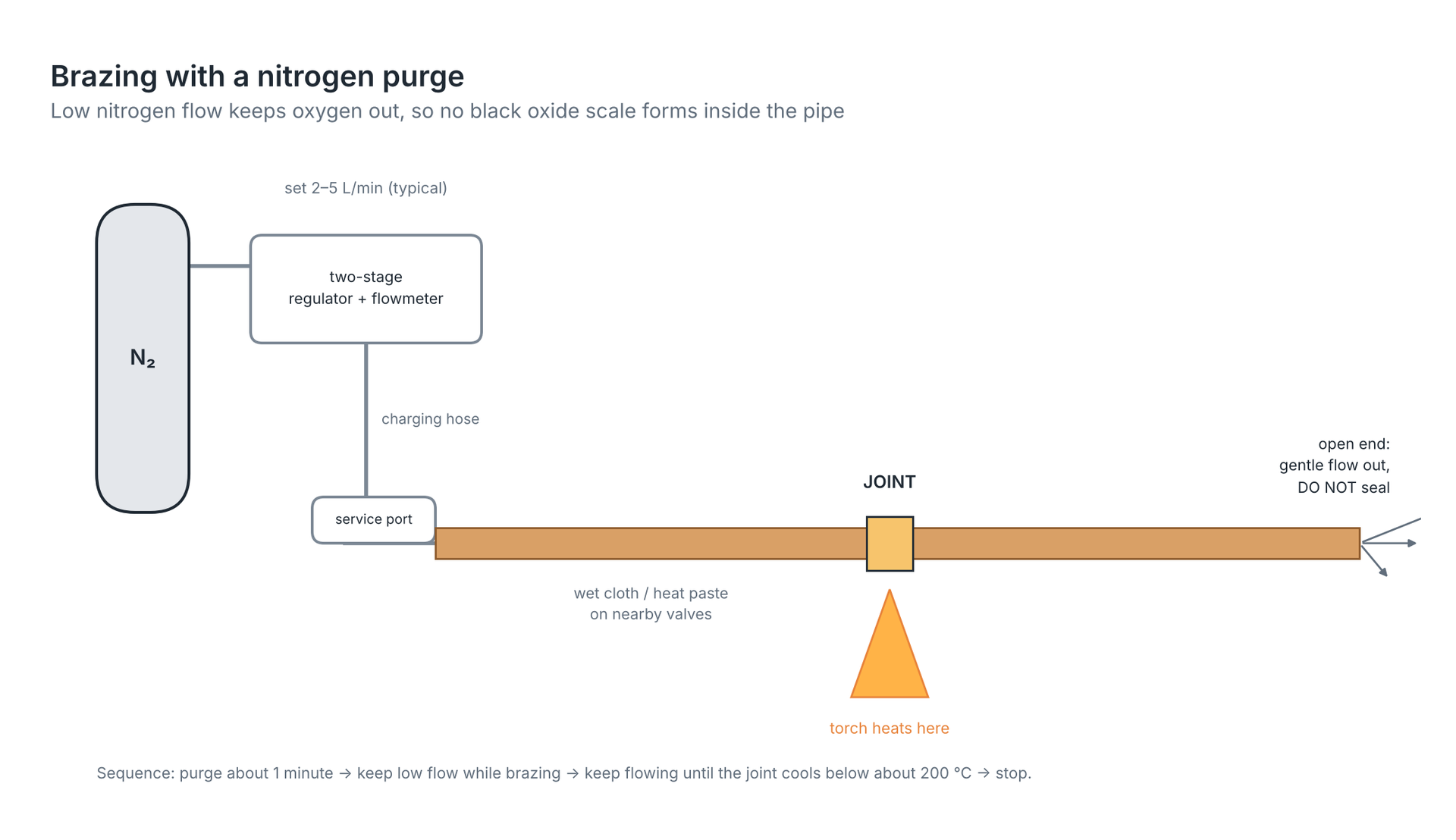
Sequence: purge for about a minute to displace air → keep low flow while brazing → keep flowing until the joint cools below about 200 °C (no colour) → stop.
Good practice
- Cut copper with a tube cutter, not a hacksaw. Ream the burr. Cap pipe ends until joined.
- Use refrigeration-grade copper (cleaned and capped). Plumbing copper is not dry inside.
- Bend with a bender; keep bend radius per the tool. Avoid kinks.
- Support pipes with clamps at typical intervals of 1–1.5 m. Insulate each line separately.
- For long vertical rises on suction lines, follow the manual on oil traps.
Pressure test
After brazing, test with dry nitrogen before evacuation.
- Pressurise in stages (for example, 5 bar, then higher). Check for gross leaks at each stage.
- Reach the test pressure in the manual. For R32 and R410A systems this is often around 38–42 bar on the high side (typical; always follow the manual and never exceed the unit's rated pressure).
- Soap-test every joint and flare.
- Hold. Typical practice is a few hours minimum and 24 h for larger systems. Record pressure and ambient temperature at start and end.
- Pressure changes about 1% for every 3 °C change in temperature at these pressures. Correct for this before calling a leak.
Worked example — temperature-corrected hold test
A split system in Lucknow is pressurised to 40.0 bar(g) at 6 pm at 32 °C. Next morning at 24 °C it reads 39.0 bar(g). Is it leaking?

- p₁ = 40.0 + 1 = 41.0 bar(a); T₁ = 32 + 273 = 305 K; T₂ = 24 + 273 = 297 K.
- Expected p₂ = 41.0 × 297 ÷ 305 = 39.9 bar(a) = 38.9 bar(g).
- Measured 39.0 bar(g). The drop is explained by cooling. No leak indicated.
Remember
- Braze only with nitrogen flowing; never with oxygen or air in the pipe.
- Always regulate nitrogen; never connect a cylinder directly.
- Pressure-test before vacuum; vacuum does not find small leaks well.
- Correct the hold-test result for temperature.
Clean, dry, leak-free copper joints made under nitrogen are the foundation of a reliable split system.
There are no comments for now.
to be the first to leave a comment.