7.2 Location, airflow, clearances and noise
An air-to-water heat pump pulls heat from outdoor air through its finned coil (evaporator). If the cold discharge air loops back to the inlet, the coil sees colder air. This is called recirculation. Output and COP (coefficient of performance, heat out ÷ electricity in) fall, and defrost becomes more frequent.
It is like a person breathing their own exhaled air in a closed lift. Each breath is worse than the last.
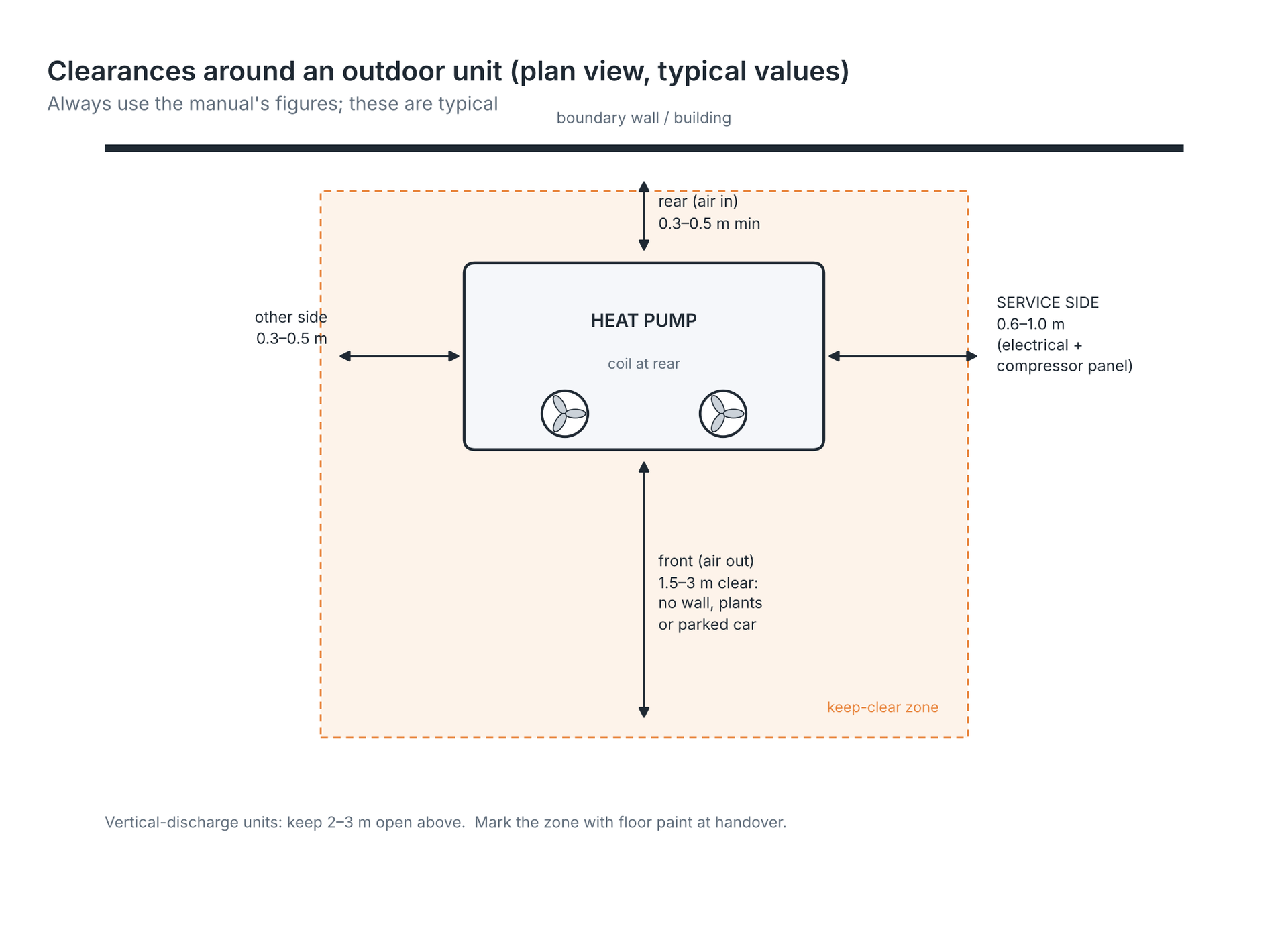
Typical clearances
Always use the manufacturer's manual. The figures below are typical starting points only.
| Side | Typical minimum clearance | Why |
|---|---|---|
| Air inlet (coil side, rear) | 0.3–0.5 m | Coil must draw air evenly |
| Air outlet (fan side, front) | 1.5–3 m clear | Stop discharge air bouncing back |
| Service side (electrical / compressor panel) | 0.6–1.0 m | Technician must open panel and work |
| Other side | 0.3–0.5 m | Airflow and pipe access |
| Top (vertical fan units) | 2–3 m open sky; no roof slab just above | Hot / cold air must rise away |
| Between two units side by side | 0.5–1.0 m typical | Avoid one unit breathing the other's air |
Noise
Sound pressure level (dB(A), what the ear hears at a point) falls with distance. In open space it drops about 6 dB each time the distance doubles. Hard surfaces near the unit reflect sound back and add to the level.
| Placement | Typical addition |
|---|---|
| Free-standing in open space | 0 dB |
| Against one wall | about +3 dB |
| In a corner (two walls) | about +6 dB |
| In a corner under a slab (three surfaces) | about +9 dB |
India's Noise Pollution (Regulation and Control) Rules set residential-area limits of 55 dB(A) by day and 45 dB(A) at night. Keep units away from bedroom windows, both yours and the neighbour's.
Worked example — noise at a neighbour's window
A unit's datasheet gives 60 dB(A) at 1 m. It is placed in a corner in a Pune housing society. The neighbour's bedroom window is 8 m away.

- Distance loss: 20 × log₁₀(8) = 20 × 0.90 = 18 dB.
- Free-field level: 60 − 18 = 42 dB(A).
- Corner reflection: +6 dB → 48 dB(A).
- Night limit is 45 dB(A). This location fails at night.
- Moving the unit out of the corner to a single wall: 42 + 3 = 45 dB(A). Borderline. Better to add distance or run quiet-mode at night.
Remember
- Keep the outlet path clear; recirculation kills COP.
- Use the manual's clearances; the table above is typical only.
- Corners and slabs amplify noise; distance reduces it.
- Do not face the fan outlet towards a neighbour's window or a narrow gap between buildings.
An air-source heat pump is only as good as the air it can breathe, so give it free inlet air and let the outlet air escape.
There are no comments for now.
to be the first to leave a comment.