2.9 What drives COP: temperature lift and operating conditions
Temperature lift is condensing temperature minus evaporating temperature. A small lift is like pumping water up one floor. A big lift is like pumping it up to the tenth floor. The higher the climb, the more work per litre.
Physics sets a ceiling called the Carnot COP. It uses absolute temperatures in kelvin (°C + 273.15). Real heat pumps typically reach about 40–60% of Carnot COP, because of compressor losses, heat exchanger temperature differences and pressure drops.
So COP rises when:
- the source is warmer (summer air in Chennai beats winter air in Delhi);
- the delivery water is cooler (45 °C needs less lift than 65 °C);
- heat exchangers are clean and correctly sized (smaller approach temperatures);
- water and air flows are correct.
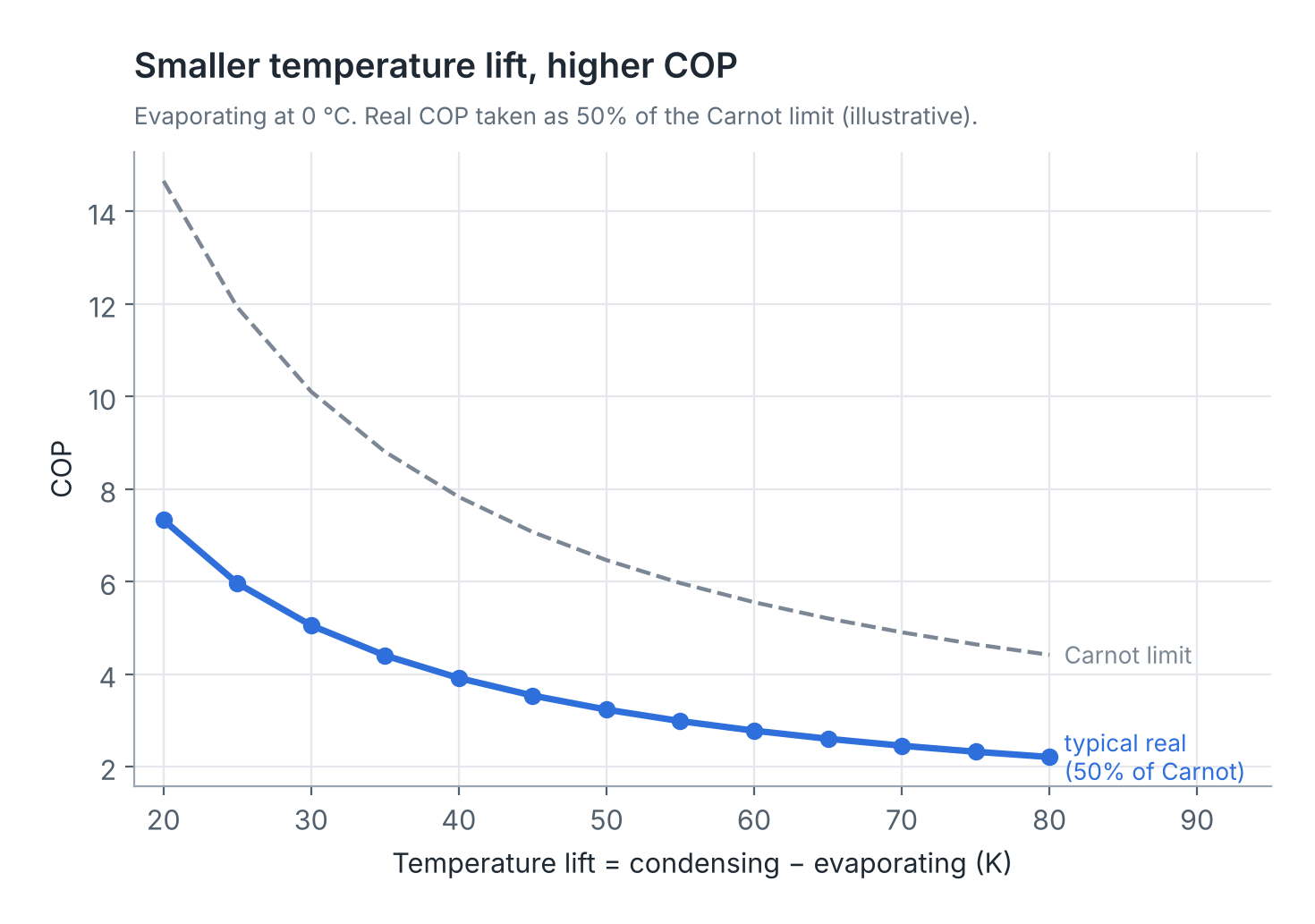
| Temperature lift (K) | Condensing temp (°C) | Carnot COP | Approx. real COP (50% of Carnot) |
|---|---|---|---|
| 20 | 20 | 14.7 | 7.3 |
| 30 | 30 | 10.1 | 5.1 |
| 40 | 40 | 7.8 | 3.9 |
| 50 | 50 | 6.5 | 3.2 |
| 60 | 60 | 5.6 | 2.8 |
| 70 | 70 | 4.9 | 2.5 |
All rows assume an evaporating temperature of 0 °C, so condensing temperature equals the lift.
Worked example — same unit, Chennai summer vs Delhi winter, water at 55 °C.

- Assume condensing at 60 °C (5 K above water) = 333.15 K.
- Chennai, air 32 °C, evaporating about 24 °C = 297.15 K. Lift = 36 K. Carnot COP = 333.15 ÷ 36 ≈ 9.3. Real at 50% ≈ 4.6.
- Delhi winter, air 8 °C, evaporating about 0 °C = 273.15 K. Lift = 60 K. Carnot COP = 333.15 ÷ 60 ≈ 5.6. Real at 50% ≈ 2.8.
- Daily 17.4 kWh of heat (from lesson 2.1): Chennai 17.4 ÷ 4.6 ≈ 3.8 kWh ≈ ₹34; Delhi 17.4 ÷ 2.8 ≈ 6.2 kWh ≈ ₹56 (₹9/kWh example rate).
Remember
- Lift is the main driver of COP.
- Lower the delivery temperature whenever the application allows.
- Carnot COP is a ceiling; real units reach about half of it (typical).
- Always quote COP with its test conditions (air and water temperatures).
COP depends mostly on temperature lift — the gap between the source temperature and the delivery temperature; the smaller the lift, the higher the COP.
There are no comments for now.
to be the first to leave a comment.