2.3 Compressors: rotary, scroll, reciprocating, screw, inverter
The compressor raises the refrigerant's pressure. Most heat pump compressors are hermetic, meaning motor and pump are sealed in one welded shell. The motor is cooled by the suction gas flowing over it.
Rotary compressors use a rolling piston inside a cylinder. They are small, cheap and common in split ACs and small heat pumps. Scroll compressors use two spiral scrolls, one fixed and one orbiting. Gas is trapped and squeezed toward the centre. Scrolls are quiet, efficient and reliable in the mid range.
Reciprocating compressors use pistons, like a car engine. They are rugged and easy to repair but noisier. Screw compressors use two meshing rotors. They suit large industrial capacities.
Inverter is not a separate pump type. It is a drive that changes the motor speed. Rotary and scroll compressors are often inverter-driven. A fixed-speed compressor runs at full speed or stops. An inverter compressor slows down to match the load, like a car cruising instead of braking and accelerating.
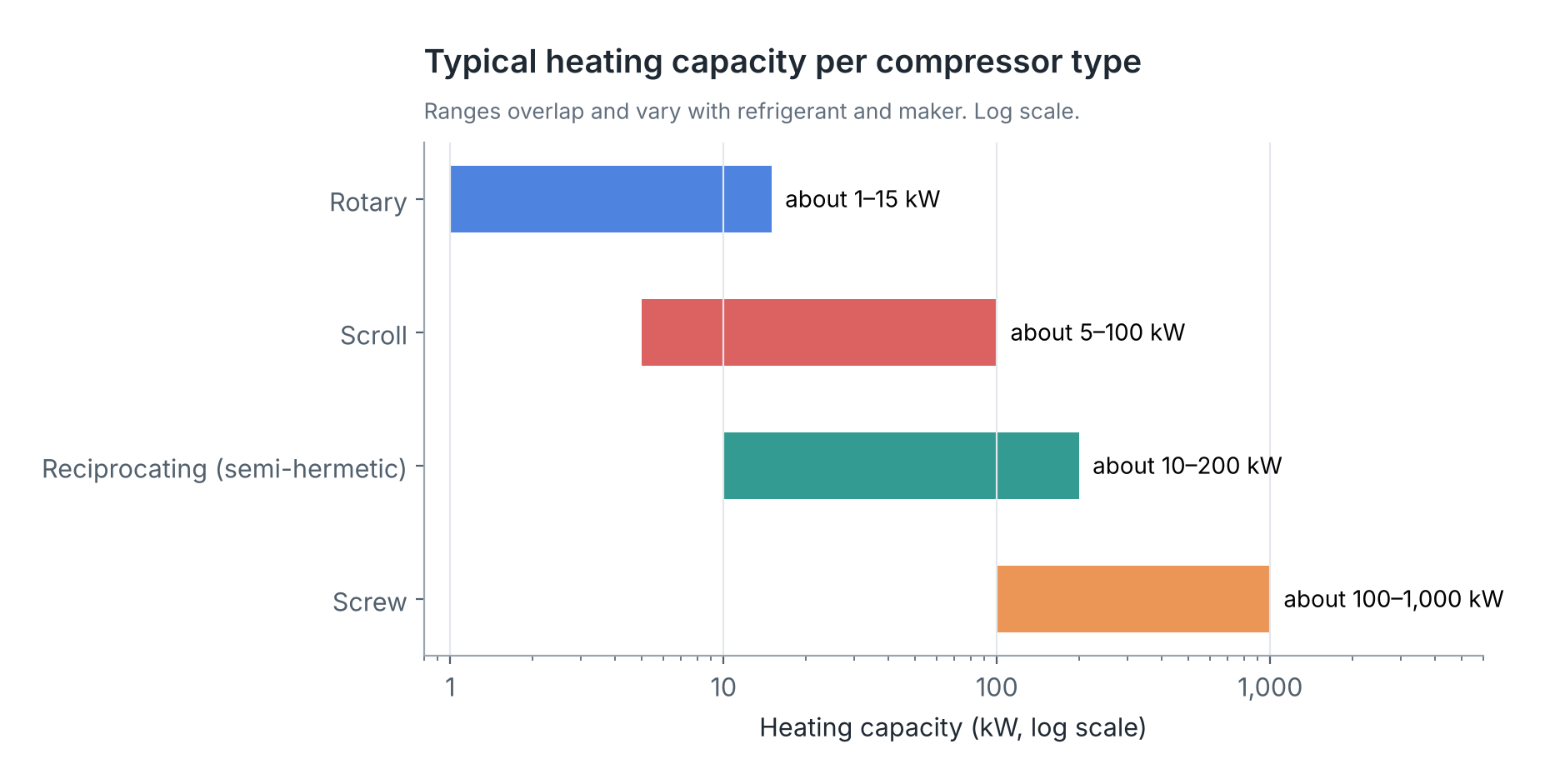
| Type | Typical capacity per compressor | Strengths | Limits | Common use |
|---|---|---|---|---|
| Rotary | about 1–15 kW | Compact, low cost | Less efficient at large sizes | Domestic water heaters, splits |
| Scroll | about 5–100 kW | Quiet, efficient, few moving parts | Not field-repairable (hermetic) | Domestic to commercial units |
| Reciprocating | about 10–200 kW | Rugged, repairable (semi-hermetic) | Noise, vibration, valve wear | Older and industrial plants |
| Screw | about 100 kW and above | Large capacity, continuous duty | High cost, oil management | Industrial process heat |
| Inverter drive (on rotary/scroll) | — | Matches load, soft start, better part-load COP | Electronics sensitive to voltage and heat | Variable-load applications |
Remember
- Most heat pump compressors are hermetic and suction-gas cooled.
- Rotary for small, scroll for mid, screw for large.
- Inverter is a speed control, not a pump design.
- Liquid entering the compressor ("slugging") can break it; superheat prevents this.
The compressor is the heart of the heat pump; its type sets capacity range, efficiency, noise and how well it handles part load.
There are no comments for now.
to be the first to leave a comment.