2.2 The vapour compression cycle, step by step
A refrigerant is a fluid chosen because it boils at a low temperature. Water boils at 100 °C at sea level. In a pressure cooker, the higher pressure makes water boil at about 120 °C. Pressure sets the boiling point. A heat pump uses this rule: low pressure for boiling cold, high pressure for condensing hot.
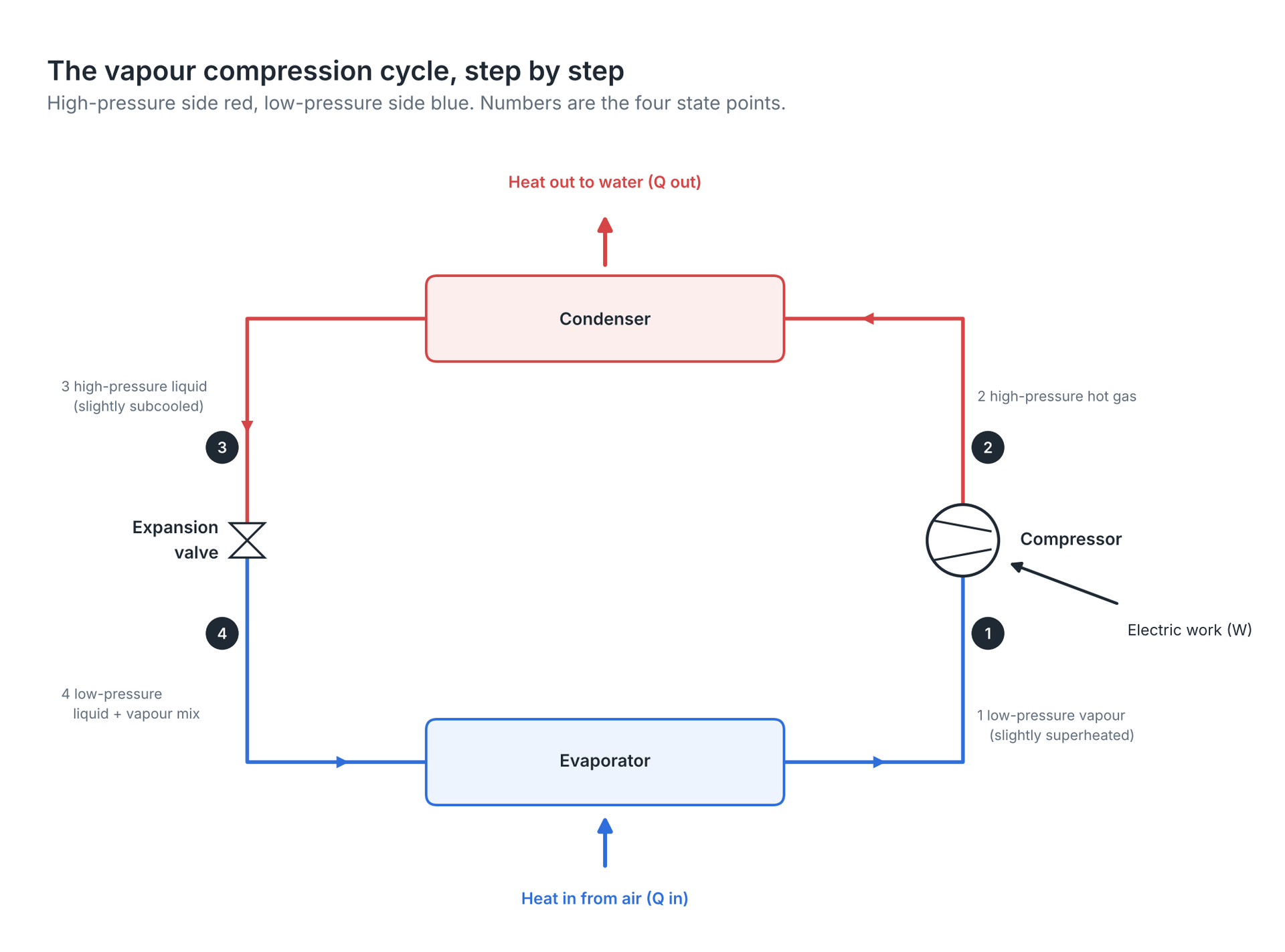
The cycle has four parts. Follow one kilogram of refrigerant around the loop.
- Evaporation (1 ← 4). Cold, low-pressure liquid enters the evaporator. It boils by taking heat from outdoor air or water. It leaves as a slightly superheated vapour, meaning a few degrees warmer than its boiling point.
- Compression (1 → 2). The compressor squeezes the vapour. Pressure and temperature rise sharply. Hot gas at perhaps 70–100 °C (typical) leaves the compressor.
- Condensation (2 → 3). The hot gas enters the condenser. It gives its heat to the water and turns back into liquid. It leaves slightly subcooled, meaning a few degrees below its condensing point.
- Expansion (3 → 4). The liquid passes through an expansion device. Pressure drops suddenly. Part of the liquid flashes to vapour and the mix becomes very cold. It returns to the evaporator.
Sweat cools your skin the same way: as it evaporates, it takes heat from you. Evaporation always absorbs heat.
| Point | Location | Pressure | Phase | Typical temperature (water heating, 25 °C air) |
|---|---|---|---|---|
| 1 | Compressor suction | Low | Superheated vapour | about 15–20 °C |
| 2 | Compressor discharge | High | Hot superheated gas | about 70–100 °C |
| 3 | Condenser outlet | High | Subcooled liquid | about 50–55 °C |
| 4 | Evaporator inlet | Low | Cold liquid-vapour mix | about 10–15 °C |
(Values are typical and depend on refrigerant and conditions.)
Worked example — energy balance on a unit.

- A unit draws W = 3 kW at the compressor.
- Its evaporator absorbs Qevap = 9 kW from air.
- Condenser output Qcond = 9 + 3 = 12 kW.
- COP = 12 ÷ 3 = 4.0.
Remember
- Pressure controls the boiling point of the refrigerant.
- Low side absorbs heat; high side rejects heat.
- Four parts: evaporator, compressor, condenser, expansion device.
- Superheat protects the compressor; subcooling protects the expansion device.
A refrigerant boils to absorb heat at low pressure, is compressed, then condenses to release heat at high pressure, and the cycle repeats.
There are no comments for now.
to be the first to leave a comment.