2.5 The condenser and heat exchangers: plate, shell-and-tube, tube-in-tube, coil-in-tank
Key idea: The condenser hands the refrigerant's heat to the water; its type decides size, water-side pressure drop and how well it tolerates scale.
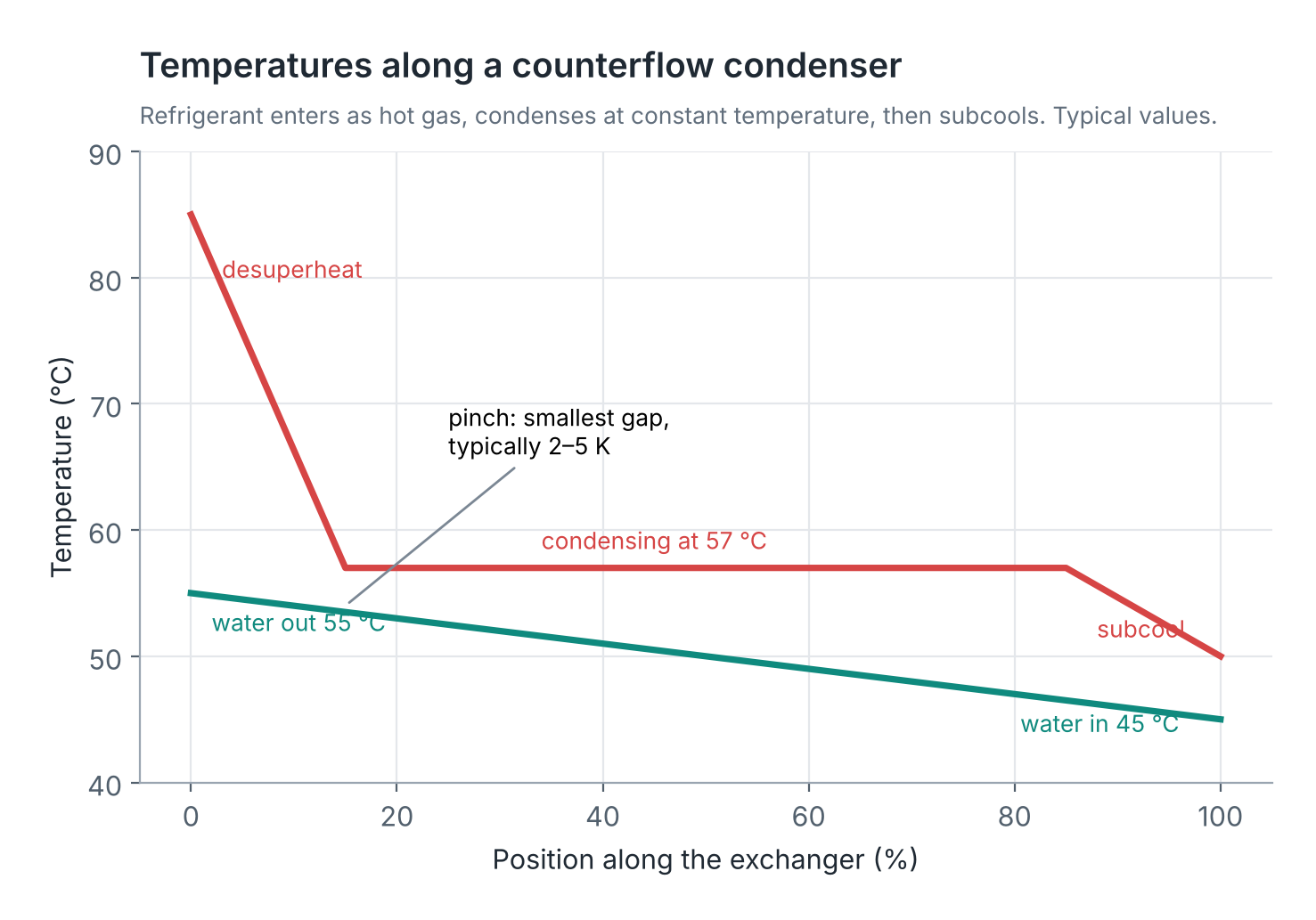
In the condenser, hot refrigerant gas gives up heat in three zones. First it desuperheats (hot gas cools to condensing temperature). Next it condenses (gas turns to liquid at constant temperature). Last it subcools (liquid cools a few degrees more).
Water and refrigerant should flow in opposite directions. This is counterflow. It lets the water leave hotter and keeps the temperature difference even along the length.
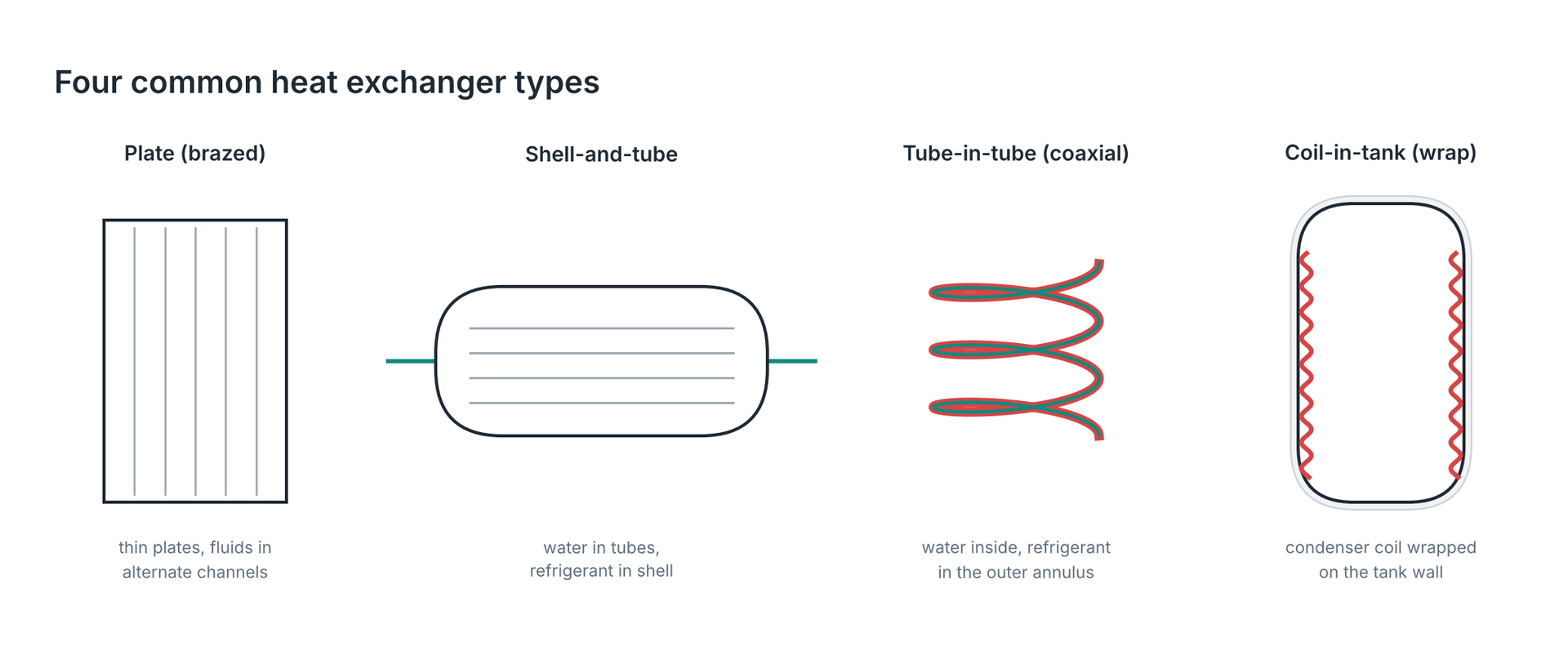
Four types are common:
- Brazed plate heat exchanger (BPHE): stacked stainless plates brazed together. Very compact and efficient. Narrow channels can scale or block with hard water.
- Shell-and-tube: water in tubes, refrigerant in the shell (or the reverse). Bulky but tolerant of dirt and easy to clean mechanically.
- Tube-in-tube (coaxial): one tube inside another. Simple and robust, often used in pool heaters and small units.
- Coil-in-tank: a copper coil wrapped on or immersed in the storage tank. No water pump needed. Slower heat transfer.
| Type | Compactness | Scale tolerance | Cleaning | Typical use |
|---|---|---|---|---|
| Brazed plate | Very high | Low | Chemical descaling only | Domestic, commercial, process |
| Shell-and-tube | Low | High | Mechanical (rod) and chemical | Large commercial, industrial |
| Tube-in-tube | Medium | Medium | Chemical | Pool heaters, small units |
| Coil-in-tank | — (part of tank) | Medium | Hard to reach | Small domestic all-in-one |
Worked example — water flow through a 10 kW condenser with 5 K rise.
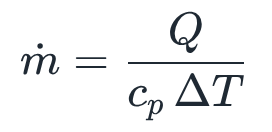
- Q = 10 kW. cp = 4.186 kJ/kg·K. ΔT = 5 K.
- m = 10 ÷ (4.186 × 5) = 0.478 kg/s.
- 0.478 kg/s × 3,600 ≈ 1,720 kg/h ≈ 1,720 LPH.
Remember
- Condensers work in three zones: desuperheat, condense, subcool.
- Counterflow gives the best temperatures.
- Plate exchangers are compact but scale-sensitive.
- Water flow must match the design ΔT.
Field tip: Many Indian borewell and municipal supplies are hard. Use a strainer and softener, and descale plate exchangers on schedule.
The condenser hands the refrigerant's heat to the water; its type decides size, water-side pressure drop and how well it tolerates scale.
Rating
There are no comments for now.
to be the first to leave a comment.