2.6 Expansion devices: capillary, TXV, EEV
The expansion device sits between condenser and evaporator. It works like the nozzle on a garden hose. A small opening holds back pressure and lets a controlled flow through.
Capillary tube: a long thin copper tube with a fixed bore. Cheap, no moving parts. It cannot adjust to changing load, so it suits small units with steady conditions, like fridges.
Thermostatic expansion valve (TXV): a mechanical valve with a sensing bulb clamped on the suction line. If superheat rises, the bulb pressure opens the valve more. If superheat falls, it closes. It self-adjusts within its design range.
Electronic expansion valve (EEV): a valve moved by a stepper motor. A controller reads suction temperature and pressure, calculates superheat and sets the valve position. It responds fast and works over a wide range. Most inverter heat pumps use an EEV.
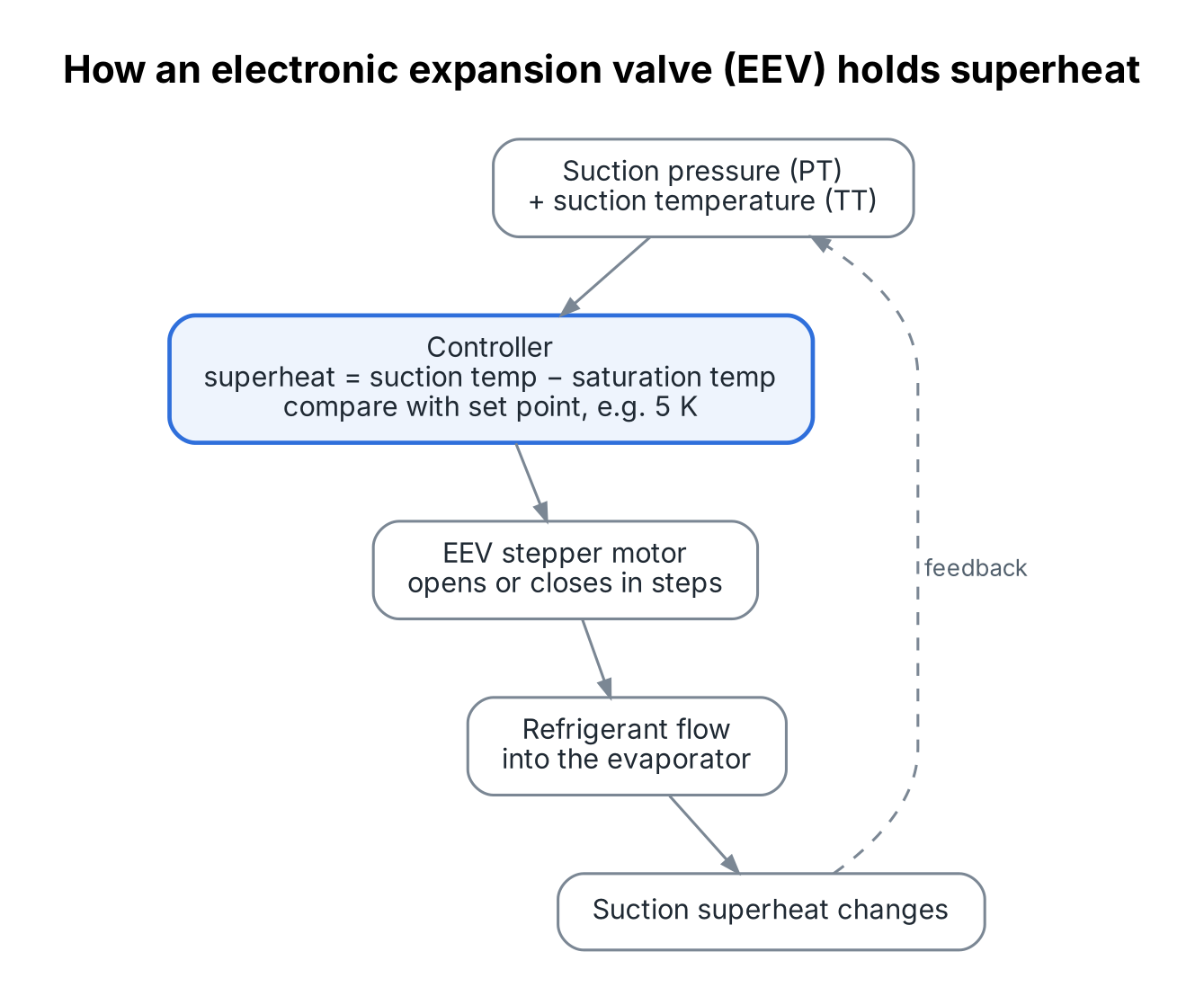
| Device | Adjusts to load? | Cost | Typical use |
|---|---|---|---|
| Capillary tube | No (fixed) | Lowest | Small fixed-speed units |
| TXV | Yes, mechanically | Medium | Fixed-speed commercial units |
| EEV | Yes, electronically, wide range | Highest | Inverter units, wide operating range |
Worked example — measuring superheat in the field.

- Suction gauge reads a pressure whose saturation temperature (from the refrigerant P-T chart) is 2 °C.
- Clamp thermometer on suction line near the compressor reads 8 °C.
- Superheat = 8 − 2 = 6 K. This is within a typical target of about 4–8 K.
Subcooling is measured the same way on the liquid line: saturation temperature at discharge pressure minus liquid line temperature.
Remember
- The expansion device creates the low-pressure side.
- Capillary is fixed; TXV and EEV adjust.
- EEVs control superheat using sensors and a controller.
- Superheat too low risks liquid return; too high wastes evaporator surface.
The expansion device drops the refrigerant from high to low pressure and meters just enough flow to keep the evaporator full without flooding the compressor.
There are no comments for now.
to be the first to leave a comment.