2.7 Controls, sensors and safety devices
The controller is the unit's brain, usually a microprocessor board. It reads sensors, runs the compressor, fan, pump and valves, and logs faults.
Temperature sensors are usually NTC thermistors. NTC means negative temperature coefficient: resistance falls as temperature rises. They are placed on water inlet and outlet, discharge, suction, coil and outdoor air.
Pressure transmitters give a continuous pressure reading. Pressure switches are on–off safety devices. The high-pressure switch (HP) opens if discharge pressure is too high, for example when water flow stops. The low-pressure switch (LP) opens if suction pressure is too low, for example on gas leak or heavy frost.
The 4-way reversing valve swaps the roles of the two heat exchangers. It is used for defrost and, in some units, for cooling mode. A flow switch proves water is flowing before the compressor may start.
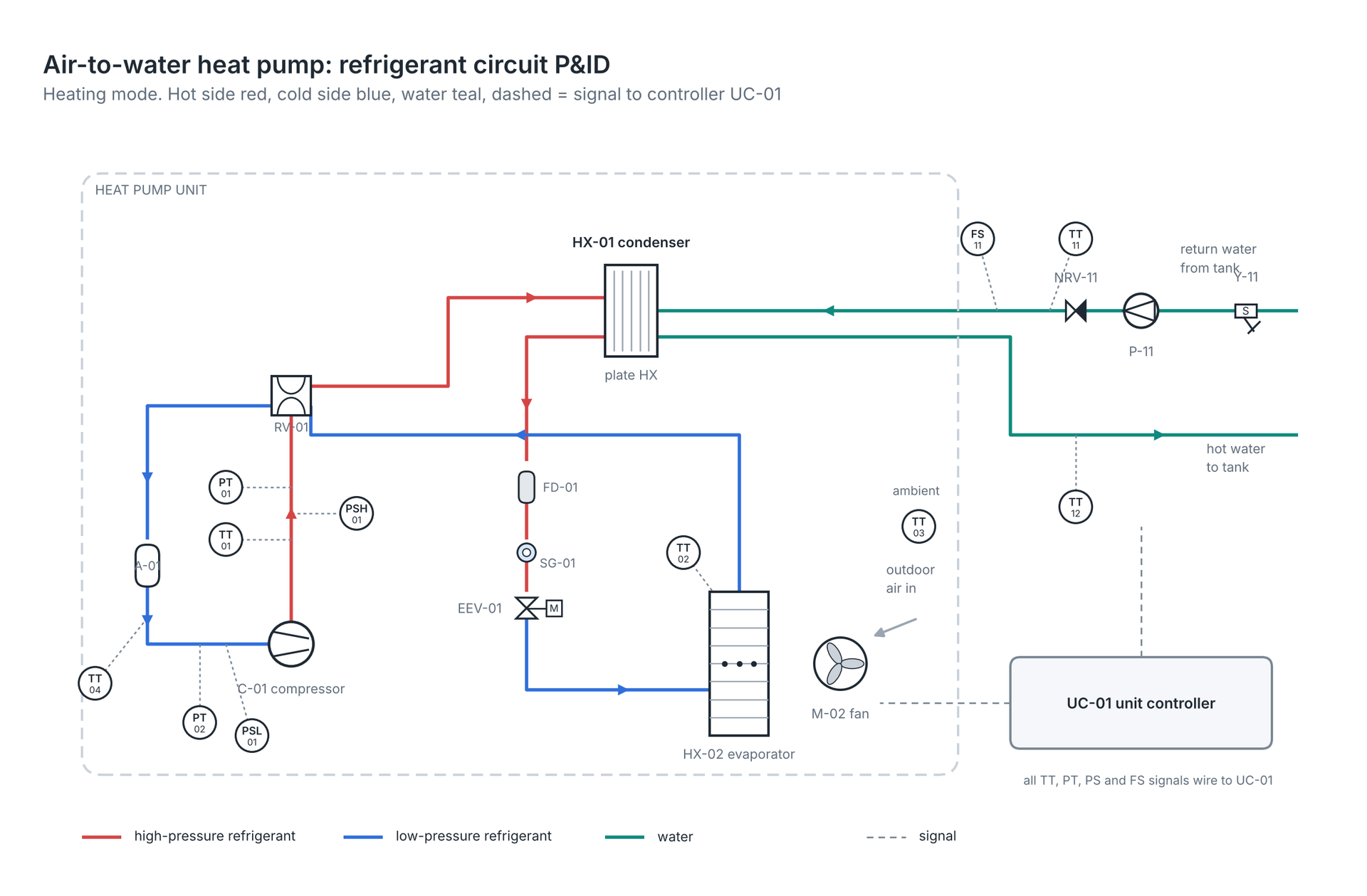
| Device | Tag | What it protects or measures | Typical action |
|---|---|---|---|
| High-pressure switch | PSH | Overpressure on discharge side | Stops compressor; often manual reset |
| Low-pressure switch | PSL | Low suction pressure (leak, frost, low airflow) | Stops compressor; auto reset with lockout after repeats |
| Discharge temp sensor | TT | Compressor overheating | Reduces speed or stops compressor |
| Water flow switch | FS | No-flow condition in condenser | Prevents compressor start |
| Coil temp sensor | TT | Frost on evaporator | Starts and ends defrost |
| Water outlet sensor | TT | Setpoint control, anti-freeze | Modulates or stops |
| Crankcase heater | — | Refrigerant migrating into oil when off | Heats compressor sump |
Pressure switch set-points depend on refrigerant and design. Always use the value on the unit nameplate or service manual.
Remember
- Sensors measure; switches protect; the controller decides.
- HP switch trips are usually caused by no or low water flow.
- LP switch trips are usually caused by leaks, frost or poor airflow.
- Never bypass a safety switch to "get the unit running".
Sensors tell the controller what the circuit is doing, and safety devices stop the unit before anything is damaged.
There are no comments for now.
to be the first to leave a comment.