2.10 Defrost and low-ambient operation
When the coil surface goes below 0 °C, moisture in the air freezes on the fins. Frost blocks airflow, like ice in an old freezer. Suction pressure falls and capacity drops.
Frosting is worst with outdoor air around −5 °C to +7 °C and high humidity (typical). In very dry, very cold air there is less moisture, so less frost. In India this matters in north Indian winters, hill stations and humid winter mornings; it rarely matters in coastal south India.
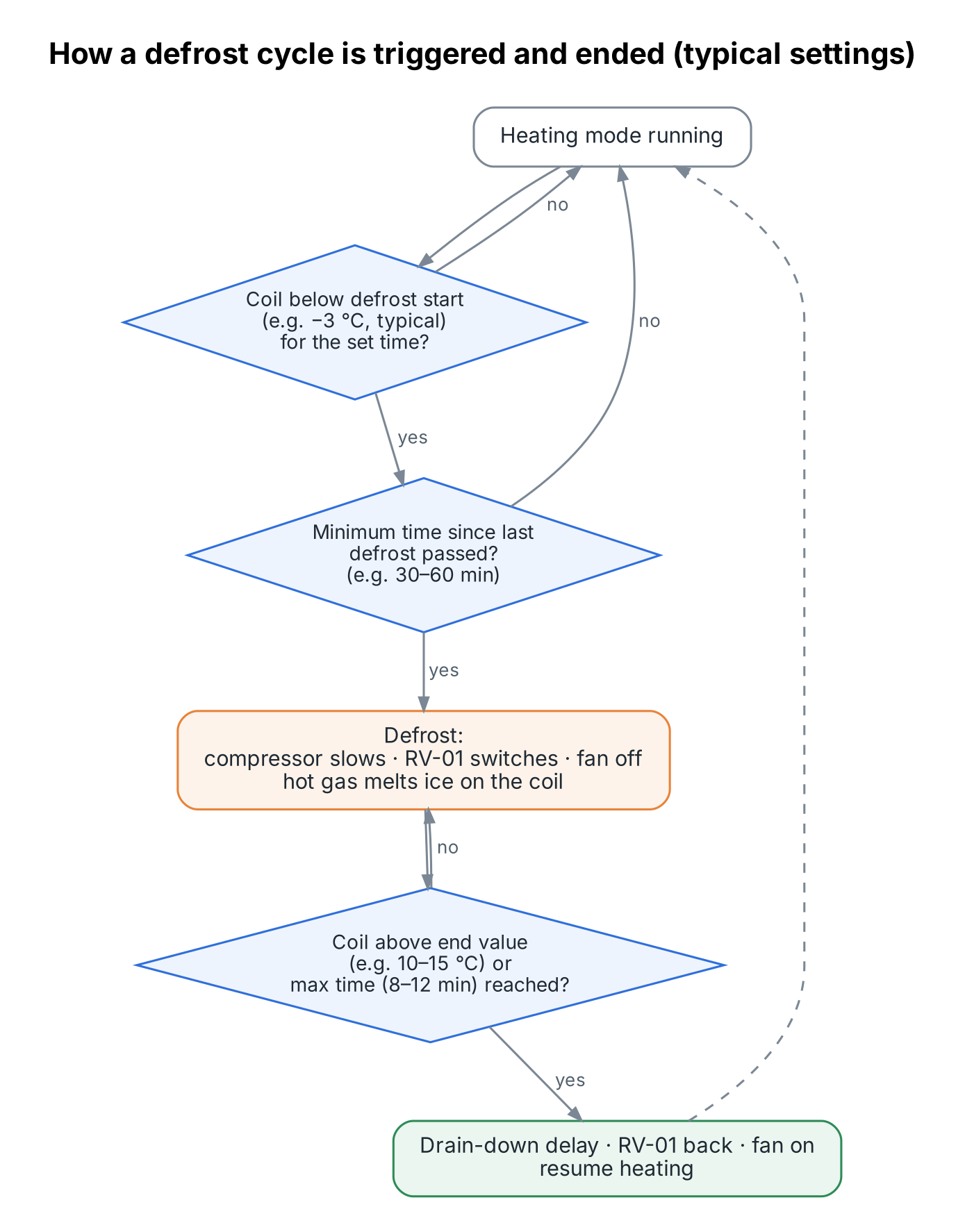
Reverse-cycle defrost is the most common method. The 4-way valve switches, so hot gas goes to the outdoor coil and melts the frost. The fan stops so heat stays on the coil. Heat is briefly taken from the water side. Hot-gas bypass defrost sends some discharge gas directly to the evaporator without reversing.
The controller starts defrost using coil temperature, time since last defrost, and sometimes the coil-to-air temperature difference. It ends defrost when the coil is warm enough or after a maximum time. Good logic defrosts only when needed.
| Low-ambient challenge | Effect | Design response |
|---|---|---|
| Frost on coil | Lower airflow and capacity | Defrost logic, wide fin spacing |
| Low suction pressure | High compression ratio, hot discharge | EVI (enhanced vapour injection) or two-stage compressor |
| Refrigerant migration when off | Oil dilution, liquid at start | Crankcase heater |
| Melt water freezing at base | Ice builds up, blocks drain | Base-pan heater, raised mounting |
| Water pipes freezing | Burst pipes, damaged exchanger | Anti-freeze pump run, glycol, trace heating |
Enhanced vapour injection (EVI) injects extra vapour mid-way through compression. It cools the compressor and restores capacity at low ambient.
Remember
- Frost forms when the coil is below 0 °C and the air is humid.
- Reverse-cycle defrost uses the 4-way valve to send hot gas to the coil.
- Defrost uses energy, so it should run only when needed.
- Capacity and COP fall as outdoor air gets colder.
When outdoor air is cold and humid, frost forms on the evaporator; the unit must periodically melt it, and at very low temperatures capacity and COP both fall.
There are no comments for now.
to be the first to leave a comment.