2.4 The evaporator: collecting heat
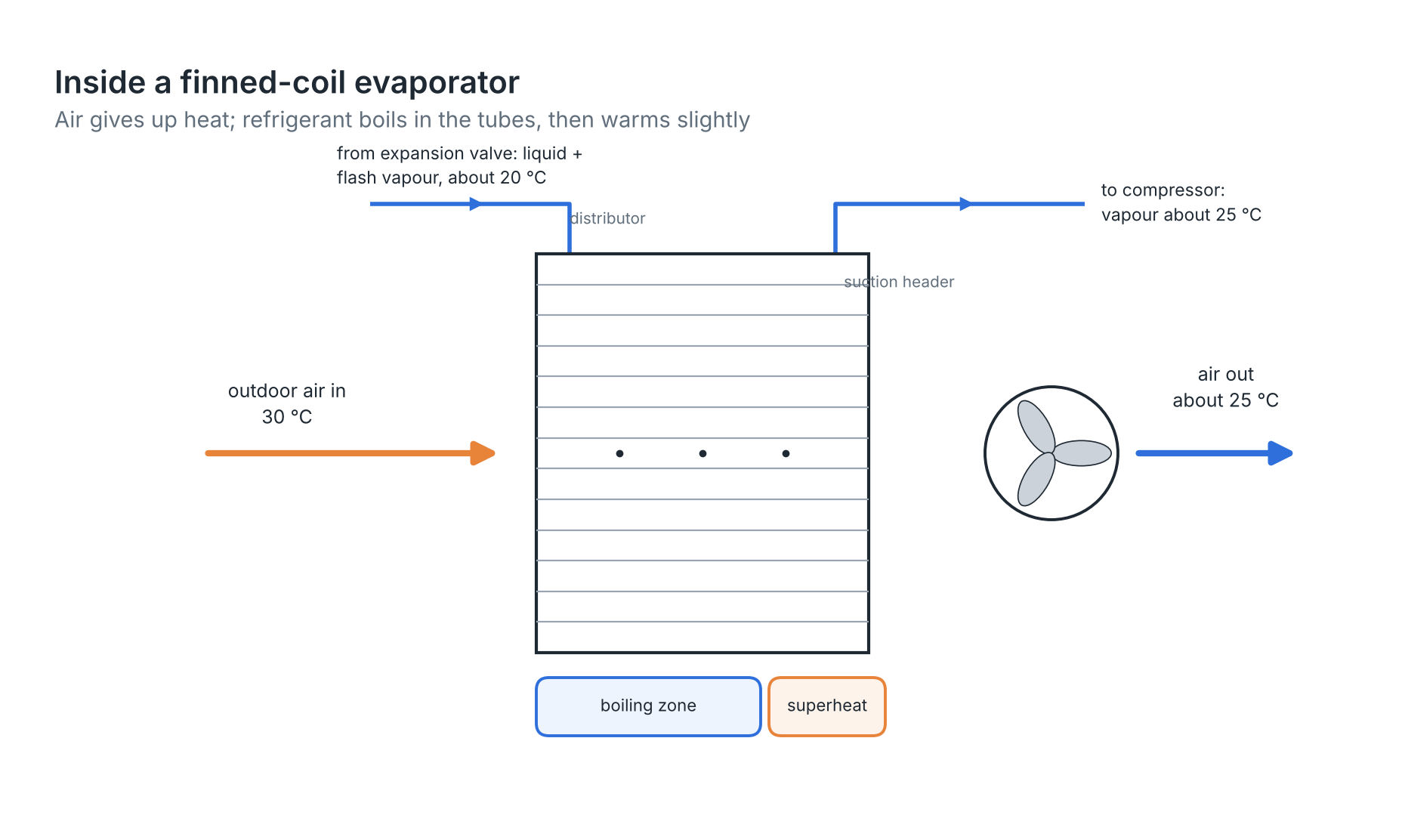
In an air-to-water heat pump, the evaporator is a finned-tube coil. Copper tubes carry refrigerant; thin aluminium fins add surface area. A fan pulls outdoor air through the fins. The air leaves a few degrees colder.
Inside the tubes the refrigerant boils at a nearly constant temperature. This is the evaporating temperature, usually several degrees below air temperature. The difference is called the approach or temperature difference (TD). Typical air-coil TD is about 6–12 K.
Near the outlet all liquid has boiled away. The vapour then warms a few degrees more. This extra warming is the superheat. A small superheat proves no liquid will reach the compressor.
In water-source or ground-source units, the evaporator is a plate or shell-and-tube heat exchanger instead of a coil. The principle is the same.
| Evaporator issue | Effect | Check |
|---|---|---|
| Dusty or blocked fins | Less air, lower evaporating pressure, lower COP | Clean with low-pressure water from inside out |
| Fan slow or failed | Low suction pressure, frost, LP trip | Fan current, blades, capacitor |
| Bent fins | Reduced airflow | Comb fins straight |
| Too little refrigerant | High superheat, low capacity | Superheat and pressures |
Worked example — air flow needed for an 8 kW evaporator, air cooled by 5 K.
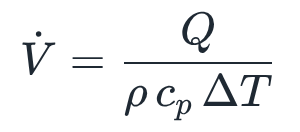
- Q = 8 kW. Air density ρ ≈ 1.2 kg/m³. cp ≈ 1.005 kJ/kg·K. ΔT = 5 K.
- V = 8 ÷ (1.2 × 1.005 × 5) = 8 ÷ 6.03 ≈ 1.33 m³/s.
- In m³/h: 1.33 × 3,600 ≈ 4,780 m³/h.
Remember
- The evaporator absorbs heat by boiling refrigerant.
- More surface and more airflow mean higher evaporating temperature and better COP.
- Superheat at the outlet protects the compressor.
- Keep coils clean, especially in dusty or coastal Indian sites.
The evaporator is where cold boiling refrigerant picks up heat from the source — outdoor air, water or ground loop.
There are no comments for now.
to be the first to leave a comment.