8.6 Superheat and subcooling
Saturation temperature is the temperature at which refrigerant boils or condenses at a given pressure. You read it from the pressure-temperature (P-T) chart or the digital manifold. A pressure cooker shows the same idea: higher pressure, higher boiling point.
Superheat is the suction line temperature minus the evaporating saturation temperature. It proves that only vapour reaches the compressor. Too little superheat risks liquid entering the compressor. Too much means the evaporator is starved, often from low charge or a faulty expansion valve.
Subcooling is the condensing saturation temperature minus the liquid line temperature. It proves the expansion valve receives solid liquid. Low subcooling often means undercharge. High subcooling often means overcharge or a restriction.
A P-h diagram plots pressure (vertical) against enthalpy (horizontal). Enthalpy is the heat content per kg of refrigerant. The dome shape is the saturation curve. Superheat sits just right of the dome on the low-pressure line. Subcooling sits just left of the dome on the high-pressure line.
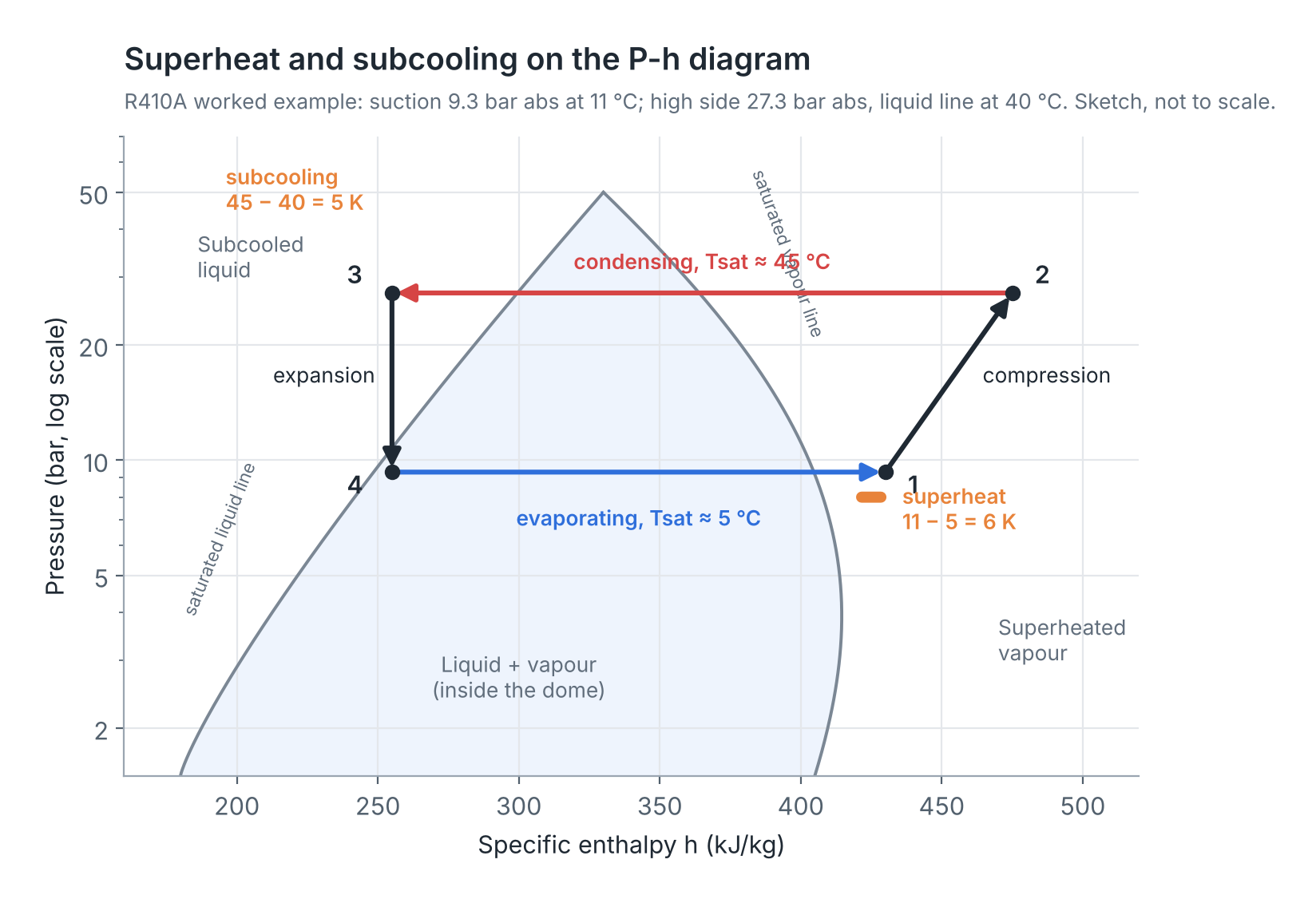
Worked example — R410A unit in Chennai, steady running
Readings: suction gauge 8.3 bar(g); suction line temperature (TT-04) 11 °C. Discharge-side gauge 26.3 bar(g); liquid line temperature (TT-05) 40 °C.
Step 1 — convert gauge to absolute pressure (add about 1 bar).
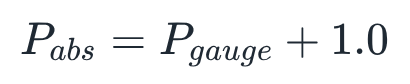
Suction: 8.3 + 1.0 = 9.3 bar abs. High side: 26.3 + 1.0 = 27.3 bar abs.
Step 2 — read saturation temperatures from the R410A P-T chart. At 9.3 bar abs, Tsat ≈ 5 °C. At 27.3 bar abs, Tsat ≈ 45 °C. (Most digital manifolds do this for you once the refrigerant is selected.)
Step 3 — superheat.

Step 4 — subcooling.

Step 5 — judge. Both values fall in the typical range below. The charge and expansion valve are working normally.
| Reading | Typical range | Too low means | Too high means |
|---|---|---|---|
| Superheat (EXV/TXV systems) | 4–8 K | Flooding risk, liquid to compressor | Starved evaporator, low charge, valve fault |
| Subcooling | 3–8 K | Undercharge, flash gas at valve | Overcharge, restriction, condenser flooded |
Always use the target values in the installation manual where given. Fixed-orifice and capillary systems behave differently from electronic expansion valves.
Remember
- Superheat = suction line temp − evaporating saturation temp.
- Subcooling = condensing saturation temp − liquid line temp.
- Convert gauge to absolute pressure if your chart is in absolute.
- Measure on clean pipe with the probe insulated, in steady state.
Superheat tells you if the evaporator is fed correctly; subcooling tells you if the condenser side has the right charge.
There are no comments for now.
to be the first to leave a comment.