8.5 Calculating actual capacity and COP on site
Heating capacity is the heat the unit puts into the water, in kW. Specific heat (cp) is the energy needed to warm 1 kg of a substance by 1 K. For water it is about 4.18 kJ/kg·K.
COP (coefficient of performance) is heat out divided by electricity in. A COP of 3.5 means 3.5 kW of heat for every 1 kW of electricity. The extra heat comes free from the outdoor air.
An electric geyser has a COP of about 1. That is why a heat pump can cut water heating electricity by two-thirds or more.

Shortcut for water (flow in LPH):

Worked example 1 — Circulating heat pump at a hotel in Pune
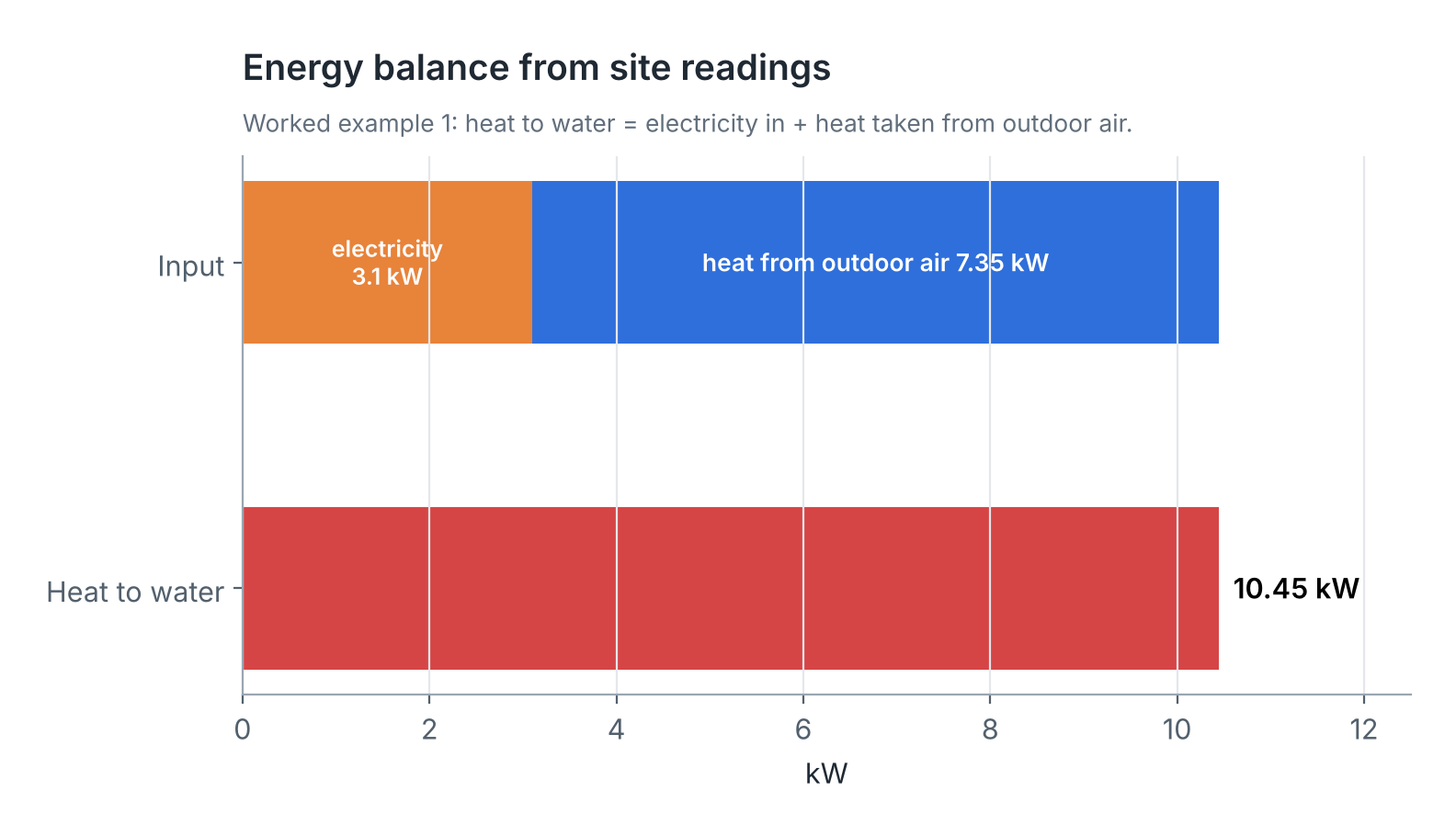
Site readings after 30 minutes of steady running. Ambient (TT-03) 28 °C. Inlet water (TT-01) 50.0 °C. Outlet water (TT-02) 55.0 °C. Flow (FT-01) 1.8 m³/h. Power meter (JQ-01) 3.10 kW.
Step 1 — mass flow. 1.8 m³/h = 1800 L/h. Water at this temperature is close to 1 kg/L.

Step 2 — temperature rise.

Step 3 — capacity.

Check with the shortcut: 1800 × 5 / 860 = 10.47 kW. Same answer.
Step 4 — COP.

Step 5 — compare. Look up the manufacturer's data at 28 °C ambient and 55 °C outlet, not the headline rating. If the data shows about 10.5 kW and COP 3.4 at these conditions, the unit is performing as expected.
Step 6 — what it saves (example rate ₹9/kWh). Over 8 running hours the unit delivers 10.45 × 8 = 83.6 kWh of heat for 3.10 × 8 = 24.8 kWh of electricity. That costs 24.8 × 9 = ₹223. An electric geyser would use about 83.6 kWh, costing about ₹752.
Worked example 2 — Tank heat-up method at a home in Bengaluru
When no flow meter is available, time a tank heat-up. A 500 L tank is heated from 25 °C to 55 °C in 1.5 hours. The energy meter shows 4.2 kWh used.




This method ignores tank heat loss and assumes the tank is well mixed. It gives a fair average, not an exact figure. Make sure no water is drawn off during the test.
| Error source | Effect on result | How to avoid |
|---|---|---|
| Probes not matched | ΔT wrong, capacity off by 5–10% | Bucket test, note offset |
| Reading during defrost or start-up | Capacity too low | Wait for steady state |
| Flow meter in turbulent spot | Flow wrong | Use straight pipe run |
| Measuring amps, not kW | Power wrong (power factor ignored) | Use a true-RMS power meter |
| Comparing to rating at different conditions | False "underperforming" claim | Compare at the same ambient and water temperature |
Remember
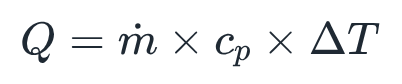
- Q = ṁ · cp · ΔT; for water, kW = LPH × ΔT / 860.
- Always compare site results with data at the same ambient and water temperatures.
- Take readings only in steady state, never during defrost.
- Small ΔT errors make big capacity errors; calibrate probes.
Capacity is water flow × specific heat × temperature rise; COP is that capacity divided by electrical input.
There are no comments for now.
to be the first to leave a comment.