8.2 First start-up sequence
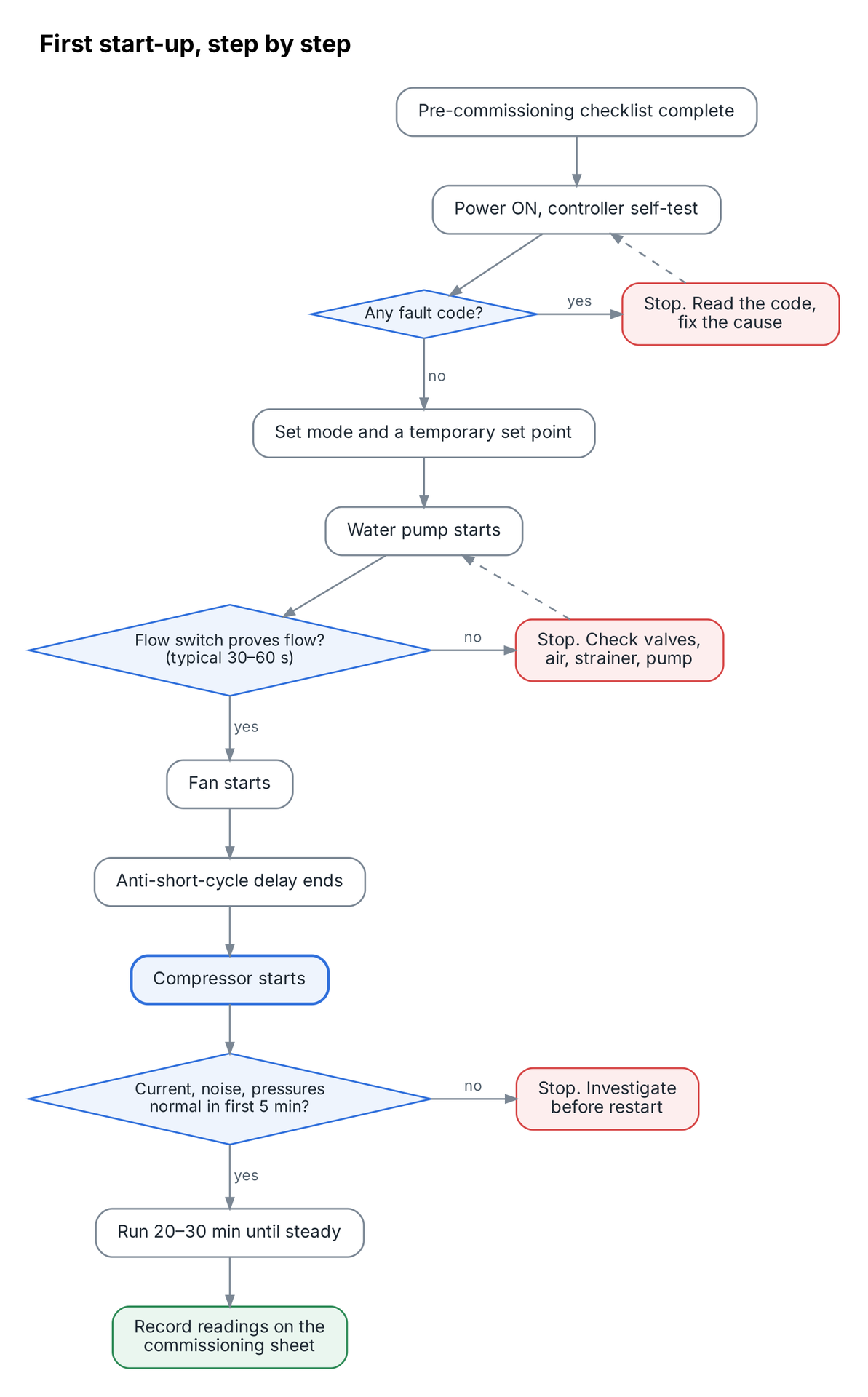
The controller follows a sequence of interlocks. An interlock is a condition that must be true before the next step is allowed. It is like a pressure cooker: the lid must lock before pressure can build.
Your job at first start is to watch each step happen. If a step does not happen, stop and find out why. Do not bypass a safety to "just see it run".
Typical order: the water pump starts, the flow switch proves flow, the fan starts, then the compressor starts after its anti-short-cycle delay. An anti-short-cycle timer is a minimum off time (typical 3 minutes) that protects the compressor from rapid restarts.
| Step | What to watch | Normal sign |
|---|---|---|
| Pump start | Pump sound, pressure gauge | Steady hum, small rise in pressure |
| Flow proven | Flow switch, controller display | No flow alarm |
| Fan start | Rotation, vibration | Smooth, correct direction |
| Compressor start | Clamp meter on compressor lead | Inrush then settles near rated current |
| First 5 minutes | Suction and discharge pressure | Suction falls, discharge rises steadily |
| 20–30 minutes | Water ΔT, superheat | Readings stable within ±0.5 K |
Remember
- Water flow must be proven before the compressor is allowed to run.
- Never jumper the flow switch or high-pressure switch to get a start.
- Measure starting and running current on every phase.
- Take performance readings only after the system is steady.
A heat pump starts in a fixed order — water first, then air, then the compressor — and each step must prove itself before the next.
There are no comments for now.
to be the first to leave a comment.