3.8 Simultaneous heating and cooling
A normal hot-water heat pump throws its cold side away to outdoor air. A normal chiller throws its hot side away at the cooling tower. A simultaneous heating and cooling heat pump uses both sides.
The evaporator chills water, typically to 7 °C supply and 12 °C return. The condenser heats water, typically to 55–65 °C. Both are put to work.
Good matches in India: hotels (AC plus bathing water), dairies (milk chilling plus CIP hot water), hospitals, food plants and pharma units.
When demand on one side drops, a balancing coil (an air-cooled coil) or the cooling tower rejects or picks up the extra heat. This keeps the machine running safely.
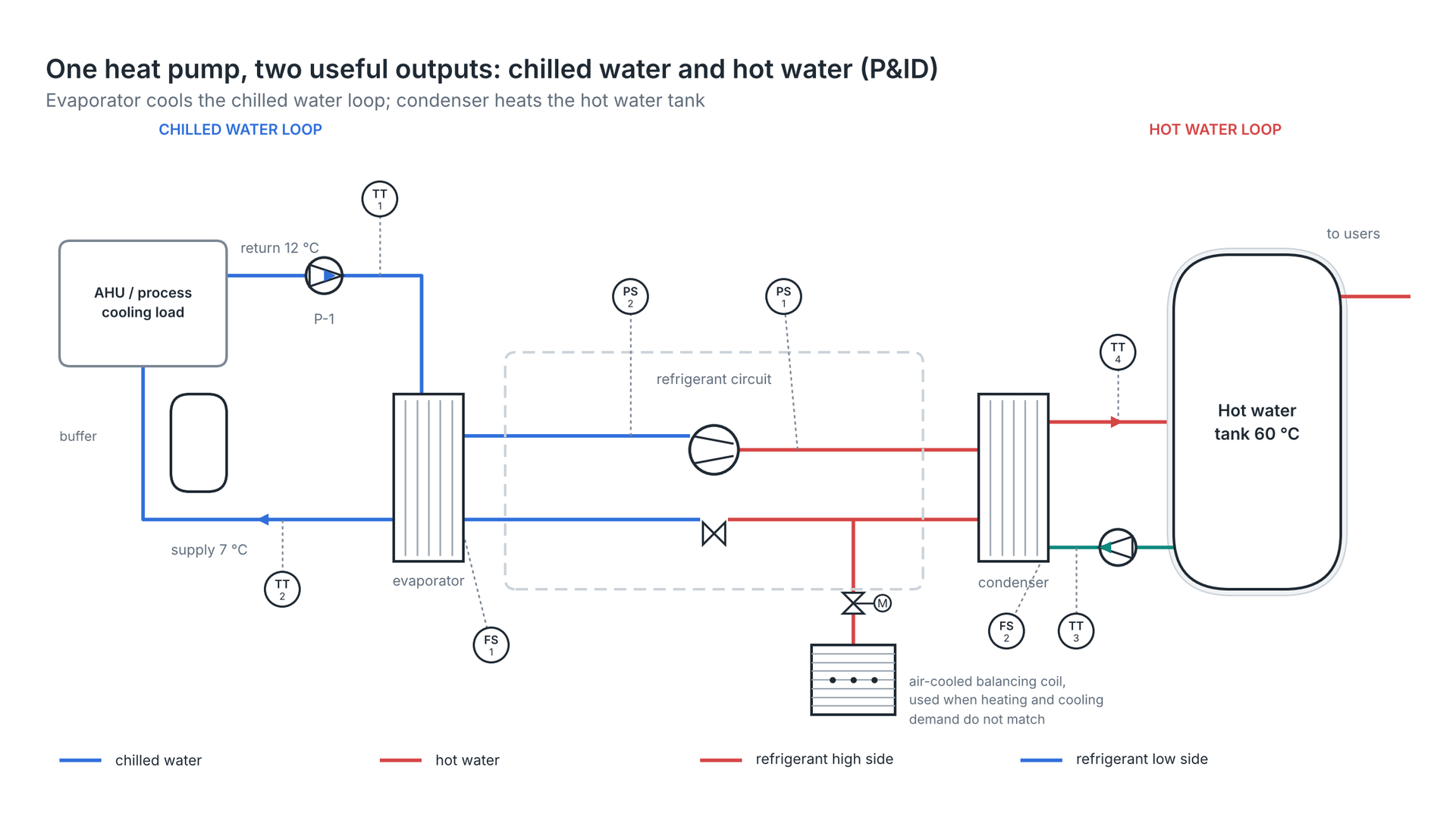
Worked example — Dairy in Anand, Gujarat
Power input W = 10 kW. Cooling output Qc = 20 kW (milk chilling). Heating output Qh = 30 kW (hot water at about 60 °C; 75–85 °C CIP water needs a booster or a high-temperature unit).

- Check: 20 + 10 = 30 kW ✓
- Heating-only COP = 30 ÷ 10 = 3.0
- Total COP = (30 + 20) ÷ 10 = 5.0
- Daily for 10 h: 100 kWh power × ₹9 = ₹900 gives 300 kWh heat plus 200 kWh cooling.
Remember
- Evaporator = cooling, condenser = heating; use both.
- Total COP = (heating + cooling) ÷ power, often 4.5–6 (typical, 7 °C chilled / 55–65 °C hot water).
- Best where heating and cooling are needed at the same hours.
- Plan a balancing coil or tower for mismatched loads.
A heat pump always produces cooling at the evaporator and heating at the condenser; using both at once nearly doubles the useful output for the same power.
There are no comments for now.
to be the first to leave a comment.