3.1 Classifying by heat source and heat sink
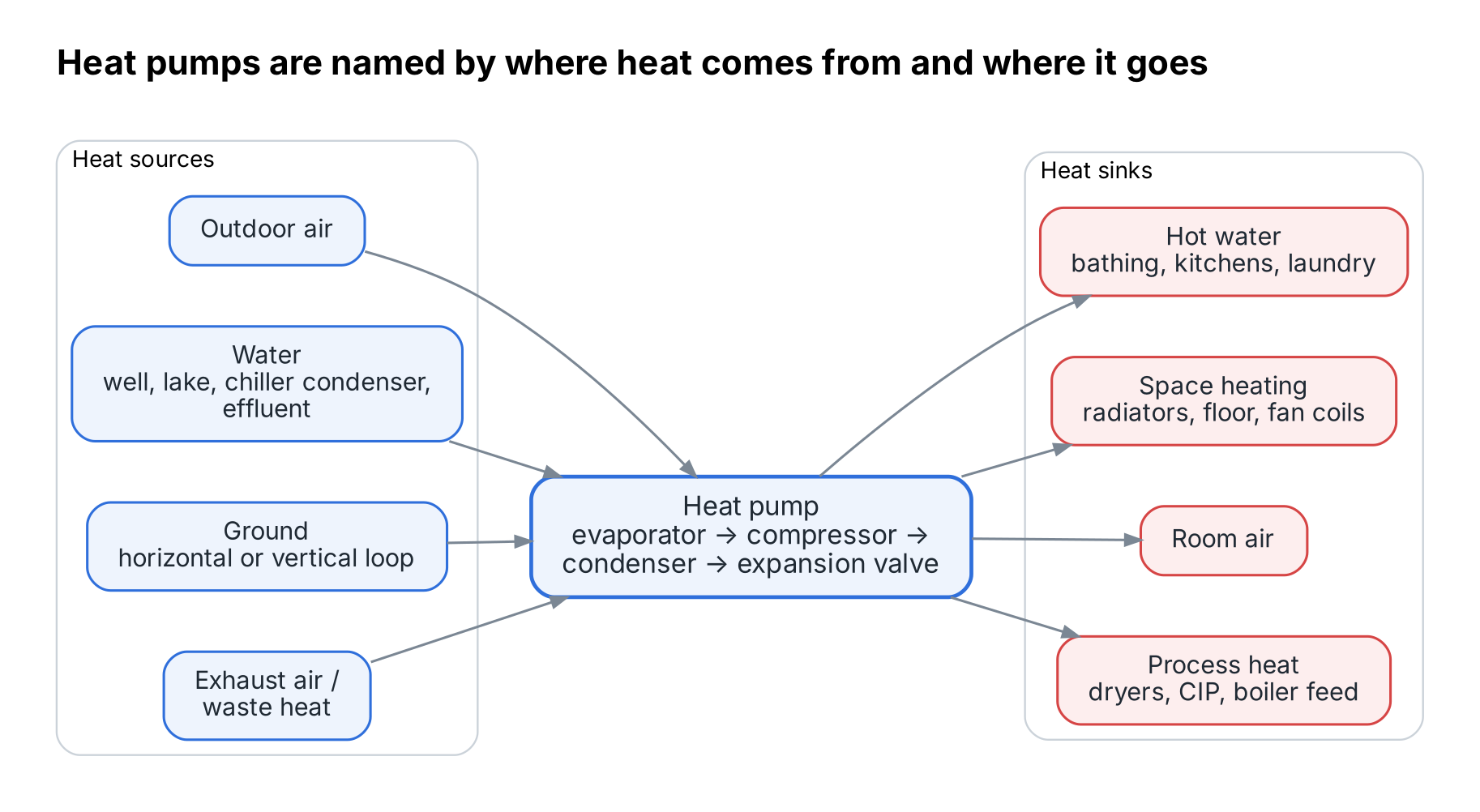
A heat pump moves heat from a cooler place to a warmer place. The place it takes heat from is the heat source. The place it delivers heat to is the heat sink.
Think of a fridge. It takes heat from the food (source) and throws it out at the back grille into kitchen air (sink). A heat pump works the same way, but we use the hot side on purpose.
The name follows a simple rule: source first, sink second. An "air-to-water" heat pump takes heat from outdoor air and heats water. A "water-to-water" heat pump takes heat from one water stream and heats another.
The three common sources are air, water and ground. The three common sinks are water, air and process (a product, a dryer, or steam).
| Type | Heat source | Heat sink | Typical Indian use |
|---|---|---|---|
| Air-to-water | Outdoor air | Water | Hotel, hostel, hospital hot water |
| Water-to-water | Water stream (well, chiller condenser, effluent) | Water | Waste-heat recovery in factories |
| Ground-source (brine-to-water) | Ground via a buried loop | Water | Cold regions, very large buildings |
| Air-to-air | Outdoor air | Indoor air | Room AC with heating mode, VRF |
| Exhaust air-to-water | Warm exhaust air | Water | Kitchens, laundries, dryers |
Remember
- Name = source first, sink second.
- Sources: air, water, ground, waste heat.
- Sinks: water, air, process.
- A warmer source means less work for the compressor and a higher COP.
Every heat pump is named "source-to-sink" — where it takes heat from, and where it delivers heat to.
There are no comments for now.
to be the first to leave a comment.