3.6 Monoblock vs split construction
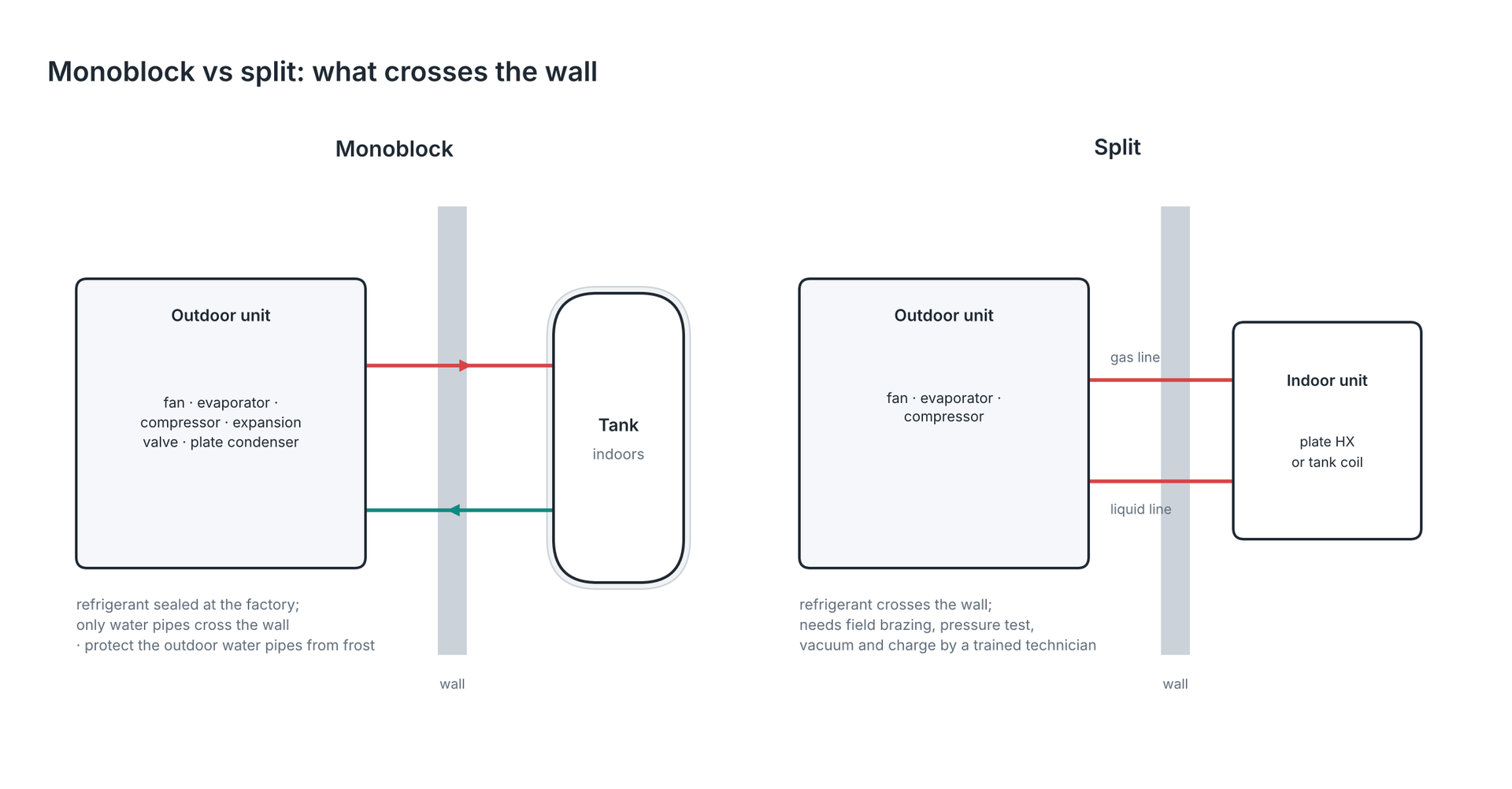
A monoblock (also called packaged) heat pump has compressor, evaporator, condenser and valves in one unit. The factory charges and tests it. On site, the installer only connects water pipes and power.
A split heat pump has two parts. The outdoor unit holds the fan, coil and usually the compressor. The indoor unit holds the water heat exchanger (and sometimes the tank). Copper refrigerant lines join them.
The split needs field brazing, nitrogen pressure test, vacuum and refrigerant charging. This needs a trained refrigeration technician. The monoblock avoids this, so leak risk on site is lower.
The monoblock's weakness is that water pipes run outdoors. In cold regions they can freeze, so glycol or trace heating is needed. In most of India this is not a problem, but in cold, high-altitude regions such as Leh and Shimla it is a real risk; see lesson 4.9.
| Feature | Monoblock | Split |
|---|---|---|
| Refrigerant work on site | None | Brazing, pressure test, vacuum, charge |
| Leak risk on site | Low | Higher |
| What crosses the wall | Water pipes | Refrigerant pipes |
| Freeze risk | Water pipes outdoors (cold regions) | Low; water stays indoors |
| Indoor space | Only tank | Indoor unit + tank |
| Service | Mostly at the outdoor unit | Two locations |
| Typical sizes | Small to very large | Mostly small domestic |
Remember
- Monoblock: factory-sealed, water connections only.
- Split: refrigerant lines, needs a trained technician.
- Monoblock is the usual choice for commercial and industrial jobs.
- Split suits homes where only small pipes can enter the building.
In a monoblock, the whole refrigerant circuit is sealed in one outdoor box; in a split, refrigerant pipes run between an outdoor and an indoor unit.
There are no comments for now.
to be the first to leave a comment.