3.3 Water-to-water and waste-heat recovery heat pumps
Many factories and buildings throw heat away. A chiller rejects heat at its cooling tower at about 32–37 °C. Laundries drain warm water. Dairies and pharma plants have warm effluent and condenser water.
These streams are too cool to use directly. A water-to-water heat pump lifts them to 55–80 °C. Because the source is warm and steady, COP is high, typically 4–6.
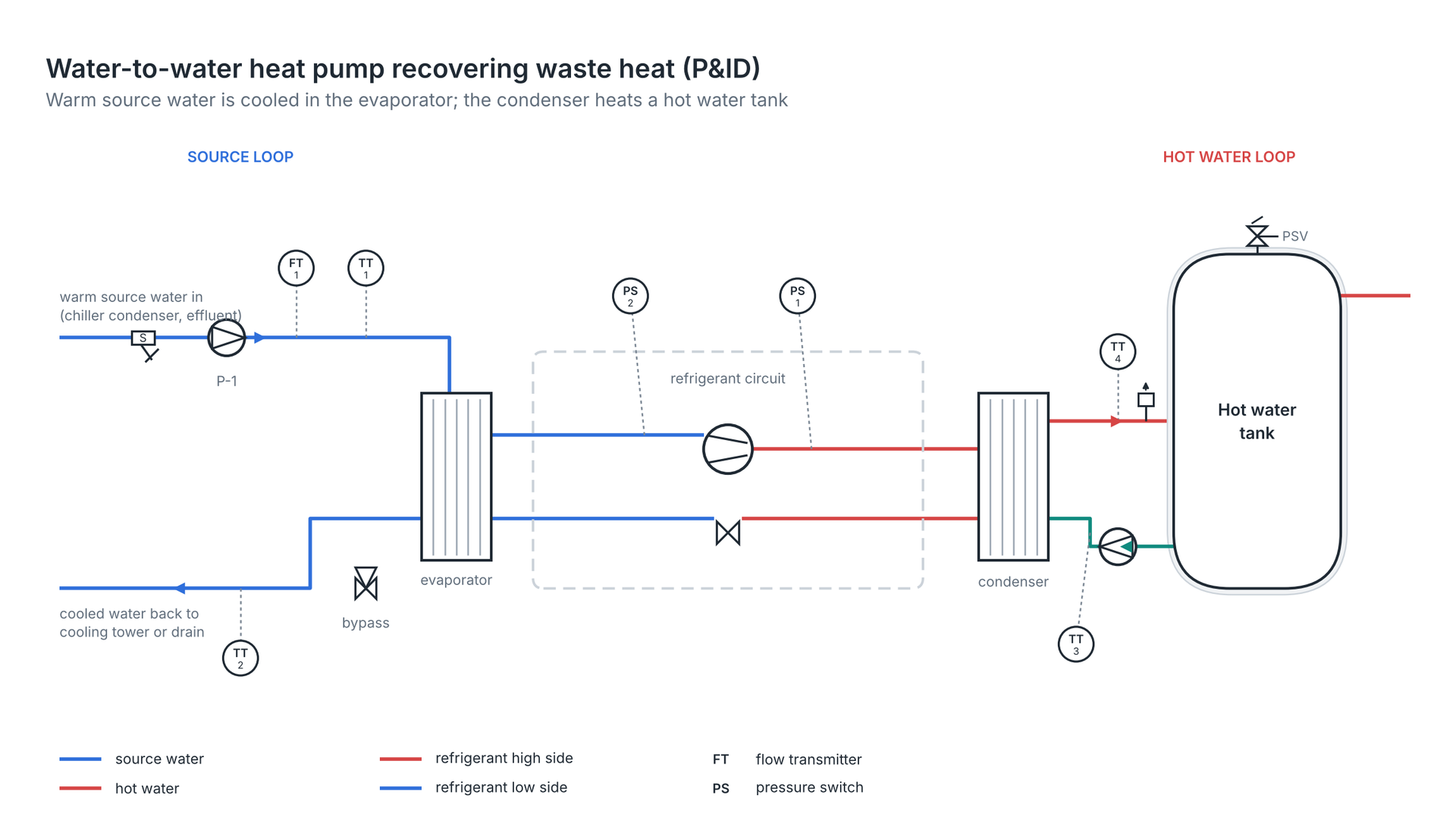
Both sides are water, so the machine is compact. The evaporator and condenser are both plate or shell-and-tube heat exchangers. There is no fan and no defrost.
Every cooling tower and drain carries heat away to be wasted. A waste-heat heat pump catches that heat and puts it back to work.
| Waste-heat source | Typical temperature (°C) | Typical hot-water output (°C) |
|---|---|---|
| Chiller condenser water | 30–37 | 55–65 |
| Air compressor cooling water | 35–50 | 60–75 |
| Laundry / dyeing drain | 30–45 | 55–70 |
| Process effluent | 25–40 | 55–65 |
| Borewell water | 25–30 | 50–60 |
(All values typical.)
Worked example — Chiller heat recovery in a Chennai hospital
Condenser water flows at 20 m³/h, cooled from 37 °C to 32 °C. A water-to-water heat pump (typical COP 5) uses this heat.

- 1.163 kWh/m³·K is the heat capacity of water.
- Q source = 20 × 1.163 × 5 = 116 kW
- Q hot = 116 × 5 ÷ 4 = 145 kW of hot water heat
- Electrical input W = 145 − 116 = 29 kW
- Bonus: the cooling tower now rejects 116 kW less heat, saving fan power and make-up water.
Remember
- Warm, steady source → high COP.
- No fan, no defrost, compact.
- Check source flow and temperature over a full day, not one reading.
- Use a strainer and a plate HX that suits the water quality.
A water-to-water heat pump takes heat from a warm water stream that is already available and lifts it to a useful temperature.
There are no comments for now.
to be the first to leave a comment.