3.7 High-temperature heat pumps (80–120 °C) and refrigerant choice
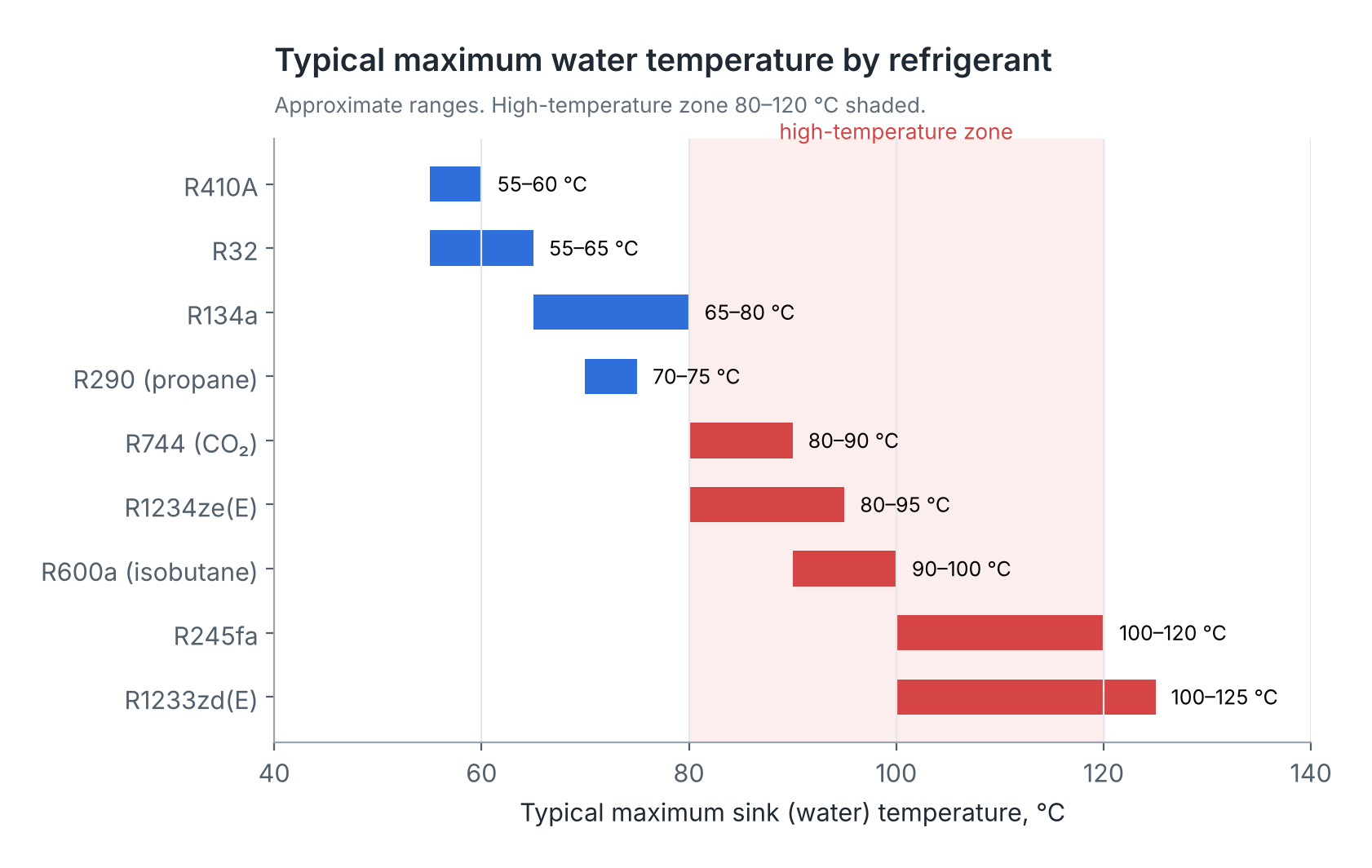
Standard heat pumps deliver water up to about 55–65 °C. Many industries need more: pasteurisation, dyeing, CIP (clean-in-place) washing, drying and boiler feed water. A high-temperature heat pump (HTHP) delivers 80–120 °C.
Every refrigerant has a critical temperature. Above it, the gas cannot be condensed into liquid. To condense at 100 °C, the refrigerant's critical temperature must be well above 100 °C.
The temperature lift is the gap between source and sink temperature. A bigger lift means a lower COP. So HTHPs work best with a warm source, such as 40–60 °C waste water.
Think of a pressure cooker. Raising the pressure lets water stay liquid above 100 °C. A heat pump refrigerant also needs high pressure to condense at high temperature, and every refrigerant has its own limit.
| Refrigerant | Type | Critical temp. (°C, approx.) | GWP (approx.) | Typical max. sink temp. | Notes |
|---|---|---|---|---|---|
| R410A | HFC blend | 71 | ~2,090 | 55–60 °C | Common in older units |
| R32 | HFC | 78 | ~675 | 55–65 °C | Mildly flammable (A2L) |
| R134a | HFC | 101 | ~1,430 | 65–80 °C | Widely used, being phased down |
| R290 (propane) | Natural (HC) | 97 | ~3 | 70–75 °C | Flammable (A3); small charge |
| R744 (CO₂) | Natural | 31 | 1 | 80–90 °C (transcritical) | Very high pressure; best with cold inlet water |
| R1234ze(E) | HFO | 109 | <1 | 80–95 °C | Mildly flammable (A2L) |
| R600a (isobutane) | Natural (HC) | 135 | ~3 | 90–100 °C | Flammable (A3) |
| R245fa | HFC | 154 | ~1,030 | 100–120 °C | Low pressure |
| R1233zd(E) | HFO | 166 | ~1 | 100–120+ °C | Low pressure, non-flammable |
(Values approximate; GWP figures vary by IPCC report. Check the refrigerant datasheet.)
Worked example — Why lift matters (ideal COP)
Compare lifting heat to 90 °C from 40 °C waste water versus from 25 °C outdoor air. Real machines achieve typically 35–45 % of the Carnot COP calculated from source and sink temperatures.

- From 40 °C water: 363 ÷ (363 − 313) = 363 ÷ 50 = 7.3 → real about 40 % → COP ≈ 2.9
- From 25 °C air: 363 ÷ (363 − 298) = 363 ÷ 65 = 5.6 → real about 40 % → COP ≈ 2.2
- The warm source gives about 30 % more heat per kWh.
Remember
- HTHP = 80–120 °C output for industry.
- Refrigerant critical temperature sets the upper limit.
- Smaller lift → higher COP; pair HTHPs with warm waste heat.
- Low-GWP options: R290, R744, R600a, HFOs; note flammability class.
To deliver 80–120 °C, a heat pump needs a refrigerant that can condense at high temperature, and a warm source to keep the lift small.
There are no comments for now.
to be the first to leave a comment.