3.4 Ground-source heat pumps
A few metres below the surface, ground temperature stays almost the same all year. It is close to the area's average annual air temperature. In most of the Indian plains this is about 24–30 °C. In Leh or Shimla it is much colder, typically 5–15 °C.
A plastic (HDPE) pipe loop is buried in the ground. Water or brine (water with antifreeze, such as glycol) circulates through it. It picks up heat from the soil and carries it to the heat pump's evaporator.
There are two main loop types. A horizontal loop is laid in trenches about 1–2 m deep and needs a large open area. A vertical loop uses boreholes, typically 50–150 m deep, and needs little land.
In hot Indian climates, ground-source is mostly used for cooling, where the ground absorbs condenser heat. For heating, it pays off most in cold regions where air is very cold in winter.
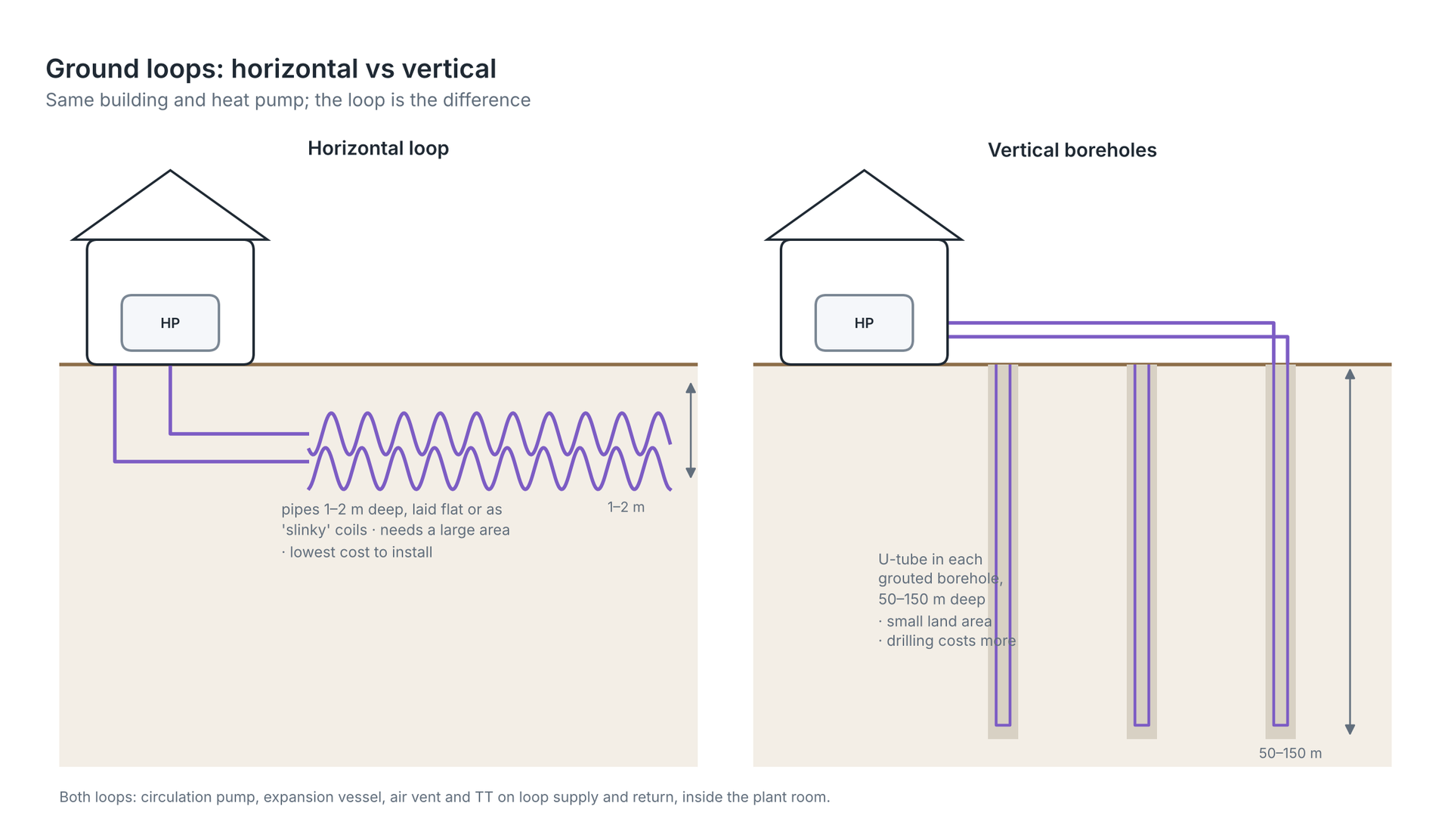
| Feature | Horizontal loop | Vertical loop |
|---|---|---|
| Depth | 1–2 m | 50–150 m (typical) |
| Land needed | Large | Small |
| Installation cost | Lower (trenching) | Higher (drilling) |
| Ground temperature stability | Varies a little with season | Very stable |
| Typical heat extraction | 10–25 W per m² of land | 30–60 W per m of borehole |
(Heat extraction depends strongly on soil and moisture; values typical.)
Worked example — Borehole length for a Shimla guest house
Heating need is 10 kW. Heat pump COP is 4. Soil allows a typical 40 W per metre of borehole.

- Q ground = 10 × 3 ÷ 4 = 7.5 kW = 7,500 W
- L = 7,500 ÷ 40 = 188 m of borehole
- Practical layout: two boreholes of about 95 m each.
Remember
- Ground stays near the annual average air temperature.
- Horizontal = shallow, large area; vertical = deep, small area.
- Highest first cost of all types; lowest variation in COP.
- Best fit in cold regions, or for large combined heating and cooling.
A ground-source heat pump uses the steady temperature of the earth, reached through a buried pipe loop filled with water or brine.
There are no comments for now.
to be the first to leave a comment.