3.5 Air-to-air and heat-recovery air conditioning
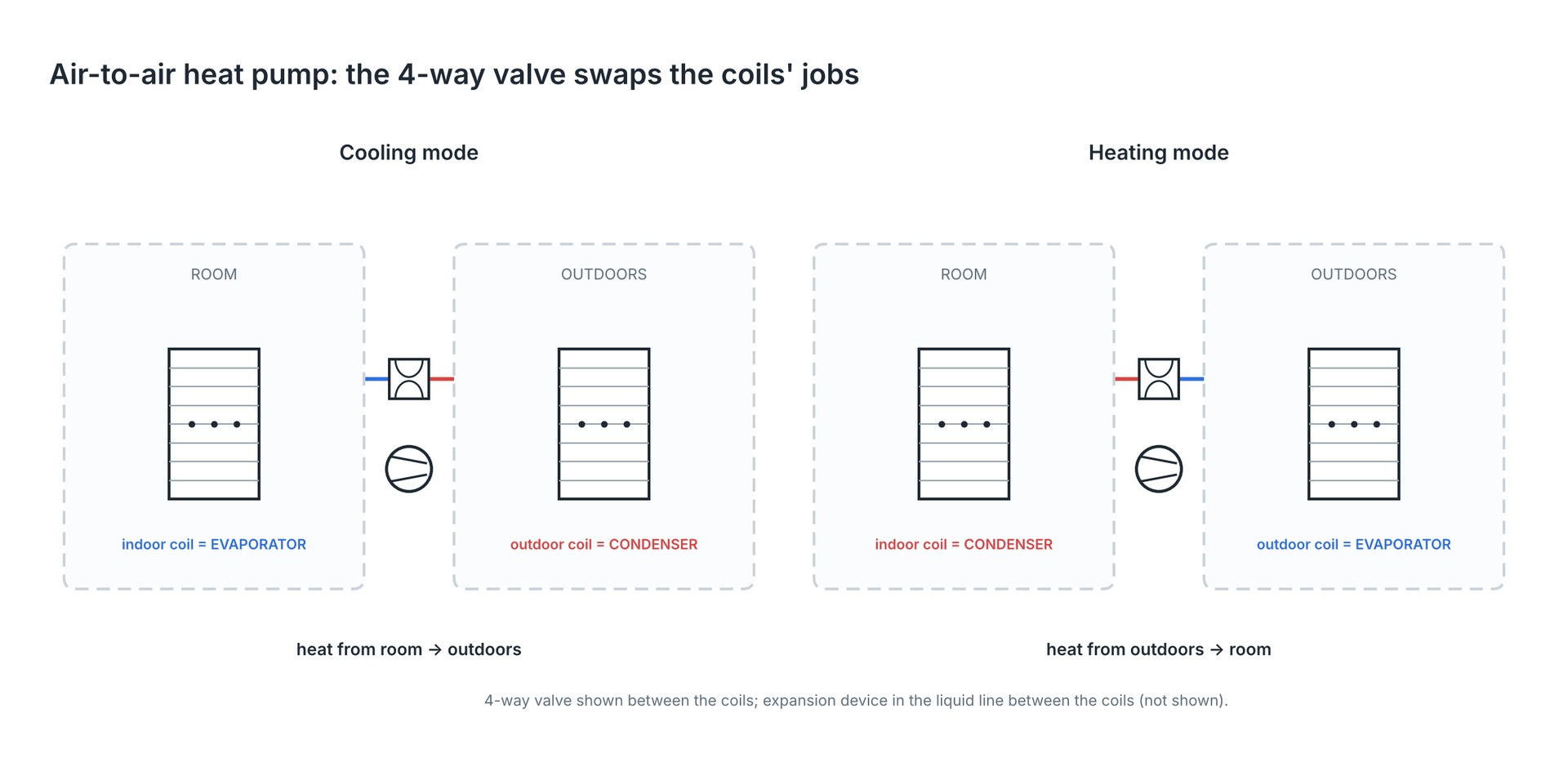
In cooling mode, an AC takes heat from room air and throws it outdoors. In heating mode, a four-way reversing valve swaps the flow. The outdoor coil becomes the evaporator and the indoor coil becomes the condenser.
Heating-mode ACs are useful in north Indian winters. They give 2.5–4 kW of heat per kW of power, typically, versus 1 kW from an oil-filled or fan heater.
Larger buildings use VRF (variable refrigerant flow) systems. One outdoor unit serves many indoor units. A heat-recovery VRF can cool some rooms and heat others at the same time. It moves heat from the server room to the reception, for example.
A simpler form of heat recovery is a desuperheater. This small heat exchanger on the hot discharge gas of an AC or chiller makes free hot water while the unit cools.
| Feature | Room AC (heat pump mode) | Heat-recovery VRF | Desuperheater |
|---|---|---|---|
| Heats | Room air | Some rooms, while cooling others | Water |
| Typical size | 1–2.5 TR | 8–60 TR outdoor units | Fraction of chiller rating |
| Main benefit | Low-cost winter heating | Moves heat between zones | Free hot water while cooling |
(1 TR = 3.517 kW of cooling.)
Remember
- An AC is a heat pump; the reversing valve gives heating.
- Heat-recovery VRF heats and cools different rooms at once.
- A desuperheater recovers some condenser heat as hot water.
- Air-to-air heats air, not water.
Every room air conditioner is an air-to-air heat pump; a reversing valve lets many of them heat as well as cool.
There are no comments for now.
to be the first to leave a comment.