1.8 Air and humidity: dew point, wet-bulb, relative humidity
Air is a mix of dry air and water vapour. Warm air can hold more vapour than cold air. This matters for air-source heat pumps, because their outdoor coil works with humid air.
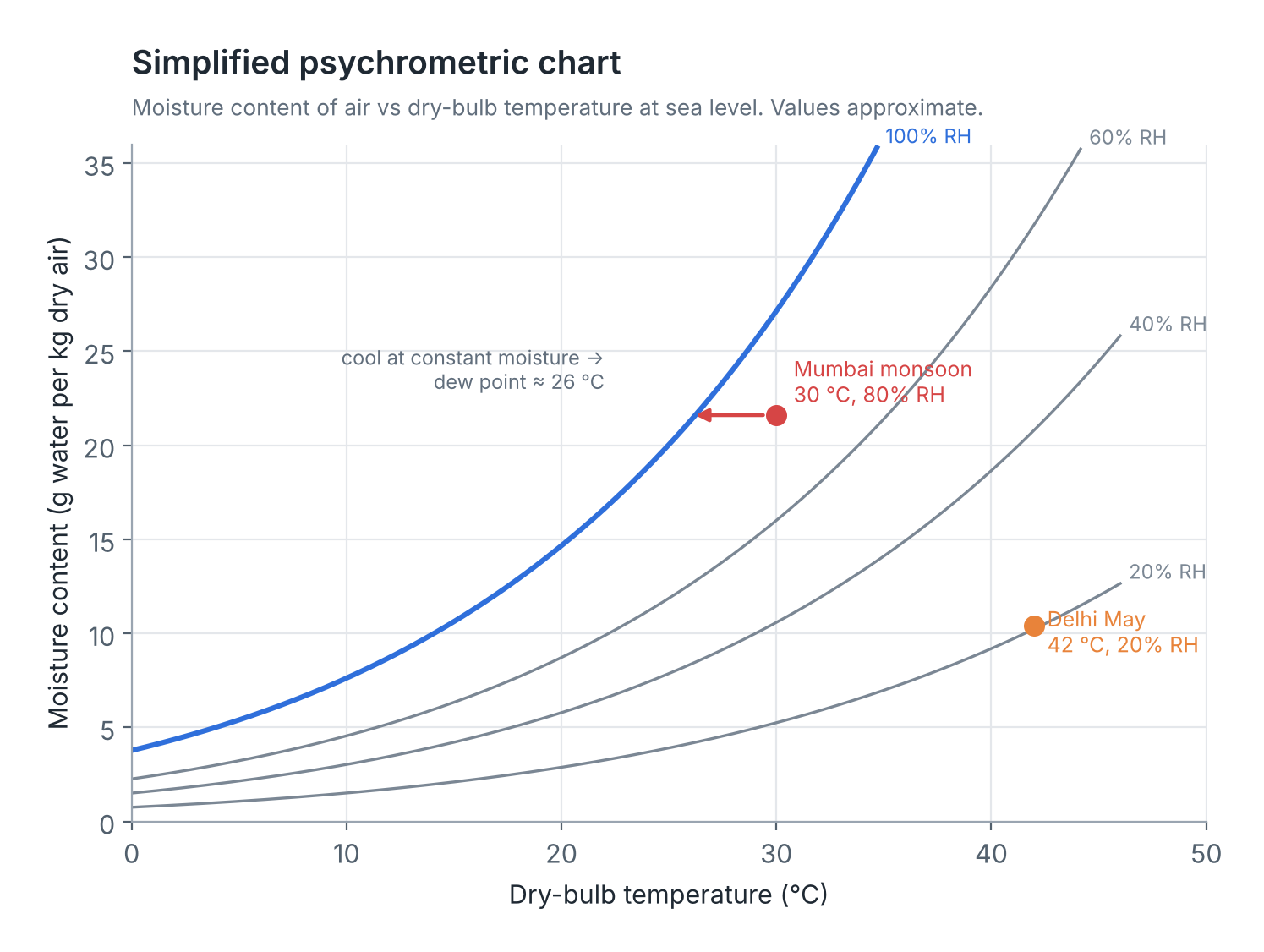
Relative humidity (RH) is how much vapour the air holds compared with the most it could hold at that temperature. 100% RH means the air is saturated. Mumbai in the monsoon often sits near 80–90% RH.
Dew point is the temperature at which air starts to condense water if cooled. A cold glass of water "sweats" because its surface is below the dew point of the room air.
Dry-bulb temperature is the normal air temperature from a thermometer. Wet-bulb temperature is read from a thermometer with a wet wick in moving air. Evaporation from the wick cools it, so wet-bulb is lower unless the air is saturated.
A desert cooler works on this principle. It can cool air close to the wet-bulb temperature. That is why coolers work well in dry Jaipur and poorly in humid Kolkata.
For a heat pump, when the outdoor coil is below the dew point, water drips off it. If the coil surface falls below 0 °C, that water freezes as frost. The unit must then defrost.
| Term | Meaning | How measured |
|---|---|---|
| Dry-bulb temperature | Normal air temperature | Ordinary thermometer |
| Wet-bulb temperature | Lowest temperature reachable by evaporating water into the air | Thermometer with wet wick, moving air |
| Relative humidity (RH) | Vapour held ÷ maximum possible at that temperature, in % | Hygrometer, sensor |
| Dew point | Temperature at which condensation starts | Calculated, or chilled-mirror meter |
Worked example — dew point for Mumbai monsoon air
Air is 30 °C at 80% RH. Use a typical saturation vapour pressure for water at 30 °C of 4.25 kPa.

- pv = 0.80 × 4.25 = 3.40 kPa.
- Find the temperature where psat = 3.40 kPa. From steam tables this is about 26 °C.
- So any surface below about 26 °C will drip water. An outdoor coil at 20 °C will condense heavily in Mumbai.
Remember
- Warm air holds more water vapour than cold air.
- RH is a ratio; dew point tells you the actual moisture.
- Wet-bulb ≤ dry-bulb, equal only at 100% RH.
- Coil below dew point → condensate; coil below 0 °C → frost.
Air always carries some water vapour, and how much it can hold depends on its temperature.
There are no comments for now.
to be the first to leave a comment.